Tuesday, September 30, 2008

Tiempon Mama'daddydy yan Mama'disising


The almost week long break from this blog has been an unfortunate side effect of the shifting of priorities since I came back to Guam.

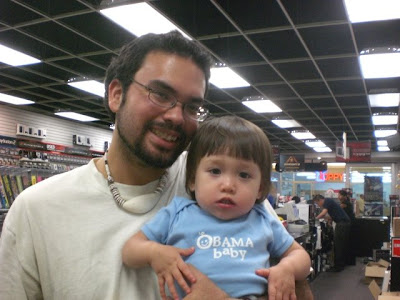
I put alot into this blog over the past two months mainly because of the Democratic National Convention and also my own close following of issues of race and gender in the campaign and the pick of Sarah Palin for VP by John McCain. I'm scaling things back now in order to spend more time trying to be a good father to my 17 month old nene Sumåhi, and also working on finishing up my dissertation as soon as possible.

Both activities require lots of attention and plenty of focus, and so sadly I might be posting less than usual for the next few months. This doesn't mean that I don't have plenty floating around in my head to post about, in fact sigi ha' machuchuda' i hinasso-ku desde matto yu' para Guahan! I have way too many things to write about now that I'm back, Guam is far from boring there is plenty happening that I'm a part of, or that I am privileged enough to witness. And hopefully I'll be setting aside some time to update everyone on what's going on.

In the meantime just thought I'd share some of my dissertation. Every once in a while I have a feature on my blog called "Fun With Footnotes" where I just share some of my nicer and longer footnotes from my academic work. The reason I usually spend alot of time writing big long footnoes is philosophical and critical. Guam, as I've often said is "a big American footnote" and so by having the footnotes in my work sometimes overwhelm the "main text" I am creating a reminder about the relationship between center and periphery, natural assumptions about what is essential and what is supplementary, both of which dictate in the relationship between Guam and the United States, who is in charge or more importantly who should and as to be in charge.


This sort of gesture is something I am working on in my dissertation.

What I'd like to share with today is sort of the basula pat tetehnan of my dissertation writing. I don't know how others write, but when I'm writing I rarely delete anything, but usually end up bumping it down to the bottom of the page or copying and pasting it at the page's bottom. I often work out my arguments as I am writing and so I never really know when I might need a line that I once thought useless, or hours later might pine for a phrasing that I'd been able to craft before, but can't quite seem to re-create again. I just finished up my rough first draft of the first chapter of my dissertation and so just so you can get a interesting, chaotic sense of what my dissertation is about and where its heading or actually where its not heading, I'll paste the basula pat tetehnan of my chapter draft below.

******************************************

Tetehnan na Tinige'-Hu Ginnen i Fine'nina na Kanton i Dissertation-Hu

The metaphoric distance is the same.

Sovereignty is ultimately the concept which emerges to provide a rationale for naturalizing or explaining those power relations.

Just as Briggs used medical history and science studies for her attempt to rework the colonial assumptions that bind Puerto Rico and the United States together, my site will be the concept o

Its reduction to a piece of territory that proves our might, something which can be traced from the Insular Cases up until today’s philosophical expositions on Guam as “the tip of the spear.”

(I could bring in here, Partha Chatterjee and “the colonial difference” as the gap which exists to determine the tendencies of sovereign power)

When decolonization takes place, we see the rules of signification for those objects become stabilized, and the possibility created for them to signify something else. We see a potential breaking of the desire that they stimulated in the colonized to need the colonizer.

Bring in here, what? Decolonial deadlock is a colonial fantasy.
What it serves.

gaps are created in the colonial world, where a chance for those objects to signify something else takes place.

At the level of its content

To that end, I developed a the

The particular negative associations with Chamorros, would become universal, would become the law of the island.

then there is nothing more horrifying, or to be forcefully resisted than decolonization, because of the threat it poses in weakening the influence and interests of the United States in Guam.

6.
The decolonial deadlock is what connects to the fantasy. To keep Guam as a colony. That what the United States wants, what it sees. Bring in from THESIS

But secondly,
successful expansion of its ideas

There is a very strong commonsense hegemony over this current collection of American states

But secondly,

This is not tied to the opinions of people, it is not something that has to be spoken to have power, but is part of the way that sovereign power works, that certain bodies, certain figures become the subjects who are supposed to be in power, while others

Guam’s participation tip toes softly, but nonetheless treads upon this current hegemony, this current order

It threatens to reveal all sorts of nasty, errant, banished ideas that contradict the image of greatness that American elections necessarily are made of. But it also threatens to upset that relationship of power, between who has it, who doesn’t, who has it over whom. A relationship which is felt and understood and assumed, both in knowledge and even more so in ignorance.

BRING IN EMAIL: Why should a place I’ve never heard of have a say in who is my next President?

His concern
Secondly, power over me


This is a feeling often found at the Federal level in dealing with the territories, the fear of setting these sorts of “national” precedents

Liberal blogger Markos Moulitsas from the website Dailykos made similar statements, questioning whether or not it was appropriate to count these votes, for these people to have their say, since they and their voices cannot actually be counted.

But in the margins, in offh

Aside from the reports of how many people voted on Guam and how close the vote was with Barack Obama barely winning.

Why should you get to vote? You didn’t die (Cram)

The current relationship between Guam and the United States, a colonial relationship which is structured largely through an oppressive national ignorance over the island, feeds into this understanding

BRING IN GUAM’S STATUS?

The gap between the US and Guam.
More people to be included, in fact these are so important, because they are so not important and so forgotten.
Then switch to
The uncritical primary excitement create an almost laughable silence over the political status of both Guam and Puerto Rico.

Instead of discussion explaining the political status, explaining American colonialism, crass military interests its treatment of its indigenous populations,

Guam has no electoral college votes, and by virtue of its status as a “unincorporated territory” of the United States, its votes for President don’t count.

and excitement not over their full and equal participat

As people from Indiana, Montana and West Virginia got to share their excitement

But in the margins, in offhand remarks, in the sort of commentary about commentary things were different.

as signs which been (mostly) surpassed, were used to create

A massive self-aggrandizing bubble was created surround the primary,

A massive bubble was created surround the primary, in which

These self-celebration was something to be closely protected however, in particular by the media and campaigns which spent an incredible amount of time and effort denying the very things that was making this election historic.

The media which spent so much time celebrating the success that the election of eite rof

The coverage of Guam and Puerto Rico was caught up in these

The coverage that the colonies of the United States who participated in the later st

Given this circle exercise of celebrating American progress and greatness and

The self-aggrandizement of American Democra

or most prominently th
or in my case, they are Chamorro and either come from there are have familial ties there, no matter where you went, suddenly Guam was everywhere.

You found mentions of Guam everywhere, and not just the usual.

The election for President had already been in full swing since the year before, when many of the major candidates of both parties announced their candidacies’. But as the primary season actually started and the battle between Senators Hillary Clinton and Barack Obama began to get tight, every delegate, no matter how small it may have seemed before, or from what backwater, rural state, or even territory it may have come from began to matter.

This was the newly bestowed political power that those of us tied to Guam, most prominently Chamorros, the island’s indigenous people felt.

Well not everywhere, but everywhere in the sense that as a distant colony of the United States, it tends to receive very little attention from just about every level of American society, and so when suddenly you hear Guam being mentioned on CNN, in your local papers, all across the internet, you cannot help but feel flushed with some energy at this glorious new recognition

But this form of recognition isn’t the power that I’m referring to. The new power came not from the mentions, but the role that Guam would play in the Democratic primary process. In a race where at one point, every vote actually did seem to count, and different campaigns and news outlets had their own ways of tallying those totals, which put one candidate ahead of the other, and vice versa.

Guam, and those from Guam were given a new incredible power. I felt

2.
During the spring of 2008, if you were from Guam or in some way tied to the Guam, and were moving in and out of political conversations in the United States, you most likely found yourself bestowed with an almost unreal power. This was the case with me, during the

The various responses to this participation provide an excellent way to start this dissertation.

The new power:

Territories are acquiring new power. They are getting things beyond what they have, what they deserve. Getting to have a say that they didn’t have before.

The reaction however speaks far more to question of who is supposed to have this power, rather than who is the new figure who is receiving it.

In the case of Obama and Hillary, the subject supposed to have power is supposed to be white men. In the case of Guam it is states, those who reside in the states, and in a broader way the United States of America.

The unspoken side of this is that Guam is a place which is not supposed to have power.
All of these things that Guam is,

In the midst of all these we see the United States, and its fully enfranchised and real citizen as the subject who is supposed to have power.

if you were from Guam or tied to Guam in some way in the United States, you found yourself suddenly bestowed with an almost unreal power.

Wednesday, September 24, 2008

The Real Challenges

Since I've come back on island I hear all the time, from the radio, the TV, I read it in the paper, and I hear it in offices, businesses, about the incredible and massive challenges that Guam is facing over the next few years. Challenges could mean anything, but in this context is almost always means, how are we going to prepare for the massive population increase, which the most recent conservative estimate claimed would be 43,000 people, that will result from the proposed US military buildup to the island?

The challenges are things we all think about, utilities, economy, education, social well being, roads, pollution, environment, etc. But these challenges are divided into two dangerously narrow categories. The first is, how can we change ourselves and improve ourselves in order to best take advantage of the coming invasion? The second is, how can we mitigate the inevitable damage it is going to cause to just about everything on the island?

Although we can see and feel the poor planning and over developing of the central part of the island, this has no place in these conversations. These conversations have no memory, just as they have no ability to implicate the United States or make demands of it. Everything is on us, the military buildup will succeed or fail based on how well we are prepared, how well we take advantage of it, or how well we don't let it destroy the island. There are so few real discussions, directed at the actual passing of laws or making of demands designed to control how this buildup effects us.

The real challenge as I see it, which is far harder than training thousands of local workers or approving the immigration of thousands of workers from the Philippines, is to change the mindset through which we are welcoming, waiting or hating this buildup. Even amongst those who may not really want it, there is still a feeling of inevitability, as if it will happen no matter what, so what can I do? One of the biggest problems is that those people who have power in this matter, aren't doing enough, or are drunk with their own forms of deluded excitement over the prosperity that the Marines will be bringing to the island in their duffel bags. Politicians are paralyzed between hating being disrespected by the military and treated as if they aren't in control of the island they are leaders on, between alienating voters over appearing to be anti-military. Going to funerals and Chamorro and Filipino ethnic pride events probably won't help you overcome an "anti-military" label come November.

On the other hand, those island "leaders" who aren't politicians, but are simply the reach and the powerful, appear to be the most useless of all. They will profit from this build up, as I've said before, if you already have plenty, the buildup is going to give you plenty more. If you don't, get ready for a lot less. The buildup may bring some opportunities, but you will have to compete for those opportunities with corporations and investors from the states and from Asia, and from the already wealthy who just want more and have more capital than you to get it with.

I was forwarded recently an email sent by one of those "powerful" people on Guam, who are in positions to help shape the way the buildup affects the island, but chose instead to celebrate it and pander to any military personnel or Federal official who will listen. This email is not extreme, but this is the way these powerful people are representing the direction of our island to each other, to all of us and worst of all to the Feds. The real challenge for Guam is getting rid of this image of Guam becoming a paradise through the intense period of militarization it will undergo.

By the time the buildup is complete, we will not have near as many military here as we did during Vietnam . And that went off very smoothly – not even considering the fact we has about half as many people as we do now. So during Vietnam the ratio of military to civilian was twice as much as it will be when the move it over. You wait and see, they will integrate very smoothly into the community while bringing tons of money (probably too much!) to our Gov’t. Every other State in the Union would give up their statehood if they could keep all the personal and corporate income tax like we do; they would also give up their statehood if they were able to receive Section 30 money. No place else gets to keep the income taxes and the Section 30 money – what a huge give this is to us – so what do we do with it? We blow it in a 1000 different ways!

There are so many things wrong with this person's email that I can't go through them all now. I'm late for a class at UOG I'm guest lecturing in. But before I go, I have to draw out one truly idiotic statement from this email. I have heard this line many many times in the United States, and it has been something which people who work in Washington D.C. and in Congress have said they hear. "Every other State in the Union would give up their statehood if they could keep all the personal and corporate income tax like we do; they would also give up their statehood if they were able to receive Section 30 money."

During a radio interview I conducted in San Francisco, I was asked this very question, namely that since Guam doesn't pay Federal income taxes, but gets Federal monies, isn't that a pretty sweet deal? Isn't that worth the disrespect and inequitable status? The fact that you get to dodge the taxes all the real Americans get to pay?

Robert Underwood once told me that this sort of response is something he and his staff would get in the halls of Congress. Attempts to talk about how Guam is mistreated or left out by the Federal government would be rejected through a fake excitement and fake jealousy over the fact that Guam doesn't have to pay Federal income taxes, and that they and their constituents would gladly give up their statehood and privileges of full citizenship if they could have the same deal. One person told me that whever they heard this remark they would push the person on it and say, really, you would rather be a territory or a colony of the United States then be a state? Ga'o-mu mafa'ga'ga' kinu ma'fatatao kontat ki ti manapapasi hao kontrabusion?

When confronted with the actual proposition and not that fake facade meant to pretend that your subordinate position is better than it actually is, they would naturally admit no, there is probably no one in the United States, people or politicians who would prefer to be treated like a territory or come from that position of powerlessness.

Everyone should beware of these sorts of things. These sorts of charming illusions which dress up your oppression, because you exist in the "fantasy" space of those who have to pay taxes. Everyone in the states may fantasize about your status, in the narrow way of not paying Federal income taxes, but would they switch their reality with you? When I am discussing Guam in the United States and trying to get people to understand why I might not be so happy with our current relationship with the United States, I ask them to switch my reality with theirs in another way. I ask them to imagine what it would be like if 30% of their state was occupied by the United States military or that their population was going to increase by 25% because of a military incerase? Would they feel so patriotic or loving of the United States military if it had that sort of existence?

My reason for writing this post is because of the article below, which appeared in the PDN last week. Which states very blandly and without the sort of urgency it should that ""Guam will experience 20 years of population growth in just five years with the military buildup."

********************************************

20 years of growth in 5:
Guam population will add 42,000 by 2013
By Gaynor Dumat-ol Daleno
Pacific Sunday News
September 14, 2008

During rush-hour traffic in Dededo, Tamuning and Tumon, cars often move at barely a crawl in bottleneck areas...

That's Guam today, with its population estimated at close to 173,000.

Add more than 42,000 people to that figure five years from now, according to data from a draft transportation plan.

"Guam will experience 20 years of population growth in just five years with the military buildup," the 2030 Guam Transportation Plan states.

The plan, which takes into account the U.S. military buildup, outlines massive projects that include widening and building new roads for civilian as well as military needs. The plan includes a mass transit system that would work for a lot more people than its current small pool of riders.

The military buildup has been projected to cost as much as $15 billion, and would include: relocating thousands of U.S. Marines and their families from Okinawa; expanding the Navy and Air Force bases; and building an Army ballistic missile defense facility.

By 2015, when the military buildup is expected to be complete, Guam's population will top 231,000, according to the report. Without the military buildup, it would take Guam at least two decades to reach that level of population growth.

The Department of Public Works plan proposes seeking a combination of funds from the Department of Defense, the Federal Highway Administration and other pockets within the federal government.

Some members of the community have voiced a mix of optimism and concern regarding the growth.

Preparation
John M. Lee, who owns a Shell service station along Route 3, in the general area of the preferred site for a Marine base, said he welcomes the anticipated growth.

"Wow," was Lee's initial comment when he heard of the population growth projection.

A larger population means more opportunities for entrepreneurs such as Lee, who's also opening popular Japanese pastry shop Beard Papa's at Guam Premier Outlets.

But, at the same time, Lee would like to see Guam -- as a community -- prepare better to handle the projected growth. He offered the analogy of would-be parents who must learn parenting skills as best as they can before having children.

"If we are going to expect that," he said of the population surge, "we must do our homework."

And that homework, he said, includes establishing social safety nets and a system that makes sure quality of life for those who already call Guam home doesn't suffer.

Potential strain
Economist Joseph Bradley said the bottom line is that, yes, Guam can handle the projected growth.

"After all, we did so during World War II, and again during the Vietnam War," said Bradley, a senior vice president at the Bank of Guam.

Defense Department representatives have called the proposed buildup the biggest military move in Guam since World War II.

The host community, Bradley said, won't like the potential strain of that growth -- crowding, traffic congestion, sewer overflows and water shortages.

"Unless we make some rather enormous moves now, today -- which we should have made last year, or the year before -- if we don't do whatever we can in the civilian community to prepare for what we know is coming, we will come nowhere close to optimizing the benefits that we might still receive," Bradley said.

"It is time to make the tough decisions and take the aggressive actions that are needed for the prospective growth and prosperity of Guam. Given the global economic situation, we can't afford to wait," Bradley said.

Housing
Part of the challenge when 20 years of growth is compressed into five years is whether there will be enough homes for all the newcomers.

Between 1990 and 2000, Guam has seen a population growth rate of 14 percent.

In five years, if the plan's projection is correct, the number of people on Guam will surge about 24 percent -- that means one additional person for every four people who currently live on Guam.

There's no reason to doubt the population growth projection in the transportation plan, states SMS Research and Marketing Inc., a Honolulu research partner for PCR Environmental Inc. PCR has been selected to conduct a housing study for the government of Guam.

Accommodating a population of 215,000 by 2013 would require housing construction rates on Guam to increase by 40 percent to 50 percent, according to SMS.

"If ... the 215,000 projection is used, and there is no change in the housing production rate, Guam would need an additional 5,573 new units, or almost 1,115 units per year, between 2008 and 2013," SMS officials said.

Contrasting markets
The military buildup puts Guam's economic outlook in stark contrast with the gloom engulfing the housing market in the U.S. mainland.

In most of the nation, the number of new homes being built has fallen to lows not seen in decades, while home purchases have seen double-digit drops, according to wire news service reports.

In contrast, Guam faces an overall construction boom that's in the billions of dollars for both private-sector and military projects.

Based on the 2015 population projection, Guam would need about 7,500 more civilian housing units, said Nick Captain, president of Captain Real Estate. His company tracks local housing data.
The military also is expected to build houses within the proposed Marine base in the Finegayan area on Route 3. About 8,000 Marines and their 9,000 dependents are expected to move to Guam.

The bulk of the military buildup construction is expected to start in 2010 -- if the military receives all the environmental clearances it needs by early next year.

During the buildup's construction phase, 12,000 to as many as 20,000 additional construction workers are expected to be needed on Guam, and their count is included in the 2015 population projection.

The military, in an industry forum on Guam earlier this year, floated the idea of Olympic-village-style housing for the temporary workers. The worker housing could be converted into low-cost housing for Guam residents when the projects are completed, according to initial discussions between the local government and Defense Department representatives.

Captain emphasized that Guam is in a unique position of being perhaps the only U.S. location with guaranteed and significant major boost in population and economic growth within the next several years.

"Guam is looking at a phenomenal period of population and economic growth over the next five years, and there will be good and bad accompanying that growth," Captain said. "It is a phenomenal growth."

Guam currently has about 26,500 stand-alone housing units and approximately 5,000 condominium units, according to Captain's estimates. The vacancy rate for the stand-alone houses, or single-family dwellings, is around 10 percent at this time, he estimated.

"If we play our cards right, and the government makes good decisions, the quality of life will increase," Captain said.

Developing social safety nets for local residents is key to helping Guam residents as the island transforms into a much bigger community, Captain said.

A Story Dying to Be Told...On California Native American Day

Today is California Native American Day at i eskuela-ku, UCSD. So in honor of the day I'm sharing with you below the press release with the list of planned events and also a call on all students, faculty and staff to honor the heritage and contributions of Native Americans. After reading this release, read the article I pasted below it, "A Story Dying to be Told" by Tim Giago from the Huffingtonpost.

************************

UCSD CAMPUS NOTICE
University of California, San Diego
OFFICE OF THE CHANCELLOR
September 23, 2008

ALL ACADEMICS AND STAFF AT UCSD
ALL STUDENTS AT UCSD

SUBJECT: California Native American Day Celebration at UC San Diego

It gives me great pleasure to announce this year’s California Native American Day Celebration at UC San Diego. This is the third year UC San Diego is participating in the celebration and it is designed to promote events that enhance the relationship between the San Diego tribal communities and the UC San Diego community.

A sample of this year’s celebration includes:

• The Native American Day Kickoff will begin at 11:30 a.m. on September 26 in The Loft of the UCSD Price Center East. It will include an opening blessing by Kumeyaay elder Stan Rodriquez.

• Following the kickoff at 1:30 p.m. in the Price Center’s Gallery A, Mike Connolly from the Campo Band of Kumeyaay Nation, Laguna Resources Services, Inc. will lead a workshop entitled, “ON SACRED GROUND: Environmental Sustainability on San Diego Reservations.”

• Grave Injustice: UCSD Repatriation Teach-In will be presented from 5 to 7 p.m. on October 13 in the Multi-Purpose Room of the Student Services Center. Four panelists will discuss issues surrounding the Native American Graves Protection and Repatriation Act (NAGPRA).

• The Native American Film Festival will run from noon to 6 p.m. on October 17 at the Cross-Cultural Center. Films to be screened are In the Light of Reverence, Doe Boy, and The Business of Fancy Dancing. Hosting the three films will be Natchee Blu Barnd, a lecturer in American Indian Studies at Sacramento State University and the author of U.S. Colonialism and Indigenous Geographies.

• Pathways to Life Experience From a Tribal Doctor, Dan Calac, M.D., and Medical Director of the Indian Health Council, Inc., (IHC) will speak at 6 p.m. on November 7 in the Comunidad Room of the Cross-Cultural Center. IHC is a consortium of nine tribes – Inaja-Cosmit, La Jolla, Los Coyotes, Mesa Grande, Pala, Pauma, Rincon, San Pasqual, and Santa Ysabel – dedicated to the continual betterment of Indian health, wholeness, and well-being.

For further information visit the website:

http://blink.ucsd.edu/go/nativeamerican

In recognition of this annual event, I am approving two hours of administrative leave with pay so that employees may apply towards their attendance at a California Native American Day Celebration activity.

Supervisors are asked to allow employees two hours of administrative leave with pay to attend one or more of the planned celebratory events, when the absence does not infringe upon the performance of required job duties or patient care.

At this time I would like to thank the members of the California Native American Day Celebration Planning Committee for their time and effort to coordinate these educational and celebratory campus events and activities.

Join me in honoring the heritage, culture, and traditions of our Native American tribes and thank you for supporting California Native American Day at UC San Diego.

Mary Anne Fox
Chancellor

********************************************


A Story Dying to Be Told
Tim Giago
The Huffington Post
9/22/08

When Lehman Brothers, Bear Stearns and Merrill Lynch took a shellacking in the world of high finances last week, many leaders of Indian tribes were hot on the phone lines to their brokers and money managers. I wonder how many of them will relay the information of their financial losses to their tribal members?

Because of extreme secrecy it's hard to determine how much money was lost by the Indian nations particularly to those tribes with rich casino operations, but you can place one sure bet on this fiasco: if they played the market they lost.

On July 31, 2008 the money in the interest bearing accounts of the tribes involved in Black Hills Settlement Claim, Docket 74B, was at $815,616,678.20 and the money invested in the Docket 74A account was at $113,193,512.73. If you combine the totals of these two accounts they come to $928,810,190.93 million. Now that is about as close to $1 billion as you can get. How many members of the Great Sioux Nation knew what was in their accounts or how much money was lost on Wall Street?

My sources tell me that millions of dollars of the Black Hills money was lost and the hope is that the recovery after the announced federal bailout may help to recoup some or most of it.

It strikes me as amazing that in the 1980 U.S. Census, four of the top 10 counties listed as the "Poorest Counties in America," were located on Indian reservations in South Dakota, with Shannon County, the seat of the Pine Ridge Reservation, taking the number one spot as the single poorest county in America. That was nearly 30 years ago and this is the time the original awards of $105,994,430.52 for Docket B, and $40,245,807.02 for Docket 74A, were handed down by the Court of Claims to the tribes of the Great Sioux Nation. As you can see, after nearly 30 years, the interest-bearing accounts have grown considerably, but in those years there have been ups and downs as the market fluctuated.

Docket 74B was for the illegal taking of the Black Hills and Docket 74A for the taking of lands east of the Hills. For all of the of gold, silver, uranium, timber, water and other natural resources taken from the stolen lands until this very day, the monetary award offered to the Lakota, Dakota and Nakota people was less than puny. It was an insult. The people of the Great Sioux Nation have not received a single shilling for the theft of their homeland.

For all of those who boldly stand up on their hind legs and ask, "What about all of the money the Indians got for hospitals, schools, government and welfare?" the answer is for them to look into their own back yards at the millions they have received from the federal government for much of the same opportunities with one exception: They did not have to give up millions of acres of land to receive those benefits. All of the supposed gifts to the Indian people that non-Indians complain about were negotiated between two sovereign nations for the most part, or decided unilaterally by the federal government after it had consolidated its power over the Indian people. When the enemies of the United States became defenseless, that is when the outright theft of their lands began.

When the poorest people in America turn up their noses at nearly $1 billion dollars, what does that tell you? And why is this one of the least-reported stories in this country? When a Lakota family is struggling to put food on the table or trying to find money to pay for a ride to the Indian hospital or grocery store or is looking at ways to survive another South Dakota winter with a premium on heating expenses, don't you believe that they think about what they could do with the money sitting in a money market on Wall Street?

And yet they refuse to accept the money. This is one of the major stories of the century and yet it continues to go unreported in the mainstream media and even in the American-Indian media. Why?

I would truly like for someone at CNN, MSNBC, FOX Network News or CBS, NBC and ABC or the New York Times, to give me and the Indian people an answer to that question.

If the news was about a takeover of a village, a violent confrontation, or worse, the MSM would be here in droves, but this story is apparently of no interest to them. Not violent enough? Not shocking enough? Too bad because it is a story that is begging to be told in all of its entirety.

If nothing else, the money lost by the Indian people of South Dakota by the money market collapse should be news. If it rocked America, it certainly rocked the "poorest of the poor."

Tim Giago, an Oglala Lakota, was born, raised and educated on the Pine Ridge Reservation in South Dakota. He was the founder and first president of the Native American Journalists Association and the founder and publisher of Indian Country Today, the Lakota Times, and the Dakota/Lakota Journal. He was a Nieman Fellow at Harvard in the Class of 1991. He can be reached at najournalist@msn.com

Tuesday, September 23, 2008

Konfrensian Chamorro

Este na sakkan mana'saonao yu' gi i Konfrensian Chamorro. Banidosu yu' na bai hu apatte i mandana' guihi i hinasso-ku put i estao i taotao-ta, giya Guahan, giya i CNMI, yan i mangaige lokkue' gi lagu.

Bai hu fa'nu'i put "National Identity," ya taimanu sina i Chamoru mandana' ta'lo. I manera siha na manafa'sahnge hit put kuttura ya taimanu gi un kinalamten "decolonization/reunification" sina i Chamoru manunu ta'lo. Solu gi este na kinalamtan sina matto "agondumana'" giya i Marianas. Todu i otro na chalan, para u na'fanmalingu hit.

******************************

Conference aims to strengthen Chamorro language, culture
Friday, 19 September 2008
By Junhan B. Todeno
Variety News Staff

ORGANIZERS of the 3rd Annual Chamorro Conference yesterday finalized the program for the two-day gathering which aims to provide a forum for the new generation and the senior citizens to articulate their views on Chamorro language and culture.

Organizers of the upcoming 3rd Annual Chamorro Conference pose after their meeting yesterday at the Saipan World Resort. Photo by Raymond A Martinez
The conference is scheduled for Sept. 26-27 at the Saipan World Resort in Susupe.

Former Rep. Daniel O. Quitugua, the chairman of the organizing committee, said the conference will look into the language issue, particularly the compliance of Public School System with Article 15 of the CNMI Covenant which mandates the promotion of local language and culture.

He said they will make a “critical review” of the accomplishment of PSS on the educating children about Chamorro language and culture.

The primary objective of the conference, he said, is to discuss issues affecting local culture.

“We like to find out from the young generation how they can maintain and protect our culture,” said Quitugua, who is also a former Board of Education chairman.

The conference may ask lawmakers to pass measures that will help protect local culture.

Quitugua said they are expecting 200 participants from Guam, Tinian, Rota, Saipan and the Northern Islands.

Last year’s conference was held on Rota while Guam hosted the first conference

This year’s panelists will include Dr. Faye Untalan, Dr. Rita Inos, Dr. Benit Dungca and Dr. Tony Palomo.

Participants are expected to discuss indigenous rights, the political status and laws of the CNMI and Guam affecting Chamorros.

The CNMI panelists are Paz Younis, former Alvaro Santos, Jose Dela Cruz, Oscar Rasa, Quitugua, Gregorio Cruz and Vicente Santos while the Guam panel is composed of Joe Garrido, Tony Sablan, Hope Cristobal, Therese Terlaje, Ed Benavente and Michael Lujan Bevacqua.

Sunday, September 21, 2008

Do You Support the Reunification of the Marianas Islands?

I wrote last month in my post "Sa' Hafa Ti Manacha?" about the regular murmurs that I hear about the possible reunification of Guam and the Commonwealth of the Northern Marianas Islands. I promised to post an interview that I gave several months ago to a student about the topic, but in the hustle and bustle of the Democratic National Convention and my moving back to Guam, I completely forgot.

I thought of this again because I will be presenting next week up in Saipan at the Tetset Konfrensian Chamorro on this very topic, "a national, pan-Marianas Chamorro identity." Achokka' ti humanao yu' para i fine'nina yan mina'dos na dinana', hu hungok na ti ma diskuti put este gi i fotmat na panels siha, lao siempre gi entre i batkada madiskuti. Taimanu na ti sina?

With the CNMI Federalization being approved and now being challenged, the military build up looming ahead, a massive Chamorro diaspora from the CNMI forming in the United States to join the one already there from Guam, and so many different groups rising up to articulate the proper "indigenous" stance of Chamorros, our islands, our identities and our fates are being tied together, manmafilak ta'lo. It is not something to simply celebrate, or to ignore, because while the reunification of the Marianas Islands may be the dreams that so many Chamorros have nurtured for so long, often times quietly, beneath the open and public animosity or resistance they reveal.

Sina na ya-ta este, sina na ti ya-ta, sina lokkue' na ti manlisto para este, lao debi di ta ma'gasi este na tinilaika, ti sina ta sotta ha'. We may want this, we may not want it, we may not be ready for it, but its going to happen, and we should take control and be certain that the islands and Chamorros are unified not to suit the interests of the United States and its military, but that it suits Chamorros, their islands, their needs.

If reunification happens out of a shared love for the United States and Chamorros are united together again because of their ties to America and ties through their limited citizenship, then it will be a disaster. If they are united out of fear or dread over the region's poor economy and a unshakeable belief in the region's eternal (economic, political and metaphorical) dependency upon the United States, then it will be a mess. And lastly, even if they are united out of a shared love of being Chamorro, but if its central drive is one of racism and anti-settler/non-Chamorro sentiment, then it will not fulfill anyones dreams. What I will present next week in Saipan is the need for the reunification drive to not be cultural, but be anti-colonial. That is the only way in which you can create the sort of nationalist drive that the islands will need to reunite and to stand up to the United States in their efforts to re-unite. Culture is a part of this, it is the glue which can hold the movement together, which can create the feelings of historical inevitability and definition, that would allow Chamorros, who generally worship America and refuse to confront the control it holds in their lives, to confront that very power and try to surpass it.
The reunification of the Marianas Islands, in all different senses, cultural, political, economic, social, is something we should all be pushing for and working towards. But it is not something that will be easy, given the divisions that others have put between us and the ways we continue to divide ourselves. If it does happen overnight, then it will not be Chamorros who are managing the reuniting of our islands and our people, and it will not be happening in our best interests, but rather happening to further sharpen the tip of America's spear that this region represents militarily. I look forward to trying to make something different, something more drive by what Chamorros want and what Chamorros need possible through my participation at the conference next week.
Meggaggai na debi di ta cho'gue, ya ti fa'set este na che'cho'-ta. Lao ni' ngai'an fa'set para u na'fanhuyong, na'fanmagahet guinife. Pi'ot un guinife gof amko'.
Here is the interview I gave below:
***************

Do you support the reunification/reintegration of the Mariana Islands?
Yes

Did you support the last attempt to reunify the islands?
I'm not certain about which attempt you're referring to, but I haven't been alive during any of the plebiscites that have taken place regarding reunification (at least that I know of).

Roughly estimate how you think people would vote on the reunification of the islands.
This would depend on the level of education that has taken place. In the run up to the reunification plebiscite in 1969, voter education in Guam was minimal, while education in the NMI was high. Although there were other factors at play, the results in terms pure voter turnout, high in the NMI, low in Guam, were no doubt affected.

Are tensions between the islanders of the CNMI and Guam still existent? Why or why not? If so, do you think this will hinder possible reunification efforts?
Yes. Tensions over the war. Tensions over who is more developed. Tensions over who is more American. Tensions over who is more Chamorro. Tensions over who is more "sovereign." All of these things are still at play in the everyday relationships between Chamorros from Guam and the CNMI, and even in the diaspora and on the internet. What I've found in my research is that so many Chamorros think of reunification, and make decisions about it through very personal and private experiences with Chamorros, who are many times their relatives from the other islands. While most Chamorros agree with reunification in a very abstract, vague sense, they often disagree with it, very forcefully through stereotypes that are created from the ways they have interacted with Chamorros from Guam or the CNMI. So what we have in this case is people making very strong political arguments, against reunification because of beliefs that Chamorros in Guam are not really Chamorro, or that Chamorros from Guam look down on Chamorros from the CNMI, or that Chamorros from the CNMI are racists or are less American, or that Chamorros from both the CNMI and Guam are mean because of the way they tease each other about how they speak.

One glaring question which is always left out of discussion of reunification is what about the non-Chamorros in these islands? What do they want? Where would they fit in the movement for it? Is there a place for them? In actuality, these last two question are moot, and its unfortunate that more people interested in reunification aren't asking them, since there will have to be a place for them in the process, or else it won't happen, and you'll see a lot of internal strife between different ethnic groups in the islands. I hope that people who are working actively towards a reunification of the islands aren't simply doing so from a Chamorro perspective, but are actually considering where other such as Filipinos, Micronesians, and other groups would fit in it.

Some people see the military buildup on the islands as a potential trigger for reunification efforts. Do you think this is what has brought up the issue after so many years? Or are there other causes?
The main force which could make reunification possible right now is unfortunately the United States. The reason for this is that there is simply no political will right now to take any concrete steps towards reunification at the level of both the CNMI and the Guam governments. The only things which could get both of these institutions to move forward on this are either strong popular movements from the islands, or the Feds/ the military. What is more likely to happen in the next few years, is that these governments will get more and more pressure from the Feds to reunify, but on terms which will benefit the interests of the US military in the islands, not the islands or the islanders themselves. What is needed is that more and more people from both of these territories, begin to demand reunification in ways which will benefit themselves and their islands, and not allow this political binding, which lies in the heart of every single Chamorro, regardless of whatever wounds we find their as well, to be fastracked and hijacked by the Feds.

In your opinion, what is the most advantageous political status option for the Marianas if reunified (Free Association, Independence, Integration/Statehood, or Commonwealth as a possible option in the process of reunification)? Why? Consider current and longstanding political, economic, social, and cultural factors.
Answering this question depends upon what the goal is for Chamorros and what is in their best interests. This question might be too vague and broad, because it depends again on what you assume to be the best interests of Chamorros. If the independent economic and immigration control that the CNMI used to have is seen as key to the survival of the islands, then moving away from the United States, and moving into Free Association and eventually Independence would be necessary. If culture is the priority or Chamorro nationalism, than independence again would be the key option. If economy is the main concern, than the most obvious choices would be either status quo or integration. But there are problems with this thinking.

A lot of fuss is made about how much the Feds put into Guam and how that would disappear if the island dared to move away from the US. If the process of Guam's decolonization, as a negotiated settlement works like it has in other instances, then there will be an interim period, during which Federal monies in Guam will continue, but at a slowly decreasing rate. Furthermore, the military presence in Guam or the CNMI would not necessarily disappear if the islands moved towards Free Association or Independence.

During the Commonwealth period on Guam, although the movement sought more autonomy and control over its affairs, it never sought an end to the military presence on the island. In fact, all Commonwealth would have meant is the creation of some sort of legal and binding framework through which the Government of Guam would have to be treated like an actual partner or a landlord in terms of what the military plans for Guam, brings into Guam, does on Guam. Its no wonder then that Commonwealth never made it out of Congress alive. To take up one of these political status options would just mean that the presence of the US military on Guam could not be taken for granted the way it is now, whereby what Guam receives is simply what it receives and there really is no way to demand more or changes the rules. In the long run, given that decolonization leading to Free Association or Independence, wouldn't mean an overnight end to all Federal funding, and that this sort of change in island policy and planning would require a more serious outlook on sustainable economic and social planning, either of these options are advantageous to the islands. Guam and the CNMI are both trapped in a dependency cycle with the US, which it will never admit to, but is so blatantly obvious, and so beneficial. Although breaking out of this cycle will mean a lot of short term problems and hardships, it is necessary for long term sustainability in the Marianas Islands.

Statehood, although improbable, would mean the most political power for the islands themselves, although not specifically Chamorros. Two Senators would give the islands incredible power in the US Federal Government, although this power might be outweighed by the extra taxes the islands would have to pay. Radical statehood is something which is being proposed in Puerto Rico, as a means of using the power of these senators to make sure Puerto Rico's agenda is recognized. But its interesting to note that this power is only truly "powerful" from the perspective of being a territory. If Guam were to actually be a state, then it would join a new level of political belonging, and would have more power than it had before, but still very little given its size and distance from the US.


If you are in favor of the status quo, explain why while taking these factors into consideration. Is reunification good simply for just one particular island or entity?
This question would have been more clear a few months ago, prior to the passage of the Federalization bill, but now, since the CNMI has already been set on the path to becoming like Guam in terms of political status, there isn't much difference.

What kind of sacrifices (political, social, economic) would each island have to make in order to reunify?
This would depend on what sort of arrangements Guam and the CNMI make with the US and with each other. Reunification and decolonization would no doubt lead to a small exodus of people, who would fear that the islands would be uninhabitable without the US, or non-viable after the will of the US was formally challenged. Sacrifices would have to be made depending on what the relationship with the US is during and after reunification, and also what sort of interim arrangement is made. For instance what sorts of funding would be made available in helping make the islands self-sustainable, and for how long would it be available. Could the islands keep up their current standard of living? I doubt it, but depending on how large the exodus is, if there is an interim period to build self-sustainability, and also if any opportunities arise because of reunification or decolonization, they could stay close.

What are the most disadvantageous political status options for the islands? Why?
In terms of Chamorros and their ability to define themselves and determine their futures, statehood would clearly be the worst option. Chamorros are well past the point where they could successfully lobby to be a Federally recognized tribe, which means that in a state framework they would be reduced to just another minority, and their claim to the land stripped away, or at least very easily stripped away. There could be an argument based on the Native Hawaiian example, that the only way in which Chamorros could be Federally recognized is if they did become a state. The only reason that Native Hawaiians have such a chance through the Akaka Bill is because of the power of having two Senators, and the favors that they accrue over their career which can thus be used for this sort of legislation. But whether or not this sort of legal entanglement and recognition would be beneficial for Chamorros remains uncertain. It might open new doors in terms of receiving Federal funding, but it closes many more doors in terms of shifting Guam's political status away from the US and eventually getting the island more autonomy.

How do you think the US will respond to a proposal to reunify?
On the US Federal side of the equation, the only options which they would legally allow are status quo, Commonwealth and although an absolutely rare chance, statehood. From the perspective of the Feds, Guam is already their property, and as its residents are mainly US citizens, it would literally take an Act of God to get them to allow the island to move any further away than it already is. This is of course what the Secret Guam Study is about, that the more ways in which you can make the island feel American, the better in terms of keeping it close and keeping it from attempting to leave the US.

Any proposal to unify the island under the three statuses that I mentioned above would actually be taken seriously, and considered. In fact, depending on how the military buildup plays out in the Marianas over the next six years, reunification is something which the Military itself might spear-head, since, their task in the islands would be easier to carry out if the statuses of all the islands were reduced to that of Guam's.

But, if the decision is made to move further away from the US, the islands will encounter incredible resistance in different forms, whether through federal cases, Federal crackdowns or loss of Federal funds. This is why, any movement for reunification which is tied to the needs and desires of Chamorros and the people in the islands (and not the interests of the US), will need to be built from a shared will and drive between the people in the islands and their political leaders/government. If you have none of these or only one of these in play, then reunification movements in the islands will falter and fail very easily against Federal pressure.

Tony Palomo has made a very commonsense argument about reunification, namely that the Feds need not be involved. That all of these issues can be resolved at a more grassroots levels. If you want to reunify, then start building organizations across the divide, or have government agencies start cooperating with each other as if they already are unified or in the process of being unified. I think that this idea is fine and good, but the question remains, that if there is not that will, which must be built and sustained to have a unified Chamorro or Marianas spirit or political identity, than those efforts will be easily overturned by the Federal challenges I mentioned above.


Will reunification satisfy Guam's quest for self-determination? CNMI's economic problems?
I already answered this in some ways in other responses.

How will it (or won't it) affect the impact of the military buildup? How might it affect the federalization of the NMI?
I'm not quite sure about this question, but I think that I've answered parts of it in other responses.

If reunification were to occur, how long do you think the process would take to be complete?
This question cannot be answered ahead of time. Depending on how reunification would occur, it could be something organically decided on the ground, meaning Guam and the CNMI hold a reunification convention and there different proposals are made about how laws, economy, government and other things will be streamlined and made consistent, or it could be something which happens from the top down, meaning something started and determined by Federal lawmakers or officials. If it originates at the Federal level, then the speed will depend upon whether people and leaders in the Marianas Islands accept this change or reject it. If it happens more organically, then it could happen as quickly or as slowly as this unity in political and social terms can be negotiated and set on a timeline. But a political reunification could mean very little in terms of a reunification of the Chamorro people, that sort of re-imagining of the Chamorro people from all the Marianas Islands as a single people could take generations more to happen, even after some sort of political reunification takes place. There would also be an issue of what happens to the short term labor in the CNMI, and what sort of animosity would persist between Filipinos from Guam and from the CNMI?

Thursday, September 18, 2008

The Feminine Turn

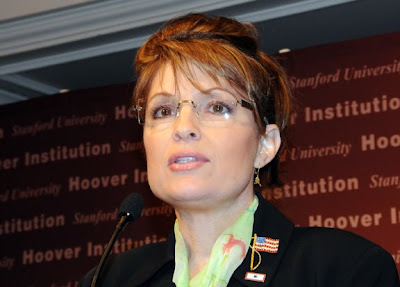
Desde ma anunsia na Si Sarah Palin inayek as John McCain para u VP gi i banda Republican, hu gof nanangga para i ineppe i Campaign Obama. Taimanu para u ma chonnek tatte kontra i dinagin McCain yan i inayek Palin? Put fin gi este na simana, ma na'publiko hafa iyo-niha strategy. Pau ma na'dana' gi i mensahi-niha, manasunto Famalao'an yan Ikonomia.

Ya bei sangani hamyo, ti desganao yu'. Ti nina'desganao yu'. Put ma ayek este na tactic, ma apreba nu Guahu na magahet i fino' Obama yan Biden. I inetnon Democratic, ma ofrefresi "ideas" yan "policies" gi este na botashon, yan i inetnon Republicans, ma ofrefresi "personalities." Pau ma kena'hasso i taotao Amerika hayi mismo umofrefresi "solutions" para i prubleman-niha, ya hayi umofrefresi "tinaya'." Manmiresi i taotao Amerika gi maseha manu na ma bota.


In recent weeks, given the glowing coverage that the Republicans have received as Sarah Palin shows a magically ability to "connect" to voters, and more uncannily, has the ability to make John McCain as President an exciting prospect, alot of Democrats have become frustrated over what the reponse of their candidate will be, and how they will deal with all the "energy" that Palin seems to be helping create. The momentum has all seemed to be on the Republican side, with the media and the country not challenging Palin enough, and John McCain's campaign becoming more and more negative and ugly.

Well, in the past few days they've unveiled their plan, and I personally like it, because its attacking what is now the perceived strength of the Republican party, a newly forged intimate tie with people, in particular women who are dealing with tough economically hard times. This new connection is vibrant and is being written about and reported on from all different angles, but it is far from strong, far from firm, primarily because its not based on very much. Its based on the fact that people "like" Palin, that they think she's "nice" or "strong" or "determined." Obama's campaign is attacking hard on this front, trying to break this connection which has only been in existence for a few weeks, not with spin, not with lies, not with hate, but instead with actual plans. The Obama campaign's new tactic for bursting the Palin bubble is to argue very forcefully, using very real issues that the Democrats have more and better solutions to the host of problems that are affecting America's working women.

In just the past few days I have been hearing discussions and Democratic talking points which are very on point in terms of talking about continuing gender inequality and sexism in the United States. They may not be using the word "sexism," but as they are outlining the differences between the two camps, they are ultimately talking about structural inequalities that disproportionately affect women, and in fact women of color more so, and in their plans for dealing with these problems, they are taking a far more critical and progressive view of American society that I thought possible this election. It may all be talk at this point, but it is far better than the gender and race neutral campaigns that we've had so far.

If John McCain wants to cheat and pretend that he is making history and being progressive with his choice of Sarah Palin, and that the party who is far more anti-women and anti-women's issues than Democrats are really the ones who are interested in breaking the glass ceilings of America, then it is up to Democrats to dispel that myth and offer up some real ideas instead. Of course, the effectiveness of this strategy all depends on whether or not McCain's Campaign manager Rick Davis is right, and if people will vote this year based on issues or personality?

Hearing the townhall meetings, speeches and interviews from both campaigns in recent days, the scathing rhetoric of the Obama campaign has come true. McCain and Palin don't have very much to offer in terms of new ideas. They don't seem to have any solutions to America's problems with the exception of drilling in Alaska. What they are offering instead is the chance to help them fight evil. Vote for them, join with them and fight not for America, but against its enemies. Fight the biased and sexist media and their Democratic allies. Raze Washington D.C. and its culture of earmarks and excess. Their rallying cry is as Mitt Romney shrieked during the RNC, replace that liberal Washington with a conservative one! The Republican party and others swept in by this message, are like a hastily thrown together, rag-tag Army, which isn't promised anything should they go to battle, aren't even promised food along the way, but seem to be caught up in the message, and seem happy enough to fight the battle, without any thoughts for whether or not they will get anything out of this war.

Its almost surreal for me to see so much mounting evidence that the Democrats are actually the more serious party this year and that they are providing far more detailed and concrete proposals for how they will improve the lives of Americans, and deal with some of the recent disasters that are besetting the country economically. Are they pandering to regular people? Absolutely, there can't be any doubt about that. But the benefit of Democrats in power is that they tend to economically pander to a wider tent, to a larger section of the population, whereas Republicans seem to be faithful in their pandering only to the richest and the least in need of just about everything.


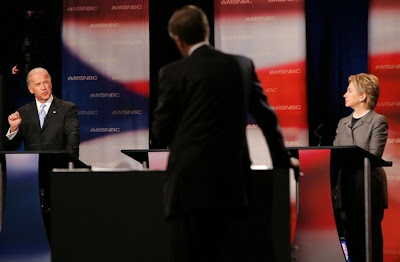
The Obama campaign released this video today, of a discussion between Hillary Clinton and Joe Biden discussing women's issues and the policy and philosophical differences between the two campaigns on thing such as birth control, right to sue based on discrimination, domestic violence and women's rights in general. Although the two political parties may appear to be very similar from certain perspectives, in this video, although it can be boring at points, since it is very policy-based, we can see that even small differences in terms of what laws will be passed, proposed, and how they will be shaped can have massive effects across the landscape of the country.

Earlier today as well, female Democrats in the House held a press conference to discuss further the differences between McCain and Obama's plans for America in terms of health care, retirement and equal pay for equal work. The conference was titled "Need, Expect And Deserve." Below is audio and video excerpts:


Speaker of the House Nancy Pelosi
on the Change America's Women:
"In the weeks ahead, we will be all over the country bringing a message of positive change, a new direction in America that addresses the economic concerns of the American people, in particular the economic concerns of America' working families and America's women. And in recent weeks, we have seen the consequences of the mismanagement of the Bush Administration on our economy. Yet, John McCain says the fundamentals of our economy are strong. American women know better. We are here today to focus on the change in America's economy. Barack Obama is the chance America's women need, expect and deserve."

Colorado Representative Diana DeGette
on
Senator McCain's Radical Health Care Plan:
"Under Senator McCain's health care plan more than 59 million women who receive health insurance through their job or spouse's job risk losing that insurance. More than 30 million women with employer sponsored health insurance who have a chronic condition could lose their health insurance and some of the requirements that some of us have fought so hard for at the state level--requiring maternity coverage and cancer screening and other coverages--would be wiped away under this plan. The bottom line: Senator McCain's radical health care plan is risky and dangerous for American women.

Connecticut Representative Rosa DeLauro
on
Equal Pay for Equal Work:
"Equal pay is at the heart of our debate for president and it has the power to make this a transformational election. Today, women are getting paid less than men, but John McCain opposes equal pay for equal work. He says, don't worry. All you need to do is get more education and training to get better jobs. And that shows why he cannot rescue this economy or help women to lift themselves up in this economy. When the Senate brought up the bill to remedy the Supreme Court's decision overturning Lily Ledbetter's pay discrimination claims to make sure it does not happen again, John McCain said he would oppose it. When it came time to vote, he didn't even bother to show up."

Illinois Representative Jan Schakowsky
on
the Threat John McCain Poses to Social Security:
"Barack Obama believes that Social Security is the cornerstone of the Social Compact in this country and he promises to protect it today, tomorrow and forever. John McCain says Social Security funding is an absolute disgrace. He simply doesn't get how it works in the first place. And he support privatization. In March, McCain said, I am totally in favor of personal savings accounts. Barack Obama opposes Social Security privatization because it would gamble the retirement plans of millions of Americans. We're talking about people over 65 years old. We're talking about persons with disabilities. We're talking about spouses and dependents, including my very own grandchildren, who lost their mother and are being helped by social security payments."

California Representative Linda Sanchez
on
John McCain's Outreach to Women and the Health Care Crisis in America:
"Despite his campaign's outreach efforts I think that McCain's efforts to bridge the gender gap is about as effective as the bridge to nowhere. And I want to take health care as an example. The lack of universal health care coverage hits women especially hard. There are over 20 million uninsured women in this country, and women are more likely than men to delay or not get medical care because of high costs. Health care premiums have doubled in the last seven years alone. No wonder only 27 percent of women are very confident that they'll be able to afford health care for themselves and their families. And, what does John McCain offer these women? John McCain offers a health care plan that would, for the first time in our country's history, tax health care benefits. And John McCain's plan won't even make a major dent in the number of uninsured Americans."

Maryland Representative Donna Edwards
on
Economic Opportunity and Domestic Violence:
"I know I wouldn't have gone to college if my father, who was disabled, hadn't been able to receive Social Security and we hadn't been able to receive benefits as children. This is important not as a ceiling, but as a floor and Barack Obama understands that. For America's women, for America's children, we understand that we want to live in our homes and in a home that's free of violence. Barack Obama, and certainly Joe Biden, understand that. They understand that when women live in homes that are filled with violence and when children withness that violence that it impacts how they perform in the workplace. It impacts how they are able to take care of themselves and their children. Barack Obama understands that. John McCain doesn't."
***********************************

As McCain makes his campaign more and more about his and his VP's personality and also about the faults in Barack Obama's personality, the choice is becoming more and more clear. If Americans would like to take another gamble at electing Presidents or Vice Presidents who they feel "comfortable" with, would want to have a beer with, or hunt some moose with, then McCain and Palin are their obvious choice. But if they would like, to quote a line from one of John McCain's favorite songs, "take a chance" on electing a President who promises more than just the aura of familiarity or worse yet mediocrity, but actually has some plans for America, which will benefit a larger majority of Americans, than simply hoping that prosperity will trickle down from the top 1%.

Perhaps this is the case for all elections where the ultimate choice comes down to deciding whether you will support the candidate is or isn't "like you." McCain and Palin are appealing to a desire that the President of the United States not really offer much in terms of change, new ideas, or even competency, but instead that the office exists as a symbolic point where my benefits from it don't have to be tangible, economic or social, but are just derived from the intimacy I feel knowing that I am on the same level as the President or the Vice President. That they are just like me.

With Obama-Biden, there is the shaking suspicion that they aren't like you, that you don't have a sort of "gut" connections to these candidates. You aren't sure about where they come from or what they're saying, since all the fancy words and big ideas they using don't seem to be grounded in any friendly ideological terrain, since they lack that "gut" tie. They will most likely offer you something different, might be better, might be worse, but supporting them represents a risk in losing that intimacy to power. It means that the possibility of things getting better for you are related to you not feeling like those who rule you "are one of you" or "are just like you" but that they are smarter than you, more competent and knowledgable than you.

It might seem like a silly choice, or structure through which choices are made, but its a natural one, and it is because of this, that although Obama clearly offers more plans and solutions to help more Americans, the race can still be so close.


Obama Lays Out Plans To Woo Women Voters:
Forget Palin, Focus On Equal Pay
Sam Stein
The Huffingston Post
9/15/08

During a conference call with national female supporters on Monday, Barack Obama and his aides outlined a comprehensive strategy to target female supporters who could be on the fence between his and John McCain's candidacies.

The plan included intense focus on McCain's opposition to equal pay legislation, which aides to Obama believe resonates beyond female voters; sending out prominent female surrogates to serve as political "ambassadors"; limiting focus on Gov. Sarah Palin in favor of McCain himself; and breaking through the media's propensity to focus on conflicts and gaffes.

"We have got a lot of work to do and I can't do it without your help," Obama explained. "In recent weeks, we have seen Republicans up to their election year tricks. In his campaign ads, John McCain and Sarah Palin - I'm being generous here - distorted my record. They inflated their own. They ran an ad accusing me of promoting teaching sex to kindergartners when in fact the bill called for ensuring that our children learn how to protect themselves from sexual abuse. That is one of the more egregious examples. And with all these antics I'm going to need all of you on call to set the record straight."

"All of you, as prominent women that the American people listen to," the Democratic nominee continued, "are going to be some of our most important ambassadors in this process. To the extent we can get people to pay attention to choice involved on issues like health care, the Supreme Court, pay equity, I am absolutely confident we will win. But we are going to have to cut through a whole lot of noise and the media's propensity to cover scandal, gaffe, polls or attacks."

The National Women Leaders Conference Call came as part of a greater effort on behalf of the Obama campaign to solidify a portion of the electorate that, with McCain's choice of Palin as VP, seems more up for grabs than at any previous time in this election.

A Hill Democrat told the Huffington Post that female lawmakers will hold an event this week focusing on equal pay legislation. In addition, the Obama campaign on Monday rolled out the endorsements of "hundreds of national women leaders in fields ranging from business to women's rights, from astronauts to athletes, from former governors to cabinet secretaries." The list includes Stacey Snider, Chairman of DreamWorks, Linda Chavez-Thompson, Executive Vice President Emerita, AFL-CIO, and Olympic gold-medalist Dominique Dawes.

Speaking on the phone with many of these individuals, Obama implored them to start reaching out on their own to help recruit female support. "Don't wait for our call," he said. "I need you to talk to your colleagues, get on the radio, write op-eds in the newspapers, talk about what is really at stake in this election."

There were several issues on which the campaign suggested these pseudo-surrogates focus. Equal pay, opposition to choice, and the economy were some of them -- Sarah Palin was not.

"I know we are getting a little distracted by discussion about Sarah Palin, but I think it is important for all of us to focus on Sen. McCain," said Dana Singiser, a strategist for Obama. "Ultimately, of course, he will be president, he will be choosing Supreme Court justices, he will be steering the federal government, and we know a lot about him and where he stands on issues that are important to women. The contrast between John McCain's record and his positions and Sen. Obama's really could not be any more stark. I go back to equal pay because, given where we are with the economy, we are finding with the polling that pocket book issues really are what is top of mind for women voters. Whether we are talking about jobs or health care or gas prices, this is what women voters and really all voters are concerned about."

Kanaka Maoli Scholars Against Desecration

September 12, 2008

Open letter by Kanaka Maoli Scholars Against Desecration

As Kanaka Maoli professors and scholars we write to publicly condemn the state-sponsored desecration of a Native Hawaiian burial site at Wainiha, Kaua`i resulting from the construction of a new home at Naue Point by California businessman Joseph Brescia. For years Brescia has been trying to build a home on top of our ancestral graves despite a litany of environmental, legal and community challenges to his construction. In 2007 Brescia unearthed and then covered over the bones of our ancestors when he began clearing the area. The illegal and immoral disturbance and desecration of our ancestors’ remains must stop now.

The Hawai`i revised statute 711-1107 on Desecration specifically states that no one may commit the offense of desecrating "a place of worship or burial," and the statute defines "desecrate" as "defacing, damaging, polluting, or otherwise physically mistreating in a way that the defendant knows will outrage the sensibilities of persons likely to observe or discover the defendant's action." In complete contradiction to their own law, the State Historic Preservation Division of the Department of Land and Natural Resources approved a "burial treatment plan" for Brescia that undermines both the very concept of historic preservation and the reason for the founding of the Hawai`i Burials Council: to protect burials, not "treat" them. This "burial treatment plan" enabled Brescia to secure permits to build as long as the graves remain "in place," which in this case means the burials have been capped with concrete already poured for the footings of his house.

To date, 5th Circuit Judge Kathleen Watanabe has denied requests for a temporary restraining order and has even refused to grant a temporary injunction to stop further construction until the full civil suit is adjudicated by the state court. State Historic Preservation Division archaeologist and Kaua`i County Council candidate Nancy McMahon testified that the dozens of previously identified burials do not constitute a cemetery, but should be thought of instead as individual grave sites—a distinction that is meaningless in the laws against the desecration of burial sites. An archaeologist hired by Brescia, Mike Dega, told the court that he would not define the site as a cemetery because for "pre-contact" burials, he has no standards by which he can say a burial ground is a cemetery. In other words, in his view there is no such thing as a "pre-contact" (by which he means pre-European or pre-Christian) Native Hawaiian "cemetery." According to the Merriam-Webster dictionary, a cemetery is defined simply as "a burial ground"; within this standard definition there are no additional historical or cultural qualifications that need to be met. Dega’s assessments and the court's acceptance of them shamelessly evade the entire moral and ethical purpose of the legislation enacted to protect gravesites by playing a deceptive game of words. Let us be clear: a burial is a cemetery and a cemetery is a burial. No matter how they describe the grave sites, they cannot erase the existence of the burials; they cannot turn these graves into a "non-cemetery," and they cannot erase the reality of the ongoing desecration caused by this construction.

Adding further insult to his desecration of Hawaiian graves, Brescia recently lodged a lawsuit against six people—all of whom are Kanaka Maoli—implicated in protecting the burial site from his construction work. He has charged them with trespassing, unspecified damages, and even "terroristic acts." Brescia subsequently filed a motion to identify nearly a dozen more "Doe defendants" and add them to his original lawsuit in an attempt to include cultural and religious practitioners from neighbor
islands that came to bear witness to and defend against the crimes at Naue. We strongly condemn this Orwellian view of who should be defined as trespassing and causing damage.

We call out to all people of conscience to join in our condemnation of the desecration of the ancestral remains; to support an end to the illegal construction supported by the state, and to protest any prosecution of those who have laid their bodies down to prevent the further degradation of the bones of our kūpuna.

Signed,

Hokulani Aikau, Ph.D., Assistant Professor, Political Science, University of Hawai`i at Mānoa

Carlos Andrade, Ph.D. Assistant Professor, Kamakakūokalani Center for Hawaiian Studies, University of Hawai`i at Mānoa

J. Leilani Basham, Ph.D., Assistant Professor, Humanities, University of Hawai`i at West O`ahu

Maenette Benham, Ed.D., Dean, Hawai`inuiakea School of Hawaiian Knowledge, University of Hawai`i at Mānoa

J. Noelani Goodyear- Ka`ōpua, Ph.D., Assistant Professor, Political Science, University of Hawai`i at Mānoa

Lisa Kahaleole Hall, Ph.D., Assistant Professor of Women’s Studies, Wells College

Kū Kahakalau, Ph.D., founder and director of Kanu o ka ‘Āina New Century Public Charter School

Lilikalā Kame`eleihiwa, Ph.D., Professor, Kamakakūokalani Center for Hawaiian Studies, University of Hawai`i at Mānoa

Val Kalei Kanuha, PhD, M.S.W., Associate Professor of Social Work, University of Hawai`i at Mānoa

J. Kēhaulani Kauanui, Ph.D., Associate Professor, Anthropology and American Studies, Wesleyan University

Manulani Meyer, Ed.D., Associate Professor, Education, University of Hawai`i at Hilo

Jon Kamakawiwo`ole Osorio, Ph.D., Associate Professor, Kamakakūokalani Center for Hawaiian Studies, University of Hawai`i at Mānoa

Noenoe K. Silva, Ph.D., Associate Professor, Political Science, University of Hawai`i at Mānoa

Ty Kawika Tengan, Ph.D., Associate Professor, Anthropology and Ethnic Studies, University of Hawai`i at Mānoa

Haunani-Kay Trask, Professor, Kamakakūokalani Center for Hawaiian Studies, University of Hawai`i at Mānoa

Wednesday, September 17, 2008

A Battle Between Race and Gender (Again, But Different)

I'm getting tired of hearing pundits and Republicans complain that Obama should have been dominating and winning this election in a landslide and that somehow the fact that polls have been tight for months, states that he can't "seal the deal."

A more mature look at the electoral landscape of the US, and the tendencies that we can find in terms of race, gender, class, political ideology, all of these factors make clear that we should actually be shocked beyond belief that Obama is close at all. That if anything he should losing this election horribly, because of America's unwillingness to deal with issues of race and racism, and the extra criticism it forces upon those from marginalized groups when they emerge into the "mainstream."

If we actually take into account much of what the media and the American people refuse to accept, we see a country which will elect the worst possible, least qualified and most intellectually crude "white people." I have to say white people now, since Palin is in the race. But will not allow the same "freedom" to a black man. Despite all the ridiculous questions about whether Obama is "black enough" the political answer that we have received this year is that he can only be elected by America if he is not black enough, not black at all.

It is the same old story about the universal and the particular. Whichever particular identity is deemed to be universal in a given context, it can stand in and govern all others without been assumed to have bias or prejudice towards its particularity. In other words, white men have traditionally been the universal in American politics, and regardless of how terrible they might govern, there are never any questions of whether or not we could ever trust a white male to lead again. The life of the particular is not as easy, and as we have seen over the past two years of political campaigning, both Barack Obama and Hillary Clinton were put through incredible never ending political gauntlets to test whether their particularities, their gender, their race, would be able to become universal, would not lead them to sacrifice the whole, the greater good, the universal care of society, for their narrow prejudiced interests. As Jon Stewart said to Larry King several months ago, the nation seems anxious over fears that if Barack Obama is elected he'll let the black people do whatever they want, and if Hillary is elected men won't be allowed to drive!

Obama received some help in his campaign, because although the media and the Democratic party may have advertised the primary as a battle between two awesome types of awesome, it was ultimately a referendum on which history of oppression is America less interested in dealing with. And the answer was that it was much less willing to deal with sexism in America, than it was with race.

As I wrote a few days ago, the election might now appear to be about gender again, but this is not at all the case. We are in much trickier territory now, in terms of explaining the dynamics. I hadn't intended this post to be very long this morning, so I'll try to explain this in as succinct a way as I can (yanggen un tungo' yu', siempre esta un tungo' na mappot este para Guahu).

With the selection of Sarah Palin, the Republicans have given America the same choice between race and gender, and which they will allow the dominate how political ideas are shaped for the next two months. Which will shape more on the surface as something which people claim they are dealing with, supporting, pushing for, and which will shape possibly far more by being suppressed, displaced, dismissed and rejected?

Palin's pick has meant resurgent of alot of "feminist talk" often times from the most ridiculous choices, Republican media and political hacks, who sound like they've just gotten their talking points from The Sexual Contract for Dummies. But this feminist talk is diluted first by the ramifications of McCain picking a white women for his ticket, thereby making a tokenist gesture towards change, while still "maintaining" the white core of America and the Republican party. The race is still about race, and how much "race" people can handle. If Americans aren't ready to relinquish the whiteness of their nation, then Obama will lose, and they will pretend that they've moved their country forward with the selection of Palin. A fake form of progress, since as I wrote last week, she could never have been elected through the primary, so the idea that America can take credit for her elevation is as stupid as when Republicans argue that they are the party for black people and minorities since Bush picked Condi Rice and Colin Powell for his cabinet.
In other words, no actual progress is being made here. What Palin instead does is revive a very old story in American history, that of the rescue narrative, in which white women would be "stolen" by black people or Native Americans and violent posses would need to be formed to retrieve them and thus protect the honor of their family and keep pure their bodies.

I've been shocked in recent weeks at how little Obama has actually talked about Sarah Palin. Watching his town hall meetings and his stump speeches, he is still talking about Bush-McCain, everything is remarkably the same. But you wouldn't know this from the media, which is either full of calls for him to start attacking Palin, or remarks that he is already attacking her too much, that he is going to far and he is being distracted by her. In addition to this, there is an almost ludicrous amount of discussion going on about how people (and him in particular) need to leave her alone, or stop picking on her, stop holding her to a higher standard, or stop getting distracted by her.

The several days traction that the "lipstick on a pig" scandal received are an indication that there is a clear willingness on behalf of most Americans and not just the media, to link Obama and Palin together, and not just in a combative way, but in a predator-victim dynamic. We heard some of this with regards to how careful Biden will have to be during the single VP debate, so as to not appear to be "mean" or overly harsh. But this warning is made for an actual interaction, must of the "angry noise" that we will hear about Palin, defending her, protecting her and counter-attacking Obama will be about simple association, will be taken from off-hand remarks, will be almost completely out of context. One could say that this is just politics, but depending on the level of indignation and anxiety it produces, it could very well be derived from the racial/ideological DNA that Americans get from their weaning on those racially charged rescue stories. Its important to remember that in the South a century ago, a black man could be lynched or assaulted for simply being in the same room as a white woman, or that many lynch mobs were formed just because of a errant "look" or casual point of contact. Over the next few weeks we will most likely see a similar thing take place, as the desire to protect and defend Sarah Palin, her whiteness and the purity that she represents, will lead to more angry discursive mobs being formed, and not just from "red meat Republicans," but from all facets of American life. While Obama might want to continually attack John McCain, America if it becomes caught up in this desire will not allow that to happen and will continually make this a race against Obama and Palin.
It will constantly be brought back to this point in order to experience those feelings of mastery, safety, sovereignty, purity, etc. This brings me to the next point. That although gender is in this race now, it has been brought into the debate in such a way that it is sealed within a horribly patronizing masculine drive. The constant defenses of Palin, the unwillingness to let her speak, let her campaign on her own, to hold her hand, and to overdefend her lack of qualifications, the inability to let her be vetted, to let her be criticized, all of these point to a sort of patronizing male defense of a mystical, pure, but untouchable female capability. All of the flurry of defensive tactics that the Republican party is taking in the past few weeks are point to Palin being some forbidden, secret treasure. It is incredible, it is determined, it is real, gritty, something that ex-urban moms will go crazy for, but alas, it is only powerful if you do not touch it!
This sort of patronizing behavior is one of the further things from feminism, because its all based on the unrealness of the woman. That she cannot "really" stand with the "boys." We may have all these talking points that say she does, but ultimately she cannot. So, again, we see America unwilling to deal with the gender issue, or determined to take yet another short cut in dealing with it. Gender is out there, its close to the level at which it could represent the sovereign spirit of the United States. But its position is such that should your or even my daughter (who will be 17 months tomorrow) were to try to become President, they might make it, but they would still be faced with this ugly, disgusting choice between being a pristine sort of empty ideological Barbie like Sarah Palin, or a gender neutral, never-whining, feminine bulldog like Hillary Clinton. Any idea that the glass ceiling has been broken, that the playing field is levelled is not indicated in anyway with the pick of Palin as VP or with the way she has been handled in the time since. Things will have changed, the field will be levelled, and the "ceiling" shattered when a female candidate, and not just a white one, can not only run for President, but can do so as a woman, and can speak to that position, and frankly, whine about it, and talk about sexism in society and not be dismissed as particular, as gender biased or limited in her scope by her gender.

Unless the glass bubble around Palin is shattered and she is treated like a "real candidate" then she may be the first Republican white female VP pick, and possibly the first white female VP ever, but nothing will actually have changed. If she is inaugurated in January of next year, the fresh smelling sweetness of the history that has just been made, will be completely overpowered by the reeking stench of the racism and sexism that got her there.

Monday, September 15, 2008

Race and the Race

Thought I'd post this today, since it relates to a longer post I'm writing today about race and gender, that I'll put up tomorrow.

************************************

Racism and the Race
The New York Times
By CHARLES M. BLOW
Published: August 8, 2008

This is supposed to be the Democrats’ year of destiny. Bush is hobbling out of office, the economy is in the toilet, voters are sick of the war and the party’s wunderkind candidate is raking in money hand over fist.

So why is the presidential race a statistical dead heat? The pundits have offered a host of reasons, but one in particular deserves more exploration: racism.

Barack Obama’s candidacy has shed some light on the extremes of racism in America — how much has dissipated (especially among younger people) and how much remains.

According to a July New York Times/CBS News poll, when whites were asked whether they would be willing to vote for a black candidate, 5 percent confessed that they would not. That’s not so bad, right? But wait. The pollsters then rephrased the question to get a more accurate portrait of the sentiment. They asked the same whites if most of the people they knew would vote for a black candidate. Nineteen percent said that those they knew would not. Depending on how many people they know and how well they know them, this universe of voters could be substantial. That’s bad.

Welcome to the murky world of modern racism, where most of the open animus has been replaced by a shadowy bias that is difficult to measure. As Obama gently put it in his race speech, today’s racial “resentments aren’t always expressed in polite company.” However, they can be — and possibly will be — expressed in the privacy of the voting booth.

If the percentage of white voters who cannot bring themselves to vote for a black candidate were only 15 percent, that would be more than all black voters combined. (Coincidentally, it also would be more than all voters under 24 years old.) That amounts to a racial advantage for John McCain.

And this sentiment stretched across ideological lines. Just as many white independents as Republicans said that most of the people they knew would not vote for a black candidate, and white Democrats were not far behind. Also, remember that during the Democratic primaries, up to 20 percent of white voters in some states said that the race of the candidate was important to them. Few of those people voted for the black guy.

Some might say that turnabout is fair play, citing the fact that 89 percent of blacks say they plan to vote for Obama. That level of support represents a racial advantage for him, too, right? Not necessarily. Blacks overwhelmingly vote Democratic in the general election anyway. According to CNN exit polls John Kerry got 88 percent of the black vote in 2004.

Think racism isn’t a major factor in this election? Think again.

E-mail: chblow@nytimes.com.

Sunday, September 14, 2008

An Indigenous View on Palin's Alaska

Below is a letter I was forwarded by Michael Leon Guerrero from the Global Grassroots Justice. I've been waiting weeks for something like this to emerge, a Native Alaskan perspective on Republican VP choice Sarah Palin's record in Alaska. I'm glad that its finally here, because the lack of this perspective has been horrifying, especially amidst all the pro-Palin exuberant coverage.

Although the erasure of the indigenous people of the United States is the norm (as they represent histories, legacies and contemporary realities that your "average" American citizen or politician refuses to deal with), I've been surprised at the lack of coverage of Native American opinions on the Republican Presidential and VP candidates.

For McCain, coming from Arizona and being for several years the chair of the Senate Committee on Indian Affairs has a long relationship with Native American tribes, and has helped write numerous laws regulating their gaming industries and their "sovereign" relationships to state governments.

For Palin, there is plenty to attack, especially for Democrats looking to tarnish her record. The criticism of her on her poor environmental record is obvious, but the ecosystems that she is planning to sell off and open up for drilling are used by Native Alaskan communities for survival. Actually, now that I think about this, I'm not surprised that Democrats aren't using this as an attack, since the criticism of Palin is one that you can make towards almost every single state government and its treatment of Native Americans. There is far more to "Native America" than just casinos, and if you don't know about the fragile relationships that reservations or tribes have with their state governments in your state, its probably not because it doesn't exist, but its either because of the metaphorical erasure of Native Americans from American consciousness, or its because they were physically erased and displaced from your area or state.

If the Republican primary had lasted longer then we might have heard more positive or negative news about John McCain from various tribes. Obama received some initial negative press from Native Americans last year, but this year has been much more positive for him. Both him and Hillary Clinton came out in support for the Akaka Bill in Hawai'i. Whatever your opinion on it, the willingness to at least allow for some debate or some Federal policy on the matter is something. Besides, the support of Obama is far more interesting than the bland and weird rejection by John McCain that he gave in a Honolulu Star-Bulletin interview last month:


Q: "Proponents of the Akaka Bill see the measure as overdue federal recognition of the rights of native Hawaiians to form their own government. Opponents see it as a 'Balkanization' of America. Please explain your views on the bill."


A: "I recognize the importance of preserving both Hawaii’s indigenous culture and its unique island culture. Hawaii is the most diverse place on earth, and I honor the extraordinary blend of races and cultures that have made the state such a special place. The Akaka Bill would compromise that special blend of peoples and cultures by creating a race-based separate nation that would differentiate treatment for the inhabitants of Hawaii based on blood type. The Hawaiian government has never been a race-based government, as a kingdom, a constitutional monarchy, a republic or a territory. I believe it would be a violation of King Kamehameha’s principles that — “All men are of one blood” — to divide Hawaii and Hawaiian families along racial lines.


I believe the Akaka Bill would be bad for the economy of Hawaii, all the people of Hawaii and for indigenous Hawaiians. Dividing people by race inevitably leads to racial discrimination and conflict. I am committed to helping those of every race who need assistance, and deeply committed to federal programs that preserve Hawaiian culture and identity for the benefit of all."


The Obama campaign in the final days of the Democratic primaries became very engaged with Native American tribes in Montana and South Dakota because of the large voting blocs they represent. A visit tot he Crow reservation in Montana culuminated in Obama being adopted into the Crow nation and given the names "Obama Black Eagle" and "One who helps all the people across the land."


Finally, before getting to the essay itself, I wanted to share a small bit of Native Alaskan info from the Democratic National Convention, that sadly got overshadowed when Palin got picked the next day. This info came via Brady Braves, who is a very good resource for tracking Native American mentions in American popular culture and political fights. Apparently one of the 10 lucky Obama supporters that got to join him backstage before his big speech on Thursday was a first time voter and Native Inupiaq from Alaska.

"Holly, a 20-year-old Alaska Native Inupiaq, is spending her summer break from Stanford University at the First Alaskans Organization interviewing native elders about their experiences with segregation. Holly is passionate about improving healthcare access for Native Americans, and protecting Alaska's Arctic National Wildlife Refuge from drilling. The 2008 presidential election is Holly's first as a voter. She says: "This was the first campaign I felt I needed to support. I don't have a lot of money, but I donate what I can because I believe in [Barack]." She will attend the convention with her mother who is the first Native American woman to pass the Alaska bar."

I hope that Holly, and other Alaskans such as Republican Mayor of Fairbanks Jim Whitaker who support Barack Obama, start making their voices heard and help to tear down the myths about Sarah Palin that John McCain's campaign is working to create and maintain. Palin is powerful so long as no one knows anything about her she is a powerful adversary and could help McCain win in November. But on the other hand, the more that her record that they are trying to assert is revealed to be false, or in the case of her "national security/foreign policy" credentials, proven to simply not be there, the less potent of a figure she'll be. This is the genius of McCain's pick, is that Sarah Palin has done so little, that all there really is to go on is what she appears to be. She is assigned huge titles like "reformer" and while there is so incredibly little evidence to support this, there is just as little evidence to contradict it. That's why its crucial for those who support Obama to constantly be putting out there, and in my case today, evidence of her poor relationship to Native Alaskans, what they can get their hands on, in hopes that in the next few weeks of campaigning, some of it might just stick to her, and might just help reveal the truth behind her lies.

*****************************

An Alaska Native speaks out on Palin, Oil, and Alaska
By Evon Peter
evonpeter@mac. com
9/8/2008

My name is Evon Peter; I am a former Chief of the Neetsaii Gwich'in tribe from Arctic Village, Alaska and the current Executive Director of Native Movement. My organization provides culturally based leadership development through offices in Alaska and Arizona. My wife, who is Navajo, and I have been based out of Flagstaff, Arizona for the past few years, although I travel home to Alaska in support of our initiatives there as well. It is interesting to me that my wife and I find ourselves as Indigenous people from the two states where McCain and Palin originate in their leadership.

I am writing this letter to raise awareness about the ongoing colonization and violation of human rights being carried out against Alaska Native peoples in the name of unsustainable progress, with a particular emphasis on the role of Sarah Palin and the Republican leadership. My hope is that it helps to elevate truth about the nature of Alaskan politics in relation to Alaska Native peoples and that it lays a framework for our path to justice.

Ever since the Russian claim to Alaska and the subsequent sale to the United States through the Treaty of Cession in 1867, the attitude and treatment towards Alaska Native peoples has been fairly consistent. We were initially referred to as less than human 'uncivilized tribes', so we were excluded from any dialogues and decisions regarding our lands, lives, and status. The dominating attitude within the Unites States at the time was called Manifest Destiny; that God had given Americans this> great land to take from the Indians because they were non-Christian and incapable of self-government. Over the years since that time, this framework for relating to Alaska Native peoples has become entrenched in the United States legislative and legal systems in an ongoing direct violation of our human rights.

What does this mean? Allow me to share an analogy. If a group of people were to arrive in your city and tell you their people had made laws, among which were:

1. What were once your home and land now belong to them (although you could live in the garage or backyard)

2. Forced you to send your children to boarding schools to learn their language and be acculturated into their ways with leaders who touted 'Kill the American, save the man' (based on the original statement made by US Captain Richard H. Pratt in regards to Native American education 'Kill the Indian, save the man.')

3. Supported missionaries and government agents to forcefully (for example, with poisons placed on the tongues of your children and withheld vaccines) convince you that your Jesus, Buddha, Torah, or Mohammed was actually an agent of evil and that salvation in the afterlife could only be found through believing otherwise

4. Made it illegal for you to continue to do your job to support your family, except under strict oversight and through extensive regulation

5. Made it illegal for you to own any land or run a business as an individual and did not allow you to participate in any form of their government, which controlled your life (voting or otherwise)

How would this make you feel? What if you also knew that if you were to retaliate, that you would be swiftly killed or incarcerated? How long do you think it would take for you to forget or would you be sure to share this history with your children with the hope that justice could one day prevail for your descendents? And most importantly to our conversation, how American does this sound to you?

To put this into perspective, my grandfather who helped to raise me in Arctic Village was born in 1904, just thirty-seven years after the United States laid claim to Alaska. If my grandfather had unjustly stolen your grandfathers home and I was still living in the house and watching you live outdoors, would you feel a change was in order?

Congress unilaterally passed most of the major US legislation that affect our people in my grandfathers' lifetime. There has never been a Treaty between Alaska Native Peoples and the United States over these injustices. Each time that Alaska Native people stand up for our rights, the US responds with token shifts in its laws and policies to appease the building discontent, yet avoiding the underlying injustice that I believe can be resolved if leadership in the United States would be willing to acknowledge the underlying injustice of its control over Alaska Native peoples, our lands, and our ways of life.

United States legal history in relation to Alaska Natives has been based on one major platform - minimize the potential for Alaska Native people to regain control of their lives, lands, and resources and maximize benefit to the United States government and its corporations.

While the rest of the world, following World War II, was seeking to return African and European Nations to their rightful owners, the United States pushed in the opposite direction by pulling the then Territory of Alaska out of the United Nations dialogues and pushing for Statehood into the Union. Why is it that Alaska Native Nations are still perceived as being incapable of€&½ governing our own lands, lives, and resources differently than African, Asian, and European nations?

Let me get specific about what is at stake and how this relates to Palin and the Republican leadership in Alaska and across this country. To this day, Alaska Native peoples are among the only Indigenous peoples in all of North America whose Indigenous Hunting and Fishing Rights have been extinguished by federal legislation and yet we are the most dependent people on this way of life. Most of our villages have no roads that connect them to cities; many live with poverty level incomes, and all rely to varying degrees on traditional hunting, fishing, and harvesting for survival. This has become known as the debate on Alaska Native Subsistence.

As Alaska Governor, Palin has continued the path of her predecessor Frank Murkowski in challenging attempts by Alaska Native people to regain their human right to their traditional way of life through subsistence.

The same piece of unilateral federal legislation, known as the Alaska Native Claims Settlement Act (ANCSA) of 1971, that extinguished our hunting and fishing rights, also extinguished all federal Alaska Native land claims and my Tribe's reservation status. In the continental United States, this sort of legislation is referred to as 'termination legislation' because it takes the rights of self-government away from Tribes. It is based in the same age-old idea that we are not capable of governing our people, lands, and resources. To justify these terminations, ANCSA also created Alaska Native led for-profit corporations (which were provided the remaining lands not taken by the government and a one time payment the equivalent of about 1/20th of the annual profits made by corporations in Alaska each year) with a mission of exploiting the land in partnership with the US government and outside corporations. It was a brilliant piece of legislation for the legal termination and cultural assimilation of Alaska Natives under the guise of progress.

Since the passage of ANCSA, political leaders in Alaska, with a few exceptions, have maintained that, as stated by indicted Senator Ted Stevens, 'Tribes have never existed in Alaska.' They maintain this position out of fear that the real injustice being carried out upon Alaska Natives may break into mainstream awareness and lead to a re-opening of due treaty dialogues between Alaska Native leaders and the federal government. At the same time the federal government chose to list Alaska Native tribes in the list of federally recognized tribes in 1993. Governor Palin maintains that tribes were federally recognized but that they do not have the same rights as the tribes in the continental United States to sovereignty and self-governance, even to the extent of legally challenging our Tribes rights pursuant to the Indian Child Welfare Act. What good are governments that can't make decisions concerning their own land and people?

The colonial mentality in and towards Alaska is to exploit the land and resources for profits and power, at the expense of Alaska Native people. Governor Palin reflects this attitude and perspective in her words and leadership. She comes from an area within Alaska that was settled by relocated agricultural families from the continental United States in the second half of the last century. It is striking that a leader from that particular area feels she has a right, considering all of the injustices to Alaska Native people, to offer Alaskan oil and resources in an attempt to solve the national energy crisis at the Republican Convention. Palin also chose not to mention the connection between oil development and global warming, which is wreaking havoc on Alaska Native villages, forcing some to begin the process of relocation at a cost sure to reach into the hundreds of millions.

Our tribes depend on healthy and abundant land and animals for our survival. For example, my people depend on the Porcupine Caribou herd, which migrates into the coastal plain of the Arctic National Wildlife Refuge each spring to birth their young. Any disruption and contamination will directly impact the health and capacity for my people to continue to live in a homeland we have been blessed to live in for over 10,000 years. This is the sacrifice Palin offered to the nation. The worst part of it is that there are viable alternatives to addressing the energy crisis in the United States, yet Palin chooses options that very well may result in the extinguishment of some of the last remaining intact ecosystems and original cultures in all of North America. Palin is also promoting off shore oil drilling and increased mining in sensitive areas of Alaska, all of which would have a lifespan of far fewer years than my grandfather walked on this earth and which would not even make a smidgen of an impact on national consumption rates or longer term sustainability. McCain was once a champion of protecting the Arctic National Wildlife Refuge and it is sad to see, that with Palin on board, he is no longer vocal and perhaps even giving up on what he believes in to satisfy Palin's position.

While I have much more to say, this is my current offering to elevate the conversation about what is at stake in Alaska and for Alaska Native peoples. Please share this offering with others and help us to make this an election that brings out honest dialogue. We have an opportunity to bring lasting change, but only if we can be open to hearing the truth about our situations and facing the challenges that
arise.

Many thanks to all those who are taking stands for a just and sustainable future for all of our future generations.

*This essay is a personal reflection and should not be attributed to my tribe or organization

Thursday, September 11, 2008

Todu Dipende Gi Hafa Ta HaHasso

People often ask me how I became "political" or how I became "radical."

There are a number of points in my life that I point to, each of which in some way contributed to the development of the consciousness that I use to write this blog.

One faint event is the time that my family spent in Africa when I was a small child, and the experiences we felt there as a mixed family with a white father and a brown mother and two brown children.

Another is a variety of experiences as a undergraduate at the University of Guam, and finding myself entangled in numerous forms of faculty racism and apathy.

One whose seventh anniversary just passed today is the 9/11 attacks. I had always been a more liberal and Democratic person, but it was the 9/11 attacks and the subsequent run up to war against Afghanistan and Iraq that pushed me to become a more mature anti-war or peace activist. It was also interestingly enough, 9/11 that helped propel me into becoming a far more intelligent and aware progressive Chamorro activist.


It was 9/11 and all the gestures that people on Guam made in order to feel and be a part of America in the aftermath that made me perceive clearly the colonial relationship we have with the United States, where the reality that we face everyday is dismissed and casually cast aside so that we may imagine, often based on nothing more than emotion that we and Guam are more American than we really are.

In the days after 9/11 this was made most clearly to me through the ways in which Pearl Harbor was invoked. Although this is an idea which has long left the consciousness of Americans, in the week following the attacks, Pearl Harbor was an analogy that was used by both local and national media in order to make "sense" of what had just happened, the "surprise" attack on American "soil." Just as the tranquillity of America life had been shattered by the Japanese attack at Pearl Harbor, Hawai'i in 1941, so too was the attacks in New York and Washington D.C. in 2001.

I found it interesting that even Chamorros, old and young on Guam, who were trying to describe their own feelings of shock and vulnerability also used Pearl Harbor, despite the fact that Guam, the island that they call home, was attacked the same day. At a moment when their feelings appeared to be so personal and intimate, so tied to their innermost feelings, it was strange that no one thought to articulate their fears through the most obvious choice, the Japanese attack on Guam in December 1941 and subsequent invasion. Instead, they imported an event from the larger national imagination of the United States, which ended up erasing their own place in that attack that brought Guam and the United States into World War II.

These ways in which Chamorros erased their own local histories and identities in order to force their way into the American family, all helped give me my first lessons into contemporary colonialism in Guam.

My first attempts at writing about this came in 2003, when I was fortunate enough to be given the opportunity to write an article for the short-lived, but still important magazine Galaide, published by the Guam Communications Network in Long Beach, California. My article was titled "Todu Dipende Gi Hafa Ta Hahasso: Chamorros on Guam and 9/11." I've decided to link to it here, to mark the seventh year since 9/11.

The Republican Olympics of Hypocrisy

Lipstick on a Wing Nut
by Katha Pollitt
from The Nation
September 10, 2008

John McCain chose the supremely under-qualified Sarah Palin as his running mate partly because she is a woman. If you have a problem with that, you're a sexist. She talks incessantly about being a mother of five and uses her newborn, Trig, who has Down syndrome, as a campaign prop. If you wonder how she'll handle all those kids and the Veep job too, you're a super-sexist. "When do they ever ask a man that question?" charges that fiery feminist Rudy Giuliani. Indeed, Palin, who went back to work when Trig was three days old, gets nothing but praise from Phyllis Schlafly, James Dobson and the folks at National Review, who usually blame all the ills of modern America on those neurotic, harried, selfish, frustrated, child-neglecting, husband-castrating working mothers. Even stranger, her five-months-pregnant 17-year-old, Bristol, gets nothing but compassion and respect from Bill O'Reilly, Rush Limbaugh and others who have spent their careers slut-shaming teens for having sex--and blaming their parents for letting it happen.

If there were an Olympics for hypocrisy, the Republican Party would have more gold medals than Michael Phelps. And Palin would be wearing quite a few of them. It takes chutzpah for a mother to thrust her pregnant teen into the world's harshest spotlight and then demand the world respect the girl's privacy. But then it takes chutzpah to support criminalizing abortion and then praise Bristol's "decision" to have the baby. The right to decide, and privacy, after all, are two of the things Palin wants to deny every other woman, and every other family, in America. Palin's even said she would "choose life" if her daughter was pregnant from rape. Can't you just hear Bristol groaning, "Mo-om...!"

The Republicans bashed Barack Obama as a "celebrity," but now they've got a star of their own, so naturally the rules have changed. Nothing would suit them better than for the media to spend the next two months spellbound by the wacky carnival on ice that is the Palin family: Todd, aka the First Dude, the kids, Levi the hunky bad-boy dad-to-be--well, maybe not him so much after his expletive-adorned MySpace page briefly came to light ("I'm a fuckin' redneck"; "I don't want kids"--whoops). The snowmobiles, the moose burgers, the guns, the hair, the glasses that are flying off America's shelves (starting at $375 a pair, and she has seven). Fretting over the work/family issue alone should take up enough column inches to employ all the female journalists in America from now to next Mother's Day. And don't forget that op-ed staple, What Does This Mean for Feminism?

Well, I'm not playing. I don't care about Sarah Palin's family. I don't care if she's a good mother. I don't care if she's happily married, or who shops and who vacuums, or who takes care of the kids while both parents are at work. I don't want her recipe for caribou hot dogs, either. Life chez Sarah and Todd might make an adorable sitcom (Leave It to Jesus?) or a scathing tell-all a decade or so down the road (Governor Dearest?). Either way, so what? This is an election, not The View. As for feminism's meaning, what can you say after you've said that her career shows that even right-wing fundamentalist women have taken in feminism's message of empowerment and that's good, but that Palin's example suggests women can do it all without support from society and that's bad?

Count me as a feminist who never believed that being PTA president meant you could be, well, President. The more time we spend on dippy ruminations--how does she do it? Queen Bee on steroids or the hockey mom next door? how hot is Todd, anyway?--the less focus there will be on the kind of queries that should come first with any vice presidential candidate, and certainly would if Palin were a man. Questions like:

§ Suppose your 14-year-old daughter Willow is brutally raped in her bedroom by an intruder. She becomes pregnant and wants an abortion. Could you tell the parents of America why you think your child and their children should be forced by law to have their rapists' babies?

§ You say you don't believe global warming is man-made. Could you tell us what scientists you've spoken with or read who have led you to that conclusion? What do you think the 2,500 scientists of the Intergovernmental Panel on Climate Change are getting wrong?

§ If you didn't try to fire Wasilla librarian Mary Ellen Baker over her refusal to consider censoring books, why did you try to fire her?

§ What is the European Union, and how does it function?

§ Forty-seven million Americans lack health insurance. John Goodman, who has advised McCain on healthcare, has proposed redefining them as covered because, he says, anyone can get care at an ER. Do you agree with him?

§ What is the function of the Federal Reserve?

§ Cindy and John McCain say you have experience in foreign affairs because Alaska is next to Russia. When did you last speak with Prime Minister Putin, and what did you talk about?

§ Approximately how old is the earth? Five thousand years? 10,000? 5 billion?

§ You are a big fan of President Bush, so why didn't you mention him even once in your convention speech?

§ McCain says cutting earmarks and waste will make up for revenues lost by making the tax cuts permanent. Experts say that won't wash. Balancing the Bush tax cuts plus new ones proposed by McCain would most likely mean cutting Medicare, Medicaid or Social Security. Which would you cut?

§ You're suing the federal government to have polar bears removed from the endangered species list, even as Alaska's northern coastal ice is melting and falling into the sea. Can you explain the science behind your decision?

§ You've suggested that God approves of the Iraq War and the Alaska pipeline. How do you know?


See more Gina Gershon videos at Funny or Die

Tuesday, September 09, 2008

Tetset Konfrensian Chamorro

The Tetset Konfrensian Chamorro is coming up next month in Saipan, September 26th and 27th.

Para hamyo ni' ti en tingo', este i mina'tres na dinana' taiguini. Mandana' para i fine'nina giya Guahan gi 2006. Para i mina'dos giya Luta gi 2007. I tema, para este na sakkan, "Fana'gue, Na'metgot, Na'famta." Pat gi fino' Ingles, "Teach, Strengthen and Share (Sow)."

Mampos magof yu' put i dinana' gi este na sakkan, sa' bai hu gaige giya Guahan gi i otro na mes, pues sina sumaonao yu'!

Here is the information and application forms for those interested in knowing more or attending:


Monday, September 08, 2008

Change You Can Handle: A White Compromise

I'm leaving for Guam today, and so I can only post something real quick.

The race for President has changed since the Democratic National Convention. The pick of the Governor of Alaska, Sarah Palin has energized everybody out there, even those who didn't really need it. Republicans are rabid, foaming at the mouth, since they no longer are stuck with guarding the legacy of a terrible President, but can now this year make their own sort of "history" and to steal a line from Obama's stump speech, "change America, and change the world" by helping Sarah Palin become the first white woman Vice President.

The media is almost as rabid, but not unified in its energy, but divided. First there are those who feel compelled to take Palin down and do the vetting the Republicans obviously didn't do, and fight against that ridiculous Republican expectation that if we say Palin is a reformer, no one should look into her past or her record, but they should just accept it since she's almost thirty years younger than John McCain and shoots moose. The other half is invigorated since they can now speak with excitement about John McCain again, after months of pretty much nothing that they could use to place John McCain on a beloved pedestal, except for his POW status, they can now bring back all the tired narratives of John McCain as bold, a maverick. In recent weeks, the faces of many mainstream media commentators and anchors have looked rather glum, as the political icon of bravery they once reified has slowly decayed into just another pandering politician, who will use anything in his biography to make or dodge a point. Now, they can finally rehash all of those old notes. Even Joe Klein, in a Time column this week, argues that Obama is a conservative and crafty leaders, while McCain is the bold and radical one. Thankfully, his argument is pretty accurate and notes that the boldness and impulsiveness of McCain is not what this country or this world needs right now.
Lastly, Palin has done wonders for Democrats, needing a shot in the arm after their convention to keep themselves unified and pushing ahead. With Palin's shots at "community organizers" and her generally sarcasm unbound in her RNC speech, she's energized different Democratic factions to keep organizing, keep fundraising and keep the Republicans honest. If there were any Hillary Clinton supporters out there who were thinking about supporting John McCain out of spite, this sort of grotesque and really insulting pandering should hopefully make them think twice. Would McCain have chosen a man with so little experience? Absolutely not.

The Republican party will now start its own collective self-lobotomy over the next 60 days, trying to reconcile how they can argue simultaneously that the past eight years have been "OKAY!" and that they are the party of change and who can bring about the changes to America that they've suppressed for all of those eight years. Palin and their newfound love of all things feminist and women-centered is creating a frenzy over their own taking charge and making history and progress. But this frenzy and this delusion is so incredibly fragile, its almost laughable. The idea that the Republican party is ready to support equality for women's issues, or ready to take seriously a woman as President can be dismissed so easily and without the tiniest bit of effort. All one needs ask themselves, is to mentally imagine if someone such as Sarah Palin could have been nominated for President on the Republican side through their primary process? Would she have had a chance? Absolutely not, no way in hell. Her tiny morsels of experience at the national and international level would have been laughed off the stage, and she would have been the object of so much misogynist ridicule, I'm sure the sound bytes could be used as fodder for anti-Republican pro-woman campaigns for decades to come.

Whereas Obama's potential election as President, as I've written many times before, represents a shortcut in terms of Americans hoping to resolve their violent racial past and present, without confronting it or doing much more than voting, Palin's selection for VP on the Republican side, represents an even cruder and more conservative way of preventing any fundamental change from taking place in this country. As I mentioned earlier, her pick is a way by which McCain and the Republicans can gain access to the spirit that is seeking a "change" this year from Bush and from Washington as usual. But whereas Obama represents a change that "you can believe in" or a change which is derived from hope or dreams in a better future (something which, even if incrementally pushes you forward), McCain's campaign has changed this race back into the question of "change that you can handle."

For all of those white voters out there who are uncomfortable or uneasy about voting for black man, who might be Muslim, and talks like he's smart and "uppity" McCain has offered them a chance to still change this country, but to still protect its perceived identity as a "white" nation. Protect the whiteness of America, but still be part of that bold pioneering American spirit!

Also its important to note that this isn't a very significant change because Palin didn't go through the primary process, which would have indicated clearly how "mature" America is on women's issues, but was instead chosen and placed in such a position where the McCain campaign hopes she will continue to emanate all the implied success of her being chosen and her being elected, while drowning about any possible references to the still subordinate she occupies, the sleight of hand through which she will be making history, and in general the horribly cynical and monstrous reasoning that led her to be selected. It is a delicate and very deadly game, and if this isn't one of the most insane things I've written recently, it will all depend on how well people like Pat Buchanan, Rush Limbaugh and Bill O'Reilly can take up "feminist" positions in defense of poor Palin.

So in sum, for all of those out there who are thinking that this will now be a campaign about gender, in my opinion it will still be very much an election about race.

Saturday, September 06, 2008

Finakpo' Denver - What I Learned from the DNC #5

What I Learned from the DNC #5:
Tokenism

(this is the fifth in a series of concluding thoughts on my time as the blogger from Guam at the 2008 DNC)

**************************

The presence of Guam and other territories at the DNC is a form of tokenism, it is not a gesture of respect or recognition based on necessity or power, but a gesture made to exude the benevolence and grandness of the one making the gesture. In times past the presence or inclusion of certain ethnic groups could be construed as tokenism, empty gestures to include you, which do not recognize you as having any power or standing.

Nowadays, especially in this election where “white” people are showing continued quiet, but nonetheless present resistance to voting for a black man, the patchwork of ethnic groups that make up the Democratic party have to be respected and have to be recognized. With Asian American, Native American, Latino American and African American populations playing key roles in whether swing states go blue or red, and whether Democrats can win certain close races. Their presence isn’t tokenistic, they are crucial and they have thus to be recognized as such, and have a place to negotiate or demand and not be dismissed out of hand.

Guam’s position isn’t such. Guam may have been lucky this year with its prime position on the convention floor (which illicited complaints from numerous “states” who had to endure the travesty of sitting behind a “territory”). But its place on the convention floor is all to show the greatness of American, to provide another example of the big tent of Democrats.

Is there anything wrong with this? For most people, no, because what matters most is the inclusion, the fact that they get a foot or a toe in the door. It was a similar situation in May when Guam participated in the Democratic primary. Although all issues of political status and decolonization were brushed up against at this time, the issues were almost completely ignored at the expense of celebrating the glorious toe that Guam got have in the door of American belonging.

Is this toe in the door, this minute often patronizing form of inclusion useless? No absolutely not, but it is very easy to make sure it is.

Tokens from power can be used for your interests, for your particular, radical, subversive gain, in inventive and creative ways, so long as you give up and reject the lure of gracious gratitude and thankful inclusion. A token is valuable so long as you aren’t enamored with the “excitement” of “just” being there.

Being inside “the house” having that small shred of power can be useful, but only if you use it for yourself and often against the “master.” This works only if you are unwilling to reinforce that idea of power’s greatness or love for you. If you use your position not to celebrate your presence or forget the ways you are still excluded, then you can make known the structure of your exclusion, or your oppression and you can change it.

For instance, so many people from the territories, in particular Guam, Puerto Rico and the Virgin Islands that I spoke to, said that their eventual hope in terms of political status for their islands’ was full integration, statehood. If that is your desire, then why not use your tokenistic inclusion to push for that desire, to try to make it happen? Celebrating your meager inclusion won’t bring it any closer to coming true, so why not put down the flags for a moment and actually confront the United States with your desire, and see what happens next? Even though in the case of Guam, I don’t support statehood, I still think that you should use whatever tokens Guam gets in order to push for whatever vision you have for a better political status for the island. The way I see it, even an expression of greater inclusion, and a push to make it happen, can help reveal the structure of Guam’s status, its relationship to the United States, colonialism and the limits of American benevolence and the falsity of the façade of Guam’s inclusion.

Friday, September 05, 2008

Finakpo' Denver - What I Learned from the DNC #4

What I Learned from the DNC #4:
The Insular Empire
(this is the fourth in a series of concluding thoughts on my time as the blogger from Guam at the 2008 DNC)

***************************
My time at the convention was incredibly frustrating, but it was made easier by the fact that the territories stick together, at least as far as they are aware of each other.

I received no access to the DNC, the Democratic officials, or the Obama campaign, despite numerous promises and attempts through multiple channels. The only elected officials who I was provided access to, or were gracious enough to provide me with time for interviews were from the US territories.

Thursday, September 04, 2008

Why Obama Has a Vision, While Palin Doesn't...Or Why I'm (sort of) a Community Organizer

I wasn't planning on writing much on my blog this week because I'm putting everything in boxes right now, preparing to head back to Guam in a few days. But, I feel like I have to after hearing the bewildering attack that Republican Vice Presidential Candidate Sarah Palin made on "community organizers" tonight. The attacks on the media and the Washington elite in her speech were expected. Pure hypocrisy, but completely anticipated.

President George H.W. Bush ranted and ran against the media in his re-election big in 1992, pleading with voters to "annoy the media" by voting for him. McCain's campaign in this cycle has regularly complained about the darling treatment that Senator Obama receives from the press. A shameless complaint since if there has been any politician in recent times who has received a bulk sale on "free passes" from the media its Senator John McCain. His gaffes, his inconsistencies, his absolute pandering and flip flopping, are all insignificant and meaningless details, overshadowed and blacked out, by his incredible biography, his heroism and bravery. I mean, even in the Democratic National Convention, speakers found (what seemed like) 72 different ways of honoring McCain's service. Even when McCain shows signs of over-invoking his POW status to deflect questions on everything from health care to his favorite songs, the media still seems to be enamored by the maverick POW visage of John McCain.

While for Democrats, Barack Obama seems to be testing the durability of his coalition, by softening his stances on certain issues and moving towards the center, thus potentially incurring the wrath of his anti-war and progressive base. John McCain seems on the verge of doing the same thing, pushing away ungratefully those who have long made up his most faithful base, the media. It was interesting to see the faces of journalists like Tom Brokaw tonight when reporting this new McCain strategy. His ashen face seemed to communicate, what his words did not, that there were obvious feelings of betrayal for being lumped in with the angry left-wing media.

Attacks on Barack Obama's lack of experience were also expected, but it was clear from the Palin pick, that the typical, John McCain fought alongside General George Washington - and therefore has more experience than any other living person, strategy wasn't going to work. Palin, despite all the excruciating twisting and resume padding that Republican surrogates and talking heads are doing, has the least possible amount of experience for the position she has been selected for. But, the experience issue couldn't be taken off the table, they needed to keep it there, but somehow make Palin's limited experience as a city councilwoman and a mayor of a small town, seem "realer" or more "authentic." The argument of "executive" experience vs. "legislative" experience could only go so far, since Palin has only had any executive experience that matters for about the same amount of time that Obama has been running for President. The easiest route would be, and they did take this route, to dismiss Obama's experience as "Washington experience," or in the vocabulary of the Republicans, the wrong type of experience, as if this country is great except for Washington which screws everything up. Don't ask me how they can make this argument without their heads exploding since Washington has been Republican occupied territory for quite a while now.

What came out of nowhere, and still makes so little sense to me, is to attack Obama and his "community organizer" experience. To not just attack it, but to demean it, to reduce it to something which has no impact on the world. To understand the demeaning part of it, just read this quote, "I guess a small-town mayor if sort of like a community organizer, except that you have actual responsibilities."

Since hearing her speech, I've really though hard about what would compel the McCain campaign to take this route, to attack and belittle people who do vital work in all communities and cannot be written off as people without "actual responsibilities." My first thought was that "community organizer" might be in the dictionary of conservative Republicans, a term for dirty liberal, hippie activist. Since Obama was one, and he always mentions it, and he is the most liberal member of the Senate, it must be a code word for crazy anarchist, or spotted owl lover. Perhaps then, they assumed, that since other "community organizers" are being arrested, being pepper sprayed and being assaulted outside of the Excel Center, and most of the media has decided to interpret these clashes as "people without messages, getting their kicks" that to attack that label would go completely unnoticed. Maybe then, it was like so much else at the RNC so far, not something meant for anyone outside of the Convention, but simply more red meat to throw to ravenous Republicans, looking for something to loathe and hate.

Or maybe, this was a response to the belittling of Palin's own resume. A reaction to the way the media has been treating her own experience as backwater, small-town, insignificant. A person with no foreign policy experience, except when it comes to negotiating with the moose. While Obama's Senatorial experience can be attacked as "Washington elitism" it can't be dismissed as small or meaningless, after all if being in the Senate is pointless or insignificant, John McCain may not be as pointless as Joe Biden, but his much much more pointless than Barack Obama. So the attack then had to come to Obama's own "small" experiences. The times before he was a national figure, the things that tie him to communities, real experiences of Americans.

And here is where the "strategy" to the McCain campaign's negativity comes into play. Palin's "small" experiences are supposed to tie her to the common American man and woman across the United States. Obama, has used, not so much now, but during the primaries in his constant introductions to state after state, his own community organizing stories as a way to show his small roots, his commitments to regular people, his ability and determination to effect change. By attacking, not the specificities of his experiences, but the label that he uses to connect himself to regular people and their concerns, they hope disrupt one of the key things in his biography that prevents him from being that fancy-pants liberal elitist, namely his work with poor/working class communities suffering from the loss of heavy industry jobs in Chicago.

This is the time in Obama's life where he was doing the things that Palin professes is what makes her unique amongst all four of the candidates, this work that's not tangled up with Washington red tape but deals with "actual responsibility," the real lives of Americans. If you take away the claim of a "community organizer" as being a real vital or important leader or responsible part of society, then you have accomplished a huge task in turning Obama into that arugula-run liberal gas bag that floats above real American issues and responsibilities, and has been cut off from any real ties to the American people and their problems. Notice, that this tactic is far easier than actually trying to propose any real policies or ideas.

********************

Part of my frustration over this attack, is that it demeans the very very difficult work that community organizers, working on so many different issues are out there fighting for. Obviously, community organizers come from all different political positions and so they are not all "liberal." But my work in community organizing and my admiration for past and present organizers and organizations come from the progressive end of the spectrum.

I have been called a community organizer before, but it is not a label that I have really accepted as my own. I know that some of the work that I've done in terms of getting Chamorro organized around certain issues in Guam, but mostly in the United States would fall under a broad definition of a community organizer, but mainly because I don't feel that I've accomplished very much, I'm uncomfortable taking on this label.

One of the reasons for this is that, unlike the realm of politics which is dictated by successes, the world for organizers, especially those who take up "radical" causes, are fraught with far more failures, and often bump into so many different rules in communities and societies that limits your effectiveness or how much you can accomplish.

When organizing communities, you are often working with an injustice and a vision. A community which is being mistreated, is not getting their fair share, has been ignored or forgotten, and you reference this historical or contemporary mistreatment in order to activate them, to propel them forward into a progressive, more inclusive, more prosperous, more equal or simply, just a better vision of the future. In Barack Obama's campaign you can see this, and contrast it with the McCain campaign's approach. Obama and the Democrats lay out the atrocities and incompetence of the past eight years, as an injustice that has been forced upon the American people, and then provide a vision, which because of Obama's skin color and background, promises not just to be a better, more prosperous one, but also promises to be a historical one, which will possibly change the color of this nation forever. McCain's campaign is very different, far far less organized (pun is partially intended), there is no singular injustice that he is trying to use to organize people and push them forward, instead he's operating on a sort of twin fear technique, working to get people to vote for him as the antidote to America's internal and external enemies.

Palin's indirect claim that community organizers are outside of real American experience may be irritating, but its not exactly wrong, but that is what makes the work that they do so difficult. When John McCain presents himself and his party, he does not articulate himself as outside of anything. He is not pointing out any real problems or failings of America, his main purpose is to convince you that everything has been fantastic and can still be better. One pundit tonight spoken very accurately about the fact that last week Democrats ran through lists of all the things going wrong with the country right now, and so Republicans will counter that by this week putting up a facade of "I don't see anything seriously wrong with this country!" The result is the typical delusional sort of amnesia and blindness that both parties get drunk on, "We are America, America is great, I can lead America to even more greatness!"

The position of a community organizer is obsessed with not celebrating the status quo in order to appease and not offend the sensibilities of your base, but rather to perceive problems and offer solutions. This position sets them, by definition outside of the community, sometimes as a saint and savior, but more usually a troublemaker, someone rocking the boat, making a big deal out of nothing, or worst of all, someone with too much time on their hands. They may come from that community, but they are defined as being those with a different vision for that community, one which is usually resisted as being impossible, naive or taking too much work to get there. The community organizer, must then endure the pain of trying to fight for a particular community, but treated as someone with "different values" because of their refusal to accept the current social order of things, by members of that same community.

Communities are bound together by a number of things and are activated and compelled to change based on certain reactions. The most obvious thing that can both reinforce and change a community is crisis. We saw this after 911 in the United States, where a moment of violence in the United States opened up the space where America could either reinforce its exceptionalist/superior notions about itself, and it's floating high above the rest of the world, or it could change and join the world as an equal partner, a powerful partner, but ultimately an equal one. What we've seen since indicates that America, with a lot of help from its government chose the first option. A crisis is the moment of sovereignty, it is the easiest way to get people to change or help them stay the same. The feeling of having lost all bearings, can be manipulated into a violent clinging into the basest assumptions of your social being, or a rearticulation of your being and a reaching to different ideas in the re-establishing of your identity.

Although community organizers can invoke a looming or continuing crisis in order to get people to move or join, it is primarily through appeals to a change in vision that their work is accomplished. And this work is slow and as I've already said, full of failures and frustrations.

To bring this to a more personal level, much of my own limited experience in trying to organize Chamorros has revolved around getting them to be more critical about the military buildup of Guam. Although in different fora, in different moments, with different people you take up or emphasize different angles, but ultimately the entire package of this sort of organizing boils down to the following:

1. Injustice: A recounting of the past 110 years of US military exploitation on Guam, that continues up until today. 2. Impacts: The potential damage that the current slate of proposed military increases to the island will have on Guam's economy, society, environment, infrastructural and movement towards decolonization. 3. Vision: Appeals to a Guam which is not dominated by the exportation of American military violence and weapons or war, but is instead built upon more sustainable ideas of community, economy, etc.

The abstract draw of all of these points are undeniable. Guam's history with the United States is not something that should incite patriotism or colonial devotion, but is full of racism, colonialism and Chamorro displacement. The military buildup does represent huge dangers to Guam's people, environment, economy and everything else, which both the local government and Federal government are downplaying. But, in engaging with a community, they are not enough to get most people to buy into a different vision for the future. The reason of course being that on Guam, the source of prosperity and order on the island is intimately tied to the US military presence there. The vision of the "average" person on Guam, or even in the diaspora is that Guam has a present and a future because of the military buildup, and all the evidence that I can provide to show the dangers, will not easily force a break with that thinking.

This is why the work of community organizers is so difficult and slow. You don't have the authority of being an "elected official," and so your impact on the community has to be made through the arduous tasks of finding the points in their lives in their histories which will activate them, which will allow them to perceive the vision or the ideas you offer differently, and possibly subscribe to them.

Speaking of elected officials, this is another point of sadly true frustration in Palin's remarks, that echo some largely forgotten remarks that Senator Hillary Clinton made several months ago. When Palin makes the distinction between the "real" work that she does, and the by default "not real" work that community organizers do, she is simply revealing the structure of society and the relationship between "activists" and "politicians" and who gets credit, or who ultimately becomes responsible for the changes brought about in a society.

It feels like it was years ago, but it was just a few months ago, that in an effort to neutralize the insurgent "outsider" and "oratorically superior" campaign of Barack Obama, she brought up the relationship between Martin Luther King Jr. and President Lyndon Johnson, in order to talk about her own relationship with Barack Obama, and the advantage that her long experience in Washington D.C. gave her. Speaking of the Civil Rights movement and its transformation from grassroots, community movement into something which became the law of the land, Clinton talked about how fantastic and inspirational MLK may have been, but how he still needed a seasoned political operative like LBJ to actualize his dream, to make it a reality.

While some, myself included, might see or feel that this characterization is a travesty and has racial elements to it (it does), it still lays out the relationship between community organizers and social movements and elected officials and government. Which is that the government as "the formal" representative of the people, who embody the true expression of their will and their dreams, exists to take credit for the work of those "informal" representatives of the people, activists, community organizers and so on. When your work reaches a certain point, others, those wealthier, more prominent, those elected, more politically connected, will eventually become subsumed or engulfed by the movement, but as they are those "democratically elected" to represent said community, the credit will most likely gravitate towards them. Certain figures such as Gandhi, Martin Luther King Jr. or even Jesus, might have been able to avoid this, but such isn't the norm.

*******************************************

I sincerely hope, although I have to admit I am not holding my breath, that there will be some sort of push back against this or outcry. Community organizer is a very broad term and Sarah Palin just dissed every single one of you.

Otro fino'-ta: "Jesus Was A Community Organizer" on Facebook.

Wednesday, September 03, 2008

Finakpo' Denver - What I Learned from the DNC #3

What I Learned from the DNC #3:
Ocean of Excited Amnesia
(this is the third in a series of concluding thoughts on my time as the blogger from Guam at the 2008 DNC)

*****************************

To the world outside of the convention the purpose of this massive complicated event is to be a show of force, an articulation of their purpose and destiny to lead the country. Inside the convention, on the one hand, the purpose might seem to be about excitement and “revving up the base.” The convention is where the party gets “fired up and ready to go.”

But during my time in Denver, talking to Hillary Clinton supporters, and also interacting with the Guam delegation, the other purpose of the convention, on the other hand appears to be the creation of a mass outbreak of amnesia.

The media coverage leading up to Clinton’s speech was obsessed with whether or not the party could “heal,” whether or not the factions could come together for the good of their party. This coverage was naturally irritating because it always seemed to overstate party divisions and also simplify the majority of American women to become beings who will follow only women. (This was revived for several weeks after the pick of Sarah Palin). But as ridiculous as it was, it nonetheless made clear an idea that haunted me the entire time I was at the DNC, especially when interacting with those from Guam in Denver or from the other territories. And that was the role of amnesia in the making of a successful convention.

The convention is all about the subsuming of the individual interests of different delegates and states, to become a temporary political movement or coalition. Although all may be Democrats, they come from states or territories with different stakes in the future, the direction of the country. Some want ethanol, some want offshore drilling, some want decolonization.

Just as the excitement of the week washed away much resistance from Hillary supporters, who were caught up in the excitement and fervor, this is supposed to be the experience of all delegates and states.

Nowhere was this more apparent than in the case of those with the most “unique” interests, who became the least self-interested of all present. Those I spoke to from Guam, the Virgin Islands and American Samoa were all, by far, the most excited to be there, who shouted the loudest and held their American flags the highest. The reason given was always that we are the smallest, come from the furthest away, we are the most fortunate and luckiest to be here. But these unique factors make them the most susceptible to this collective amnesia, even if they should be the most resistant for so many reasons.

Tuesday, September 02, 2008

Finakpo' Denver - What I Learned from the DNC #2

What I Learned from the DNC #2
Ideology
(this is the first in a series of concluding thoughts on my time as the blogger from Guam at the 2008 DNC)

***********************
The spirit of the two main American political parties right now are very distinct. Both claim to represent the future of the United States, be the proper, capable, just heirs to this august responsibility. You achieve this feat, this Master Signification by accomplishing the proto-ideological gesture, the naming of who is responsible for the problems of the world.

Life is inconsistent, unfair, violent, confusing and ideology is the glue that holds it together in a meaningful way by assigning the blame for its problems to certain figures, groups, events. People or groups attain power not by the solving of problems or the resolving of conflicts, but by being the ones who name those responsible.

For the Democrats their task is easy and obvious. Everything is Bush’s fault. It is the fault of those who have been in power for the past six to eight years.

For the Republicans, their blame has been less obvious, less focused and much more difficult to gain ideological traction. They have at different points blamed Barack Obama, the Democrats, “Washington as usual” and the media. Their tactics are often feeble and laughable, and have only gained some national consistency through their base and racism and ignorance amongst some independent voters. (Not the conflicting arguments about the lack of power, experience of Barack Obama, and therefore he cannot lead, but somehow we can also blame him for huge massive problems like the financial crisis, and energy crisis, which the McCain campaign has tried to do)

So in this way, both are the same, but past this point is where they are different. First, the big tent, grassroots, social welfare platforms or ideology of the Democrats actually do attempt to provide relief to the many ills that Americans feel. The blaming of the Republicans for all of America’s problems is thus followed up with, yes often generic plans and appeals, to elevate the majority of Americans.

Republicans, at least not at this point seem to move much beyond the blame. In recent weeks it has become increasingly clear that they don’t have anything to offer the American people, save for attacks on Barack Obama and more empty accusations towards “Washington.”

And the problem is that this sort of strategy can work. Obama and Democrats regularly appeal to the “better angels of human/American nature.” It is a collective call, that the little we all give can potentially mean everything to someone less fortunate. And those who believe this may gain some individual pride or personal gratification, but the impact stretches far beyond the “altruistic” ego boost.

For Republicans, they are aimed sharply at individuals through their policy, but while rhetorically alone invoking collective identities. As such they feed into the most basic desires for self-protection and selfishness. They appeal not to a collective American, but simply a collection of individuals.

For those obsessed with themselves, plans to fix their problems are secondary, what is craved is that tiny piece which will complete their identities, will provide them security in their world view, and that is who is to blame for their problems. The knowledge of knowing who is wrong and who is bad, who they must hate and be against is more than enough.

Protests and Police Crackdowns at the RNC

From The Up Take


Monday, September 01, 2008

Finakpo' Denver - What I Learned from the DNC #1

What I Learned from the DNC #1:
Democrats vs. Republicans
(this is the first in a series of concluding thoughts on my time as the blogger from Guam at the 2008 DNC)


****************************

For the territories the differences between Democrats and Republicans can be negligible and often boils down to simple politeness or rudeness. If Guam was to seek to become the 51st or 52nd state of the United States, then you would find the foundations of both parties be the same “NO!” but the rhetoric lain atop that foundation very different. One friendly, nicer, more willing to listen, open to nuance, while the other a clear, direct rebuke, like “You are not Americans!”

Depending on your perspective this could be something or nothing. It could mean that engaging at the level of national American politics is either pointless or important, or some mixture of the two.

For me, it creates the appearance of a far better possibility of working with Democrats instead of Republicans, and this “appearance” while arguably small and minor, is not without its usefulness. It was under the Democrats in the early 1990’s that the non-voting delegates to the United States first received their “symbolic” votes in the House. It was under the Republicans that they were taken away. Democrats gave them back in 2006 and the Republicans have sworn to take them away when they regain the House majority.

While this power is symbolic and doesn’t overcome in any real way the general indifference and powerlessness of the territories at the Federal level, it does afford them some marginal powers, which can be wielded in important ways. For instance, the non-voting delegates under these symbolic rules can now again serve as chairs of subcommittees.

But this “appearance” of help or possibility like all things, becomes a reality through the use of these small forms of power and not the trust or hope in the benevolence of the Federales.


More on Palin

Right now, I'm working my final thoughts post on the DNC last week, but at the same time trying to pick up and get ready to leave for Guam next week. In the meantime, there is still plenty of discussion keeping me distracted about John McCain's VP choice Sarah Palin.