Posts

Showing posts with the label Manmofo'na

Tu'los Mo'na Lahi-hu

Image
My 19 month old Makåhna, admiring the såkman model that is part of the Hinanao-ta Exhibit at the Guam Museum. I love bringing people into this part of the exhibit, where we can see the features of Chamoru life at the time of contact with Europeans. Their religion and culture. Their weapons and style of warfare. Their diet and architecture of their homes. And of course their navigation and seafaring abilities.    This section is always tinged with some sadness though because of what awaits in the next gallery of the exhibit, the consequences of colonization, one of them being Chamorus losing this connection to the sea and the depth of knowledge to navigate the open ocean as their ancestors before them had done for millennia.    But just as when I see my children playing near this model, hope is also on the horizon as well, if you look a little further. Chamorus have been learning from others in Micronesia for decades now about how to carve and how to navigate and the ...
Adios Tan Agnes

Image
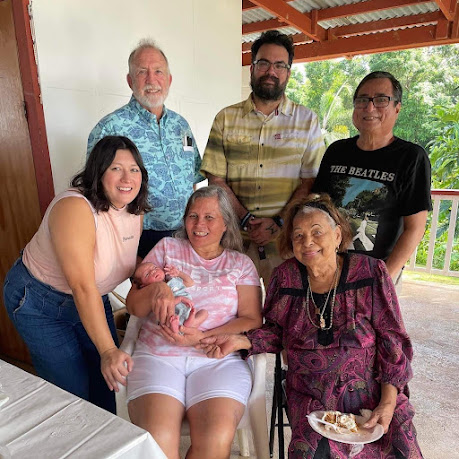
  The grandmother of my partner Desiree, Tan Agnes Duenas Perez (familian Pepero) passed away last month at the age of 92. Her youngest great-grandchild is our daughter Lulai, born just last year. I am so thankful that they got to meet before her passing. I am also glad that I have was able to spend some time with her and listen to her stories. She was just 11 years old when the Japanese invaded Guam. She was the eldest of her siblings and helped care for them during this traumatic time. From her auntie Tan Amanda Guzman Shelton, a pioneering Chamoru nurse she learned some basic skills for helping the sick and the elderly. Soon after the war she married musician Josephat Mauro Perez and began to raise a large family. She spent time in those immediate postwar years helping to start the network of community centers and programs for manåmko’. Her family would become prominent in the village of To’to’ and well known for their musical talents. Tan Agnes had 12 chi...

Early History of the Marianas

Image
I islå-ta siha giya Marianas i fine’nana entre todu i islas Pasifuku ni’ masagåyi. I manmofo’na na mangguelo-ta mantekngo’ put båtko yan i tasi ya maasusuma na manmanaliligao nuebu na lugåt ni’ para u ma sagåyi anai manmåtto mågi.   Annai ma tutuhon i mangguelo-ta manmañaga guini, ma usa todu klåsen rikesa gI isla para u ma få’tinas i ramientan-ñiha para i gualo’ yan peska, yan lokkue’ ma få’tinas åtmas siha para u maprutehi i guinahan-ñiha.   Guihi na tiempo, duru machalapon siha gi todu isla ya maestablisa songsong siha giya interu Marianas.   Yanggen guaha ira komu påkyo pat tiempon fañomak’an guaha na ma dingu i lugåt-ñiha para otro na isla para nengkanno' yan liheng. Mit años tåtte guaha matulaika gi hagas payon-ta, i hinalom fama’åyan yan i acho’ latte.   Uniku i gima’latte giya Marianas tiot guihi na tiempo annai guaha dångkolo na tinilaika yan hinanao taotao.   I latte un simbilon i menhalom-ta. Komo i haligi para gima’ mangguelo-ta, ha repr...

Ancient Chamoru Gender Dynamics

Image
 I recently gave a lecture talking about the Maga'håga spirit and the matrilineal strain that runs through Chamoru culture. In putting it together, I had to scrounge for different quotes from the early accounts of the Spanish, when they encountered Chamorus in the 16th and 17th centuries. It provides a stark contrast in most ways we see gender relations today, but it must have felt nightmarish at times for a Catholic priest of the time. To see women with this much authority over life and over their husbands, I imagine it would have given San Vitores and others plenty a panic attack.  Here are some of the quotes I used in my presentation: *******************   In each family, the head is the father or older relative, but with limited influence. A son, as he grows up, neither fears or respects his father. In the home it is the woman who rules, and her husband does not dare give an order contrary to her wishes, nor punish the children, for she will turn upon him and beat him...

Latte Stone Significance

Image
The  latte  has become a key symbol in expressions of contemporary Chamoru identity and a key means by which they have come to establish a meaningful connection to their ancient ancestors.  Following centuries of colonization, Chamorus had their connection to their ancestors was severely disrupted and felt little intimacy with regards to their ancestors prior to Spanish colonization. They had come to accept that they and much of their culture and beliefs were primitive or savage.  The study of the  latte  and its promotion as a historical artifact in the 20 th century helped create the everyday possibilities for Chamorus to form new positive connections to their ancestors. The  latte  is no longer a discarded remnant from a primitive past, but an icon of ethnic identity, empowerment and sacredness.  As the Chamoru people have undergone significant cultural shifts over the past four centuries, primarily due to colonization, the...

Circumnavigations #3: March 6, 1521

Image
In Magellan's trip across the Pacific, he passed by thousands of islands, the majority of which they did not see. They noticed a few, but they had no resources to offer and only made the voyagers more distressed. Guam and the Marianas were the first landfall they made after months at sea, where many became ill and more than a dozen died. The interactions between Chamorus and Magellan did not go well, and I'll write more about that later. Because of this contact, Magellan's voyage was able to obtain some supplies to help them eventually reach the Philippines less than two weeks later. As a result, hundreds of years later, Guam still has a small, but secure place in the history of European imperialism and the stories of its mastering of the world. One historian refers to this moment as the first taint of civilization, and if you believe in notions of cultural purity than it is easy to understand or accept that thesis. But even from the general ways these moments of first ...

Chachalåni

Image
--> Chachalåni By Jay Baza Pascua Fo’na yan Pontan hu gågaogao hamyo Chachalani i famagu’on-miyu Ginen Pontan na gaige ham guini gi tano’-ta Ma nå’i ham ni tahtaotao-ñiha Fo’na yan Pontan hu gågaogao hamyo Chachalåni i famagu’on-miyu Ginen Fo’na na gaige ham guini gi tano’-ta Ma nå’i ham ni’ lina’la’-ta!

Lukao Fuha 2018

Image

Si Maga'låhi Gadao

Image
This legend of Gådao is an intriguing one. In some ways it fits the mold perfectly for a Chamorro legend. In other ways it feels different, like something borrowed from a Greek legend perhaps. One thing that stands out is the idea of Gådao becoming a Maga'låhi or a king for the entire island. This stands in contrast to much of what we know about ancient Chamorro culture. Where they seemed to be like most indigenous people, where they had a society were power was actively distributed and made diffuse to prevent anyone from dominating too much over others. Although the emphasis on great accomplishments bringing one great social standing feels very appropriate. If I had to guess about the origin of this story, it seems in some way like a legend made by a Chamorro during the Spanish period, meant to reflect the greatness of their ancient past. Gådao existed in some form for sure, and perhaps the legend of him and Malagua'i or Malaguaña is an older form. But this...

Para i Finakpo', i Tinituhun

Image
Thought it would be nice to end the year with a reference to what is considering to be the beginning of the Chamorro people, namely Fouha Bay, where most consider the Chamorro creation story to be set. Here is some information on it, placing it in both a historical and contemporary context and briefly how it connects to an upcoming project my family will be published. ******************* Fouha Bay/Laso' Fouha The Birthplace of Chamorro Civilization There are several creation stories for Chamorros. Some deal with Magellan getting lost, others with Marines hitting beaches, and then there are those which imagine the beginning with snakes tempting fruit aficionados in paradise. One creation story that is achieving more and more prominence is the tale of Fu’una and Puntan, which is partially set in the village of Humatak, and it is also the setting for a comic that I have been working on with my brother Jack as part of our Guam Bus creative plans.  For...

Maisa the Movie

"HITA: Maisa, the Chamoru Girl who saves Guåhan" Trailer 2 from Twiddle Productions Inc. on Vimeo . ************* Buenas yan Hafa Adai, The Guam Department of Education (GDOE), Chamoru Studies Division is inviting you to the premiere showing of    "Maisa, The Chamoru Girl Who Saves Guåhan", an animated movie in the Chamorro language, on Monday December 7, 2015 at the Tango Theater located in the Agana Shopping Center, show time will be at 7:00 p.m.  The film is produced by the GDOE Chamorro Studies and Special Projects Division, and Twiddle Production.  It is 100% federally funded by US Department of Education Consolidated Grant,Title V (Prugråman Giha Mås Mona).  Please call 300-5048 or email to confirm your attendance by 12:00 p.m. on Friday, December 4, 2015. Si Yu'os Ma'ase', Angela F. Weger Administrative Secretary I GDOE  Chamoru Studies & Special Projects Division 192 Dero Road Ordot, Guam 96910 Tel:...

Ancient Chamorro Love Poem

Image
When I hear people discuss nowadays their connections to i manmofo'na or Ancient Chamorros, it is always interesting to see their connections and how they express their similarity, their fidelity or their disaffection. There are things that we can identify as coming from ancient times up until today. Some of them are abstract, coming from the nebulous realm of values and ideas. Others are rooted in the land and those things which remain despite things appearing to be so drastically different.  When people want to draw affinity to those ancient ancestors it is rarely a reciprocal game. People will take up things that fit within their lives today, often times things which are incredibly simple or easy to integrate or provide verbal support for, but actually have little affect on their lives. It is common in all cultures to speak on behalf of our ancestors, to speak to them. But when people praise and pay homage to them it makes me wonder what their responses would be? Would th...

Estorian Taga'

Image
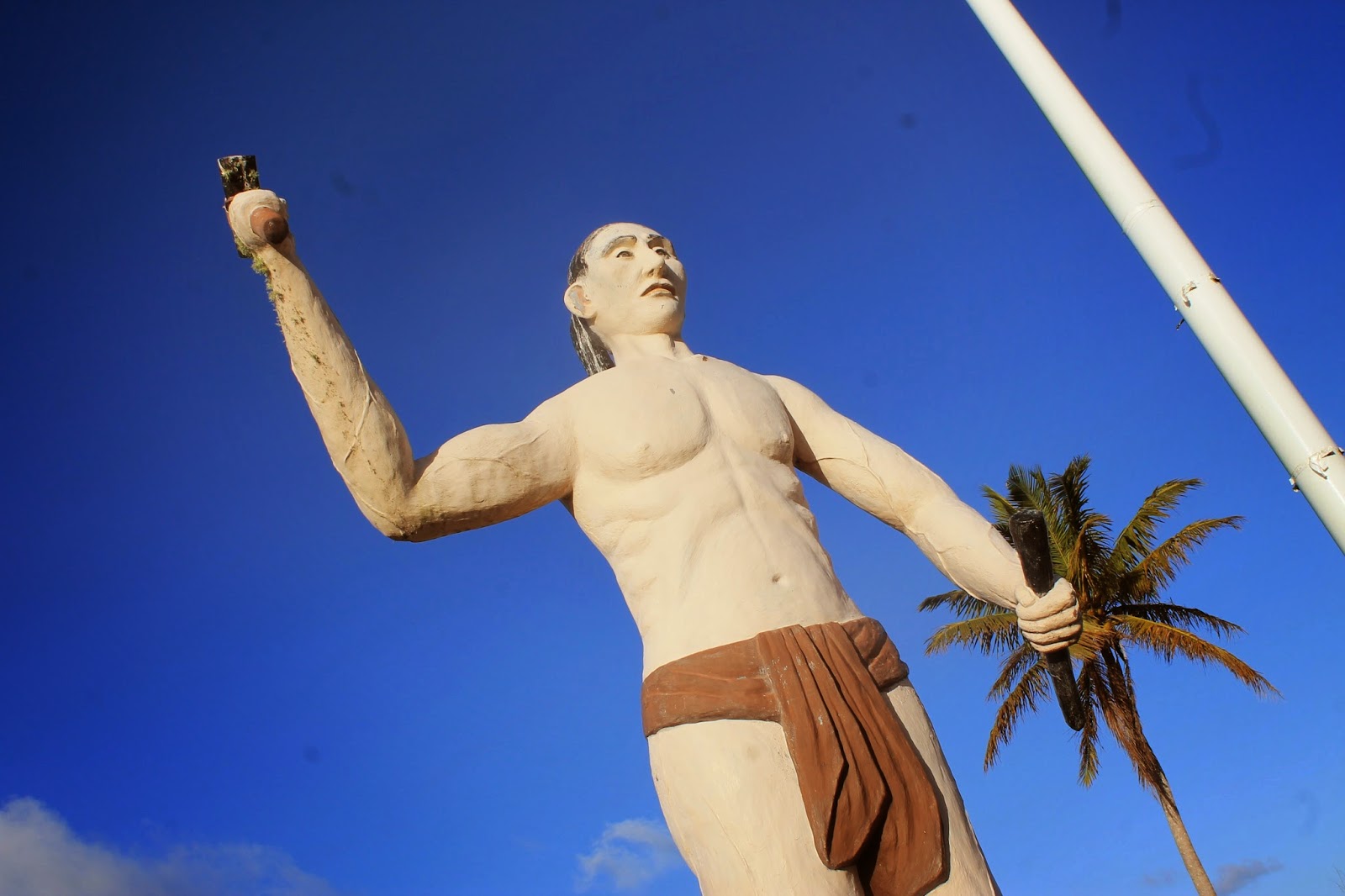
Taga', the Great Maga'lahi of the CNMI and in particular the island of Tinian. He is well-known for the latte house in Tinian that bears his name. In Rota there is a statute of him that stands before the As Nieves quarry there. LIke Gadao in Guam he is a larger than life figure for whom there are many stories and not just the ones that people write on monuments and record in story books. But like so many figures of this type there are those stories that are flattering and those that aren't so flattering. Taga' for example is not only associated with the erecting of great latte houses, but he is also known for being an angry and cruel parent. Take for example the story below from Pedero Ogo in 1962 about Taga'. Ogo is best known for helping Donald Topping and Bernadita Dungca with the creation of the Chamorro-English Dictionary that is widely used today. In this story, Taga' is not a great hero, but a father who sees that his son may surpass him in streng...

Kao Gaige Hamyo?

Image
It is almost time for Chamorro Month. I'm getting in the mood for it by stretching myself too thin with a sakman-load of projects and presentations. I've also spent the day listening to Chamorro music. Not the usual cha cha style, which has its own merits, but the more conscious Chamorro music. There are so many songs out there that for me have a far greater and deeper message than most Chamorros allows themselves to think about. Those are the songs that fill my soul and keep me going. Johnny Sablan has so many of them. The group Chamorro had half an album filled with them. J.D. Crutch has a couple. K.C. Leon Guerrero one or two. One group which isn't as well known as a group, but is comprised of many famous local musicians is Native Sun, which released the CD "New Horizons." Although most of the songs on the CD are in English it has a definite island feel to it.  The song that stuck out the most for me was "Ko Gaige Hamyo?" o...

Mata'pang gui'

Image
Sesso nina'triste yu' ni i estorian Maga'lahi Mata'pang. Matatnga na gerreru gui'. Ha kontra i Espanot ko'lo'lo'na i mamale' anai ti meggai na Chamorro kumokontra. Guihi na tiempo meggai mano'sun nu i inentalo', lao i meggaina manma'a'nao nu i atmas i sindalun Espanot. Tumachu Si Hurao kontra siha gi 1671, lao manguahlo'. Kana' ma ikak i Espanot, lao manggineggue siha ni un pakyo'. Mandinestrosa i gima'Chamorro siha, lao tumotohgue ha' sin danu i gima'yu'us Katoliko. Gi 1672 anai umannok Si Mata'pang gi i estoria-ta, ha na'hasso i taotao na debi di u mana'suha i taotao sanhiyong. Ha puno' Si San Vitores yan i ayudante-na, i halacha na mafa'santo na Tagalog as Pedro Calusnor. Si Mata'pang ha fa'nu'i i tiguang-na siha na ti manyu'us i gilagu, sina mehagga'. Gi minagahet esta i Chamorro ma tungo' este, lao manmaleffanaihon. Gof na'ma'a'se na i hiniyon...

I Kannai ni' Pumoksai

Image
Este i kannai i dos ni' pumoksai yu. Para i manmofo'na na Chamorro siha, i kannai un gof impottante na simbolu put i guinaiya i saina-mu, ko'lo'lo'na i famalao'an na manaina-mu. Anggen matai un sen presisu yan ti tulaikayon na palao'an put hemplo Si Nana'-mu pat i Nanan Biha-mu, siempre para un chule' i te'lang i kannai-na. Para todu i manmatai un chule' i ha'i'guas, sa' ayu i ankla, ayu muna'chechetton i anten-niha para i tano' i familai. Lao para un sen mangge' na palao'an ni' gumu'ot yan fuma'maolek i meggai na patte gi i familia, i mas takhilo' na simbulo i tel'ang kannai.