Posts

Showing posts with the label USS Guam

This Month in Guam History: August

Image
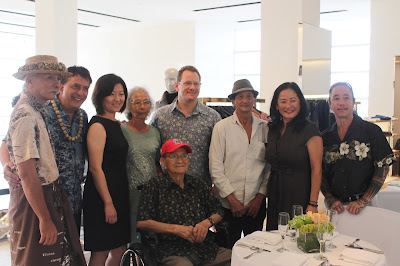
Before we say “Adios” to August, let us look back at this month and how important it has been in the past for Guam, Chamoru and Marianas history. When I first started working as curator at the Guam Museum in 2021, I was given some of the late Tony Palomo’s notes on Guam history. In addition to being a Guam war survivor, an author, a journalist, an elected leader and a historian, Siñot Palomo had worked as the administrator for the Guam Museum towards the end of his life. Part of his duties at the museum was to publish a regular series in the Pacific Daily News highlighting “This Month in Guam History.” It is my honor as the curator of the Guam Museum to continue this tradition. Let’s look at some of the events that happened in Guam and the Marianas in the past during the month of August. ************** 343 years ago: In August 1681, Don Antonio de Saravia was appointed governor of the Marianas, and during the following month, he appointed Chamorus to the positions of assi...
Kiko Zoilo

Image
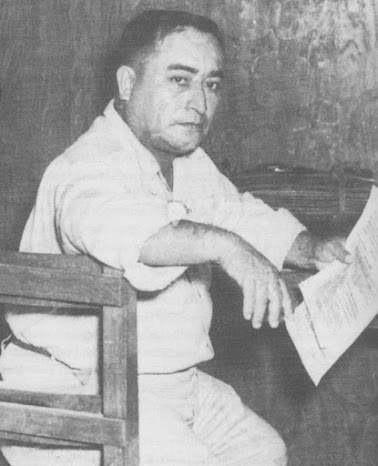
One of the most fascinating figures from 20th century Guam History for me remains Francisco Baza Leon Guerrero or Kiko Zoilo. One day I hope to write something or create something that can show the breadth of his accomplishments and advocacy, at a time when most Chamorus did not feel comfort being critical about the US as their colonizer. He was a political figure before and after the war. One of the founders of the Young Mens League of Guam. The Father or the Organic Act and even a Speaker of the Guam Legislature.  For Independent GuÃ¥han, I prepared some quotes from him and about him, that were used when we honored him as Maga'taotao for one of our General Assemblies. I wanted to share them here, for those looking for a place to start in understanding this important figure (that is largely unknown for most people today). ****************   “He was a great believed in the democratic way of life and freedom of action. He wouldn’t kowtow to anyone, no matter what ...

For the Love of Language

Image
When San Vitores first came to the Marianas the Chamoru people were largely accepting of the new religion for a few reasons. The Spanish offered gifts to those who converted to the new religion, including sometimes precious  lulok or metal. They were the newest hottest thing on the island. Exciting simply because it was different, like when Applebee's or McDonald's first came to Guam. Some converted seeing the chance for greater power by being closer to those that they perceived might shake up island hierarchies. Some may have followed the new religion, because it truly spoke to them.  But one of the things that helped San Vitores win over the people in many ways was his ability to speak to them in Chamoru. Chamorus had interacted with Europeans for more than a century at that point via hand gestures and sailors from the Philippines and Southeast Asia who were able to communicate using Austronesian terms with the Chamorus they encountered. Spaniards, Filipinos and African slav...

Mensåhi Ginen i Gehilo' #25: Hagåtña, 1899

Image
I'm working on an exhibit for Humanities Guåhan, and its put me back into researcher/scholar mode. I've been pouring through books and reports for the past week looking for various bits and pieces of information. Part of this meant re-reading some books and archival documents I hadn't touched in over a decade. Given the way in which conversations over decolonization and self-government have begun to take on a new character lately, I was particularly attracted to passages that can help me or others reflect on our development over time, how far Chamorros and Guam may have come, or haven't, especially in the context of their political connection to the US. There are many ways that we can say that Guam has changed over the past 500 years or over the past 100 years. As we remain in the era of American colonialism, I am mostly concerned with the impact of the US and its policies. As I have written about in a variety of ways, these changes are tangible and very real, but a...

Mensahi Ginen i Gehilo' #22: Biba UOG Press!

Image
After World War II, Chamorros launched into a period of aggressive Americanization, which you could argue is still going on until today. This Americanization had many levels and dimensions to it. There were clear desires amongst most Chamorros take on the material and consumer comforts America seemed to offer. There were also clear moves by some to ensure that there children were properly or at least passably Americanized, most notably through the refusal to use the Chamorro language with them. There were frameworks of economic, social and political dependency that were created and eventually celebrated by Chamorros themselves. There were also dramatic shifts in lifestyle due to land loss and trauma from the war, which made things such as cultural maintenance difficult because occupations and life-ways were changing so quickly. Alot of these shifts could not be helped, but simply came about because the US is so much larger than Guam, and it produces ideological content and material...

Tinige'-hu put si Grandpa

Image
This article about my grandfather, the Chamorro Master Blacksmith Joaquin Flores Lujan or "Tun Jack" was first published in the Pacific Daily News on October 14 and October 21, 2016. I have been missing my grandparents like crazy since they passed away in 2013 and 2015, and sometimes only writing about them can help me overcome the sadness I feel.  December is always difficult, as this is the month that grandma, Elizabeth Flores Lujan, passed away three years ago. This is also a difficult month emotionally because of all the family emphasis and for Chamorros, the fact that December 8th represents when our elders, i mamparientes-ta, i manamko'-ta, were swallowed into the beast of a great war.  I keep writing about my grandparents because I find myself remembering things that I struggle with at other times. It don't know why that is the case, perhaps it is because I feel more secure in the fact that as I am writing/typing, I am keeping their stories live. Kee...

Hami, i Taotao

Image
Hami, i Taotao Guahan by Michael Lujan Bevacqua The Marianas Variety July 29, 2015   On December 17 th , 1901 a group of more than thirty men, primarily Chamorros gathered in Hagatna. Most prominent on their minds was the political status of their island Guam, which had been taken by the United States during the Spanish American War three years earlier. Since the transfer of power, confusion over Guam’s future hung like dark foreboding clouds. Although the American flag flew over Guam, the United States had not set up a government in which Chamorros would now enjoy the glories of American democracy. They had established a military regime which the US Navy total control over the lives and lands of Chamorros. The group that gathered in HagÃ¥tña represented some of the largest landholders, the wealthiest families and some of the most educated Chamorros of the day. They carried last names familiar to us today, such as Perez, Torres, Dungca, Quitugua, Mart...

Anai Kahulo' yu' gi Batko

Image
I worked last year on a project for the Guam Humanities Council titled Sindalu: Chamorro Journey Stories in the US Military, and that topped off more than a decade of doing research and speaking and writing about the effects of militarization on Chamorros and their lands, and also about the central place that militarism as an ideology has in contemporary Chamorro life. This is why Guam is referred to as "the tip of the spear," and why it has been given a number of other nicknames over the years, such as USS Guam, Unsinkable Aircraft Carrier. It is why Liberation Day is the largest holiday on the island each year. It is why Chamorros are thought of as superpatriots sometimes, internally and externally, and why a documentary came out recently titled "Island of Warriors." This is also why Guam has been in the past 2/3 military bases and is today almost 1/3 military bases. This militarized core is understandable given Guam's history. When we look at the past. Wh...

Rudof Agaga' Gui'eng-na

Image
I didn’t grow up singing any Chamorro Christmas songs. There was little to no Chamorro in my house growing up in Mangilao. We celebrated Christmas, but didn’t do it in the way that many Chamorros do it. Where it involves a bilen, the creation of a nativity scene, the making of bunelos dagu, or the singing of Chamorro Christmas songs, the majority of which are Catholic in nature. So learning about Chamorro Christmas experiences, the stereotypical, more general kind is bewildering in a way. I am coming into traditions that people who sometimes know far less Chamorro language than I do and much much less Chamorro knowledge or history than I do, know more intimately than I do. To them these experiences are commonplace, are normal, are kind of boring. For me they are interesting. While for most of my students the idea of gathering material for a bilen is irritating and frustrating, it is intriguing to me. Something I would like to do one day, not because of any affec...