Posts

Showing posts with the label CNMI

Chamoru Repatriation News

Image
Since I began working at the Guam Museum, repatriation of human remains, of artifacts, or cultural materials, has gone from being something that was just on a list of things that indigenous people struggle with in general, to something that is literally part of my job description.  For those unfamiliar with the term, since it can be used in different contexts, repatriation as I'm thinking of it here means the return of cultural properties, ancestral remains to their countries, their peoples, usually from museums, universities or other institutions. As the curation for the Guam Museum, part of what I do deal with seeking possibilities for repatriation of Chamoru artifacts and ancestral remains. Whether they have been taken away a few years ago or decades ago for research or some other reason.  (Rematriation is something I'll have to get into on another post. Less discussed, but critically important as we see the returning of artifacts, as less the end of a process, but an impor...

Right to Democracy and Right to Self-Determine

Image
In my life I have attended a number of events, whether in person or virtually, where representatives were gathered in solidarity from each of the current US territories. But in these spaces, there was usually just a single representative from different territories, owing to the distances or difficulties in physically bringing together people Guam, the CNMI, the US Virgin Islands, Puerto Rico and American Samoa. One thing that made the recent Right to Democracy summit different for me, was the amount of people in attendance representing each of the territories, and how each community wasn’t reduced to a single voice, a single soundbite or a short presentation. The experiences of those in the current US territories was not on the fringes or the margins, which is the norm, but instead we were all centered. This summit focused on developing a network across the territories, with the aim of helping to dismantle US colonialism, created a lot more possibilities than usual and that was exc...

Bokkonggo

Image
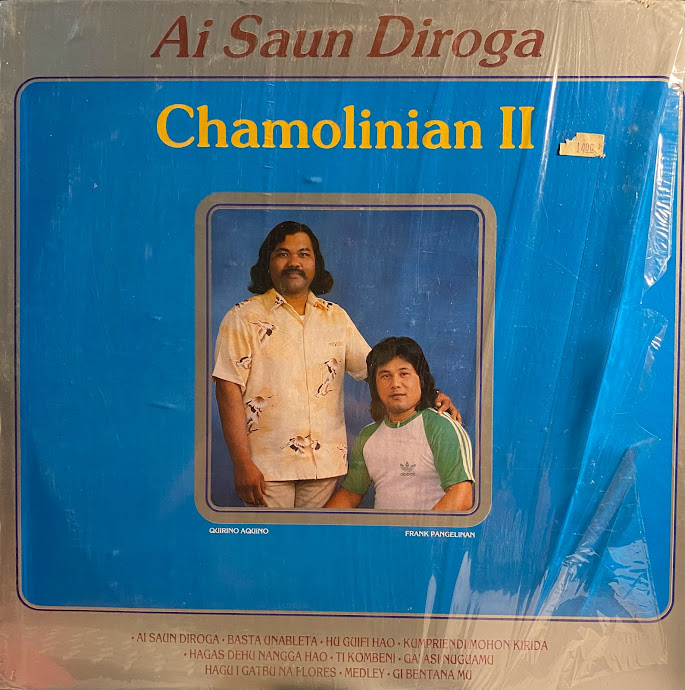
Ever since I first began learning Chamoru my interest in Chamoru music has continually grown.  I grew up sometimes hearing Chamoru music, but couldn't understand it and didn't really connect with it.  But from the first time that I sat down with my grandmother at the dining room table and had her help me translate the CD "Chamorro Yu'" from Johnny Sablan, kinenne' yu'. I have been hooked.  To this end I have been collecting Chamoru music, whether in CD, cassette or vinyl form.  I've collected whatever I can from newspapers, magazines and scholarly sources related to Chamoru music.   I have also been fortunate enough to sit down with many musicians and talk to them about their experiences and why in a world where English dominates, they chose to record and release music in Chamoru. Last month I was very very luck, gof suettettette, to be able to pick up the album "Ai Saun Diroga" by Chamolinian II while searching for Chamoru music online.   Fr...

Yo'Ã¥mti Donald Mendiola

Image
 This coming week's episode of Fanachu! will feature an interview with Saina Donald Mendiola, a yo'Ã¥mti and CNMI Cultural Icon. I'm excited about this episode, where I'll get to learn more about Saina Donald's journey to becoming a healer, and also the recent recognition he has received in both Guam and the CNMI for his work in the community and in schools. Below is an article from June in the CNMI. ******************** Senate resolution honors traditional healer, educator  by K-Andrea Evarose Limol Jun 21, 2022 Updated Jun 21, 2022 Marianas Variety THE Senate on Friday unanimously adopted a resolution honoring traditional healer and educator Donald Benavente Mendiola. Authored by Sen. Edith Deleon Guerrero, S.R. 22-24 acknowledges and honors Mendiola for his long-lasting contributions to the CNMI. Mendiola has been practicing Chamorro medicine for around 47 years. He was 8 when he began navigating the practice of being a “suruhuÃ¥nu” or “yo’Ã¥mti” under his ...

Lemmai Sustainability

Image
  For Immediate Release October 7, 2020   SENATOR MARSH (TAITANO) CONTINUES HER CRUCIAL CONVERSATION SERIES, BREADFRUIT  AS A MEANS FOR FOOD SUSTAINABILITY AND SECURITY Senator Kelly Marsh (Taitano) authored a bi-partisan supported bill to capitalize on Guam’s lengthy history of reciprocal intraregional relationships which have been part of the region’s traditional approach to surviving and thriving within the Mariana Islands, Southeast Asia, and Micronesia. Her bill would develop a Guam Intraregional Commerce Commission, which will spearhead efforts to strengthen regional resiliency and rebuild and re-envision our economy in the face of the current global pandemic era.  With this focus on the need for greater regional economic collaboration in mind, Senator Marsh (Taitano) this Friday continues her Crucial Conversation Series, highlighting ways that we can build more sustainable industries while preserving our environment and culture. This week’s episode will d...

The Colonial Whisperer

Image
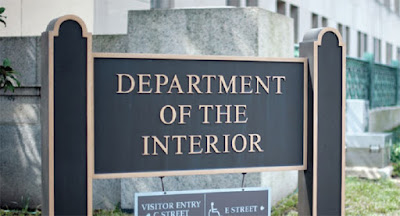
When I was writing my dissertation more than 10 years ago, one question that I constantly had, was what is the "Department of Interior" in the United States, especially in relation to the territories. The easy answer is that it is the office to oversees them. It is the office that oversees the natural resource, the parks, the relations with Native Americans, but also the way the US connects to its insular areas and colonies. We can refer to the Department of the Interior as the make-shift colonial office, a colonial office in denial that it is a colonial office. The office manages resources and helps to remind those of us who live in the territories that we are a resource, that our lands, our lives are more explicitly than any other place within the US and its empire, thought of as a commodity. The fact that our strongest link to the federal bureaucracy is the DOI is key in understanding our relationship to the US. We may have a variety of fantasies about what we are to ...

Water from the Stone of CNMI Sovereignty

Image
Next month I'll be back in Washington D.C. to resume my research about federal territorial relations that I began last year. Much of my focus last year was on Guam and its commonwealth movement, but as I conducted interviews and sifted through files, I also found more and more references to the commonwealth of the CNMI as well and found its evolution and devolution to be even more fascinating. Even just the contrast of reading about what has taken place there for the past few decades in federal documents versus local government is striking. Take for example when a number of sovereignty provisions that had been negotiated through the commonwealth were lost about ten years ago. This process was referred to the in CNMI as a "federalization," akin to a takeover by the federal government. Within the federal government however it was referred to as as normalizing of a relationship, whereby those provisions were considered to be only temporary and would eventually be done away...