Posts

Showing posts with the label Umamerikanu

How to Save a Language

Image
Years ago I was teaching a series of basic Chamoru language classes for The Hurao School, what they call Eskuelan MaƱaina. These are the classes that are required for parents of children in the Hurao after school, summer camp and now charter school. They have taken on different forms, and sometimes are attended by dozens of people, sometimes a handful of people. They goal has always been to encourage the parents of children in Hurao's programs to learn and use more Chamoru, to support their children who are also learning. It is one of the sad realities, that some children have been stunted in their language growth because after being immersed in Chamoru at Hurao, they return home and then are surrounded by English.  Nowadays these classes are much more organized and sometimes are divided into different levels of learners, but when I was teaching some of them, it was everyone, fluent, not yet fluent, elders, all mixed together. Sometimes we were able to focus on lessons, drills, act...

Diasporic Projections

Image
The term Diaspora can be tricky, even if it is something that I use regularly and work with and around regularly, even more so during the pandemic.  The Chamoru diaspora used to be a divide. A fairly sharp divide where Chamorus on the island side were fundamentally different than those who were from the stateside. It would come about in an avalanche of anecdotes that could be heard from both ends of the Pacific. Chamorus in the states would complain that Chamorus on Guam were too backward thinking and stuck, not progressing and not advancing. Despite often very similar problems in their own areas in the US, they would speak about things like government corruption or inefficiency as if they were Guam-brand products and certainly didn't exist in the land of Olive Gardens and Costcos.  Chamorus from the island would speak about those from the states as if there had never been a tribe of people more stuck up and full of themselves. For everything back home, there were stories abou...

Happy US Imperialism Day (Ta'lo) (Ta'lo) (Ta'lo)

Image
Since 2003 I have had a number of uneven traditions associated with this blog. Many of these have dissipated as I have used this blog less and less, but a few I have continued to hold on to. One of the longest held traditions is "Happy US Imperialism Day!" It started as a thinking piece while I was working on my Master's Thesis in Micronesian Studies at the University of Guam. I had spent a few years reading as much as I could about Guam History. I had interviewed hundreds of elders born prior to World War II, who had experienced Japanese occupation. I had even begun working for Puerto Rican filmmaker Frances Negron-Muntaner on a documentary that would later become War for Guam. I was also spending time with activists of every stripe on Guam, trying to talk to anyone who I could find who had long been critical of the things I was just starting to learn about the historical and contemporary realities of the Chamoru people.  I was encountering the history and the present of...

Many Nenis

Image
For the past few months my Saturday morning Chamoru coffee shop classes have been structured around two activities. Each class begins with the translation of a Chamoru song into English. Usually the students get to the pick the particular song, or at least the type of song. Second, we go through a longer narrative, sometimes a story, a speech or a poem in Chamoru and also spend time translating it and practicing reading it. As a result of this, I've been translating lots of Chamoru songs lately. When I first started learning Chamoru, gi minagahet, I was terrible at transcribing Chamoru songs. I hadn't grown up with the ear for hearing or catching Chamoru and so my transcriptions of songs were often wildly inaccurate. For the first few years I had people both politely and impolitely correct my attempts at transcription and then translation. My ear for Chamoru has gotten better, but I still struggle sometimes with particular artists who may have their own flair for pronunciat...

Media Resolutions for 2018

Image
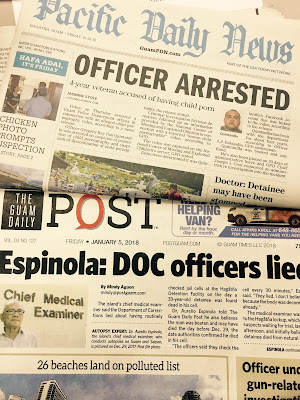
Media Shouldn't Defend Colonial Status Quoby Michael Lujan Bevacqua January 5, 2018 Pacific Daily News As we crawl out of the dumpster fire that was 2017 for much of the United States and its territories, we inch cautiously into 2018 and hope for the best.  As someone who has been working over the past few years to elevate the community consciousness about decolonization,  I am most interested in what the coming elections and federal cases will bring in terms of changing the island’s political status. What occupies my thought process is the role of the media in helping build that consciousness or impede it. The media institutions in any society don’t just exist to report or investigate. These institutions also, often in less perceptible ways, promote values and norms, usually on behalf of elite segments of society. In a colonial context, these roles gain a colonial dimension. Both institutions and individuals often will be compelled to defend and natur...

MƄnu i Mas Ya-mu na KƄntan Chamorro?

Image
My Pacific Daily News columns from the past two weeks focused on Chamorro music and how to determine what makes a great Chamorro song. It didn't pick any favorite Chamorro song, but it was fun thinking about the issues and how one might go about it. Here are the two columns. ******************* The decades since World War II have brought a great number of changes to Chamorro culture and Chamorro life. Practices and trades once considered essential to life have disappeared or been adapted to societal and technological changes. The decline of the Chamorro language is one of the clearest ways you can perceive these changes. But there is one way in which the Chamorro language, even as it was banned in schools and not taught to children in many homes, remained alive and well, and that was in Chamorro music. During a time of rapid Americanization, where Chamorros were actively giving up and tossing away things that had once defined them proudly as Chamorro...

Mensahi Ginen i Gehilo' #22: Biba UOG Press!

Image
After World War II, Chamorros launched into a period of aggressive Americanization, which you could argue is still going on until today. This Americanization had many levels and dimensions to it. There were clear desires amongst most Chamorros take on the material and consumer comforts America seemed to offer. There were also clear moves by some to ensure that there children were properly or at least passably Americanized, most notably through the refusal to use the Chamorro language with them. There were frameworks of economic, social and political dependency that were created and eventually celebrated by Chamorros themselves. There were also dramatic shifts in lifestyle due to land loss and trauma from the war, which made things such as cultural maintenance difficult because occupations and life-ways were changing so quickly. Alot of these shifts could not be helped, but simply came about because the US is so much larger than Guam, and it produces ideological content and material...

Mensahi Ginen i Gehilo' #20: Independence Daze

Image
It is intriguing the way that so many people assume something to be impossible and frightening in a particularly local or familiar context, but then completely miss the way that they accept such things in other contexts without even a hint of fear or apprehension. In Guam, a colony of the US for more than a century, and a colony of Spain for several centuries prior to that, this is frustratingly true and real in terms of the people of the island, both indigenous and non-indigenous, living in terror of Guam becoming independent. For other nations and other locations, independence is something to celebrate, a key moment in terms of a nation's development or evolution, something to look back on pride, even if your country has serious problems past or present. But it is intriguing how for example, Filipinos, Chinese or Koreans and others on Guam can celebrate the nationhood and the independence of their own nations, whether it be from colonialism, from imperialism or from their own s...

Setbisio Para i Publiko #32: Isao-hu Magahet Hunggan

Image
If you were to ask me what type of music is my favorite, I will always say Chamorro music. It isn't really that I like every single Chamorro song, but I will purchase every single Chamorro CD or record I can get my hands on, in order to support one of the main ways that the Chamorro language persisted even during the generations which were quietly trying to silence it by not teaching it to their children. Chamorro musicians deserve far more support and credit than most people give them. They are, within recent Chamorro history, the ones who played the most significant, but unheralded role in keeping the language spoken and alive. While most families did not speak it to their children, collections of singers decided to keep using the language to make music, despite immense pressure to simply sing in English and Americanize the way everything else seemed to be going. Within that collection of musicians a few names stand out more than others. There are those who had their names on t...