Posts

Showing posts with the label Dandan

Unboxing Chamoru Cassette Tapes from Siñot Joe Taimanglo

Image
One of the most exciting gifts that I received last year, right in time for Christmas was from longtime singer and musician Joe Taimanglo. He sent me a box filled with Chamoru music lyrics books and tapes, since as the curator for the Guam Museum I am always interested in collecting, preserving and then educating about things from our past, but also as the producer for the Fanachu podcast, we've been digitizing and collecting Chamoru music for several years now. To date we've uploaded more than 400 songs to the Fanachu YouTube page .  I've had Siñot Taimanglo on the Fanachu podcast twice as a guest where he has been such a wealth of information on the history of contemporary Chamoru music. He keeps lists of Chamoru musicians, sometimes shares Chamoru music on his social media, still performs, and also writes posts remembering Chamoru and Guam-based musicians who have passed away.    Sumåhi filmed and edited a video of me unboxing this special box from Siñot Joe, filled wi...

Miget's Chamoru Vinyl Collection

Image
After my third child Lulai was born in 2021, I had a month of paternity leave from working at the Guam Museum.  During this time, I would usually take Lulai at night for around four or five hours, to give her mother Desiree a chance to sleep or relax or do anything undisturbed for a while.  I would sing to her, rock her, hold her while she slept. It gave me time to think, to reflect, to watch things, to read. One of the things that I thought alot about at the time was Chamoru music and its future.  I never really made the jump to digital music platforms like Spotify, but I do listen to music on YouTube.  While I would be watching Lulai I would want to sing to her different Chamoru songs and I would look for them on YouTube and not be able to find the songs. I was frustrated because I had the songs on tapes or on CDs or on vinyl records, but my hands were full with a child, or the physical copies were packed away in boxes in storage somewhere and it would take forever...

Adios Tun Candy

Image
  In June of last year, the Marianas lost one of its most influential musical pioneers with the passing of Tun Candido “Candy” Babauta Taman. Over the years, I had the honor and privilege of working with Tun Candy on several projects, conduct interviews of him and sometimes just sit and chat and listen to him tell stories. Each year, I usually got a call from him in late November or December, checking in with me and letting me know how he is doing. If he had some of his music or CDs to sell, he would also let me know that they would make great Christmas gifts. When he called in late 2022, I eagerly bought a copy of everything he was selling and gave them as gifts to different friends. Tun Candy was born to a CHamoru mother from Sumay, Guam and a Carolinian father from Saipan with roots in Chuuk. Across his life he worked to promote and develop a Marianas musical sound as well as cultural consciousness. Because of the way his roots, his heritage represented ...

Sounds both Old and New

Image
Sunidu Pasifika was formed prior to the 12th Festival of Pacific Arts (FESTPAC) held in Guam in 2016 to help teach the making and playing of the belembaotuyan to future generations. The group performed as part of the two-week festivities, including a rendition of “Fanohge CHamoru.”    Sunidu Pasifika was led by Delores Taitano Quinata, who was the last apprentice of Master of CHamoru Culture for the belembaotuyan, Jesus Crisostomo. She was assisted by musicians Ruby Santos and Jesse Bais, as well as her husband Joe Quinata from the Guam Preservation Trust.    Many of the members of Sunidu Pasifika were CHamoru language and culture teachers in Guam’s public schools, who learned how to make and play the belembaotuyan with the hopes of bringing this knowledge into their classrooms.   I look forward to hearing more of the belembaotuyan around the island, especially in schools. I wish some younger Chamoru musicians would take the sound and auto-tune it or find ways t...

The Sound of Silencing

Image
In the 20th century, the fate of the Chamoru language depended heavily on the development of a contemporary Chamoru music industry. This is something that is scarcely discussed both in historical terms, but sadly even less so in terms of what it may take to revitalize or sustain the language in the future.   As the Chamoru language was rapidly losing relevance in society following World War II, with the language being used less and less, especially among younger generations, the creation of Chamoru music was essential in creating new and contemporary possibility for the language. It wouldn't be chained to the past, something to just disappear and fade away. It was something tied to the current moment, something that could gain new sounds and new life.   But with the decline of Chamoru music in the past two decades, as fewer and fewer artists are releasing songs or albums in the Chamoru language, means that this source of vitality has disappeared as well. Compared to ...

Dalai Nene

Image
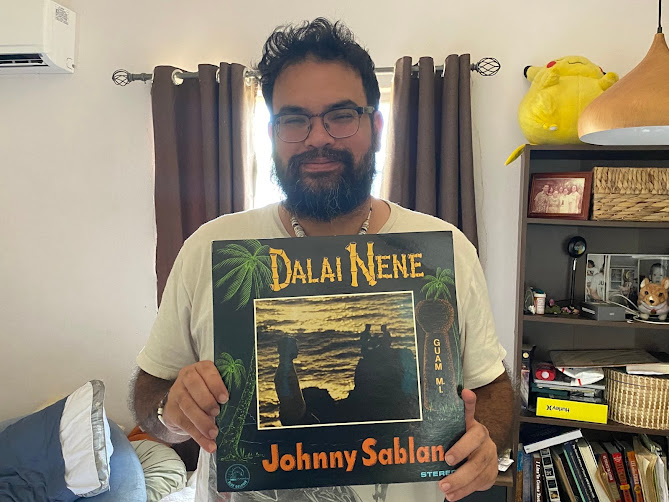
I have for several years now been collecting plåkan Chamoru or Chamoru vinyl albums.  Each week I scour the internet searching for records I haven't seen or heard yet.  Every few months I'm able to find a new one to fill in the gaps in my collection.  I have over the past few years been able to find four copies of this album "Dalai Nene" released by Johnny Sablan in 1968. This was the first ever Chamoru language music album and was released when Johnny Sablan was just 20 years old.  I have collected four in all, one for each of my kids (three are already here, one more is a few months out from when I am typing this).  Each will inherit one of them when I pass away.  This album is historic in so many ways, but one thing for me makes it even more unique and special, namely its use of Chamoru for its text.  There are hundreds of Chamoru albums that have been released on vinyl, cassette and CDs. And while all used Chamoru as the primary language for their ...

Kalang Hao Paluma

Image
Ti ya-hu i mubi Operation Christmas Drop. Ti ya-hu i estoria.  Ti ya-hu na ha fatta i militåt.  Lao ya-hu na manannok i tano'-ta gi i mubi. Ya guaha taotao-ta lokkue' mana'annok gi mubi. Ya gof ya-hu na este na kånta mana'saosaonao gi i soundtrack para i mubi. Kada såkkan, hu usa este gi klas-hu Fino' Chamoru gi zoom. ******************* PALUMA The Dolls (Operation Christmas Drop Soundtrack)   Kalang hao paluma Na ti siña hu go’te Måtto hao mambisita An manengheng i puengi Pues gumupu hao gi langhet   You are like a bird That I can’t hold on to You came for a visit When the night was cold And then you flew up to the sky   An umali’e’ hit ta’lo Yan parehu i puti’on Yan hu li’e’ i matå-mu Para ta aguaiya ta’lo   If we meet again And the stars are the same And I see your face We will love each other again   Hu hasso i kulot I paopao-mu Kalang i isa Yan i pao-ña i aire Yan i sinienten i korason-hu...

Bokkonggo

Image
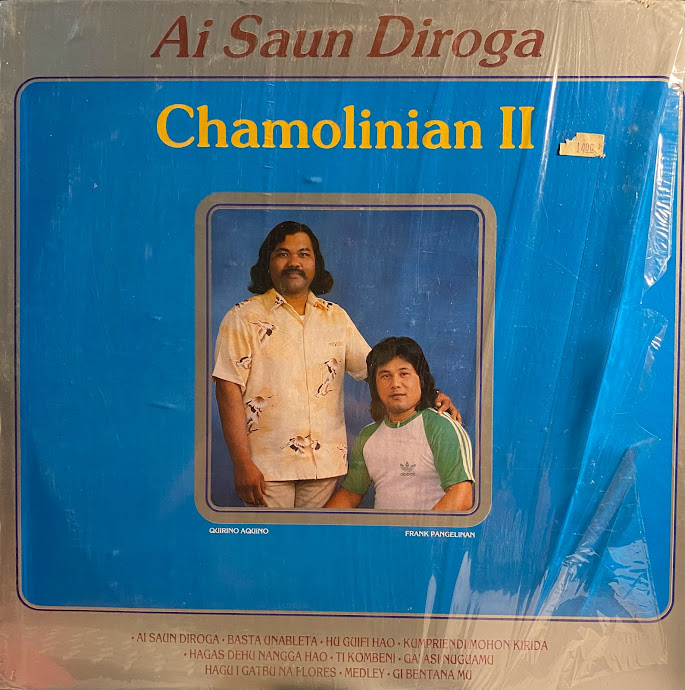
Ever since I first began learning Chamoru my interest in Chamoru music has continually grown.  I grew up sometimes hearing Chamoru music, but couldn't understand it and didn't really connect with it.  But from the first time that I sat down with my grandmother at the dining room table and had her help me translate the CD "Chamorro Yu'" from Johnny Sablan, kinenne' yu'. I have been hooked.  To this end I have been collecting Chamoru music, whether in CD, cassette or vinyl form.  I've collected whatever I can from newspapers, magazines and scholarly sources related to Chamoru music.   I have also been fortunate enough to sit down with many musicians and talk to them about their experiences and why in a world where English dominates, they chose to record and release music in Chamoru. Last month I was very very luck, gof suettettette, to be able to pick up the album "Ai Saun Diroga" by Chamolinian II while searching for Chamoru music online.   Fr...

The Importance of Chamoru Music

Image
In recent years my research and scholarly work has become heavily focused on Chamoru music.  Part of this stems from the fact that my own journey in starting to learn the Chamoru language, more than 20 years ago, was heavily aided by Chamoru music, listening to songs and trying to translate songs with my grandmother.  Party of it also stems from the fact that when you go through Guam's history, even from the perspective of outsiders, music was an essential part of life, and one of the most important ways that Chamorus expressed themselves. This is something that the Spanish smartly focused on in their colonization of the Chamoru people in the 17th century. Using Chamoru and focusing on teaching the new religion through songs. Here is an account from Le Gobien in 1700, At first the natives shyly held back upon the arrival of the ships and did not want to come aboard. San Vitores, however, encouraged them to sing the litany of the Virgin and soon they approached...

Na'lå'la' Songs of Freedom Vol 4

Image
In light of COVID-19, Independent Guåhan moves their annual Na’lå’la’ concert on air and online this Saturday on KUAM For Immediate Release, July 8, 2020 –  Since 2017, each July Independent Guåhan has hosted a free concert,  “Na’lå’la’: Songs of Freedom.” This event is a chance for the community to connect to conscious and empowering messages for social change and decolonization through music, poetry, art and dance. Due to the COVID-19 pandemic and the need to social distance, this year’s concert is going online and on-air.  Independent Guåhan invites the community to tune in Saturday, July 11 th  from 7 to 10 pm on KUAM TV 8 for “Na’lå’la’: Songs of Freedom Vol. 4.” The concert will also be livestreamed on KUAM News’ Facebook page. The concert is held each year close to the Fourth of July or Independence Day in hopes of opening up the holiday up to a new more locally focused interpretation. Independent Guåhan encouraged the island as a whole and beyond t...

Litråton Na'lå'la' Vol. 3 Siha

Image

Na'lå'la' Songs of Freedom Vol. 3

Image
Share Your Vision of Guåhan’s Future at Independent Guåhan’s “Na’lå’la’: Songs of Freedom Vol. 3” Concert on July 4 th .  For Immediate Release, June 21, 2019 –  Each July 4 th  the island commemorates the Independence Day of the United States, despite the fact that Guåhan remains its colony. For the past two years Independent Guåhan (IG) has organized an annual concert on the Fourth of July to reflect on the colonial history of Guåhan and the need for a decolonized future. IG is proud to announce its third concert, “Na’lå’la’: Songs of Freedom Vol. 3” set to take place Thursday, July 4 th  from 4-7 pm in the front field at Adelup. This event is free and open to the public.  Independent Guåhan is an organization that is committed to educating the island community about the importance of Guåhan’s decolonization and the possibilities should it become an independent country. The organization has spent the past three years organizing General Assemblies, v...