Posts

Showing posts with the label Bilen

The Bevacqua Bilen

Image
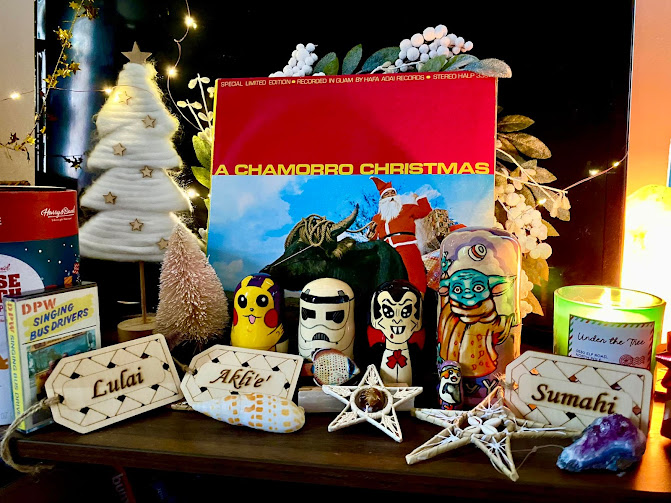
  As is the tradition for the Guam Bevacqua family, we put together our family bilen this month.    Each member of the family gets their own figure in the bilen representing them.    This year’s bilen is different however, since part of my gifts for everyone was to get Desiree, SumÃ¥hi, Akli’e’ and Chuguangguang (Lulai) each a nesting doll.    Each was made in Ukraine and was purchased to support Ukrainian small businesses and artists.    SumÃ¥hi is the Pokémon, Akli’e’ is the Star Wars, Desiree is the Dracula and Chuguangguang is the Neni na Yoda.    I forgot to buy one for myself though, so I chose the cassette tape for the Chamoru album by the DPW Singing Bus Drivers to represent me.    The background for our family bilen is the two disc vinyl album from Johnny Sablan “A Chamorro Christmas.”    Si Yu’os Ma’Ã¥se to Lulai’s nina Isa for the wooden name tags that came with our gifts this year.    The bilen...

Chamorro Press Releases

Image
I felt like I've written a hundred press releases this year, most of them for the Independence for Guåhan Task Force, but plenty of others for the Chamorro Studies Program at UOG. I've been meaning to post them here just to easily archive them, especially for when I apply for promotion to UOG in the coming year. It is intriguing, because what made me think of this tonight, was a column written today by Paul Zerzan in the Guam Daily Post. It discusses how the Chamorro language is a dead language. It isn't very well-written and its argument is incredibly poor on almost all possible levels. Part of it hinges on him describing an anecdote whereby a Chamorro cultural event planned in 1993 was attended by only himself, therefore clearly proving the language being dead. What struck me as bewildering about this particular portion of his argument, was that on a regular basis I attend and organize (ko'lo'lo'ña gi UOG) Chamorro events that hundreds of people att...

Rudof Agaga' Gui'eng-na

Image
I didn’t grow up singing any Chamorro Christmas songs. There was little to no Chamorro in my house growing up in Mangilao. We celebrated Christmas, but didn’t do it in the way that many Chamorros do it. Where it involves a bilen, the creation of a nativity scene, the making of bunelos dagu, or the singing of Chamorro Christmas songs, the majority of which are Catholic in nature. So learning about Chamorro Christmas experiences, the stereotypical, more general kind is bewildering in a way. I am coming into traditions that people who sometimes know far less Chamorro language than I do and much much less Chamorro knowledge or history than I do, know more intimately than I do. To them these experiences are commonplace, are normal, are kind of boring. For me they are interesting. While for most of my students the idea of gathering material for a bilen is irritating and frustrating, it is intriguing to me. Something I would like to do one day, not because of any affec...

Puengen Minagof Noche Buena

Image

Iya Belen

Image
--> Tonight the Chamorro Studies Program through the wonderful work of the Chamorro language instructors at UOG held Puengen Minagof Nochebuena, a night for celebrating Chamorro language and culture in the context of Christmas. The event was a great success, with over 250 community members showing up to see the bilens made by Chamorro classes, to sing along to Chamorro Christmas songs and to taste a dozen different kinds of bonelos. Chamorro language is the most popular language course at the University of Guam. Far more students take it than take Japanese a language that everyone feels has more economic value. But even though it is the most popular language and so many students and community members expect that UOG be a place where the language can be learned and preserved, there is currently no tenured full time faculty who teaches Chamorro. The same goes for the new Chamorro Studies program, which is already doing great work both on campus and off, but has no facu...

Okinawa Independence #9: Revitalizing > Preserving > Promoting

Image
My previous trips to Okinawa revolved around demilitarism and decolonization in a political sense. This trip, because of my participation in the Island Language Revitalization Symposium at Ryukyu University was focused on decolonization with regards to the language in Okinawa. As people have asked me about my trip to Okinawa and what it was like I have developed a sort of easy to use, easy to understand narrative that I rely upon. Most think of Okinawa and Guam as places that are linked only through the presence of US military bases. Chamorros from Guam know Okinawa primarily through the imaginary of the military, as a place where they once lived, trained or heard stories of how the people there protest the US military. I want to challenge those limited ideas and show that there are more potential connections beyond that, more chances for solidarity. I want to help people see Okinawa from Guam not through the lens that you get by serving in the military, or ...