Posts

Showing posts with the label Variety

The First Chamoru Female Navigator

Image
Every week I host the podcast Fanachu. In the past my role was something in the background with others such as Manny Cruz, Lawrence "Siguenzama" Lizama or Albert Toves and Hannah Rebadullah taking the lead.  Since the pandemic, I've been the primary producer and host for Fanachu, and it has been tough at times trying to put out an episode kada simÃ¥na, with so many other things constantly going on in my life. I've been grateful for a handful of other creators who have come along to help produce content for Fanachu and give me some breathing rooms some weeks.  Recently Monaeka Flores from Prutehi Litekyan and Independent GuÃ¥han has been great in terms of hosting and helping organize guests related to current protest movements on Guam. I'm excited that next year Tori Manley, a young up and coming Chamoru activist with Replenish Earth will be taking on regular episodes.  One of the most consistent people in the past two years in terms of helping produce content is Ann...

The Sound of Silencing

Image
In the 20th century, the fate of the Chamoru language depended heavily on the development of a contemporary Chamoru music industry. This is something that is scarcely discussed both in historical terms, but sadly even less so in terms of what it may take to revitalize or sustain the language in the future.   As the Chamoru language was rapidly losing relevance in society following World War II, with the language being used less and less, especially among younger generations, the creation of Chamoru music was essential in creating new and contemporary possibility for the language. It wouldn't be chained to the past, something to just disappear and fade away. It was something tied to the current moment, something that could gain new sounds and new life.   But with the decline of Chamoru music in the past two decades, as fewer and fewer artists are releasing songs or albums in the Chamoru language, means that this source of vitality has disappeared as well. Compared to ...

Fanhasso - 10 Years Later

Image
10 years ago the cultural arts group Inetnon GefpÃ¥go premiered "Fanhasso, Fanhita, Fanachu" a musical journey through Guam History and Chamorro issues written by Michael Lujan Bevacqua and Victoria Leon Guerrero, with choreography by Vince Reyes. The musical was directed by Clifford Guzman. The cast was made up of island youth in the group Inetnon GefpÃ¥go.  Next Tuesday, December 8th, Inetnon GefpÃ¥go and Independent GuÃ¥han are holding a webinar to reflect back on the 10 years anniversary of this performance, which eventually was transformed into the play PÃ¥gat in 2014.  The webinar will be live on the Facebook pages of Independent GuÃ¥han and Inetnon GefpÃ¥go from 10 am - noon on December 8th. To say that I'm excited about this webinar would be an understatement. I am elated to the point where words are starting to fall short of expression.  The musical Fanhasso... was something I worked on with Victoria less than a year after starting teaching at UOG full-time and finish...

Fanohge Columns

Image
The Fanohge Coalition formed earlier this year in part as a way of continuing the energy that was captured during last year's Fanohge: March for CHamoru Self-Determination. So far the group has written letters to elected leaders, organized forums and is planning to also send out a candidate survey this month. The Fanohge Coalition is made up of 37 different groups, and represents a wide swatch of Guam society. There are political status task forces, non-profits, small businesses and cultural organizations. Some are more conservative, some are more progressive. All are united however by the idea that the Chamoru people deserve to be treated with dignity in their own land and part of that is protecting their right to self-determination. Another unifying aspect to the coalition is the belief that Guam's political status should be changed to something more equitable. The coalition isn't untied by any particular options, but believes that a new status where Guam and its communit...

Media Resolutions for 2018

Image
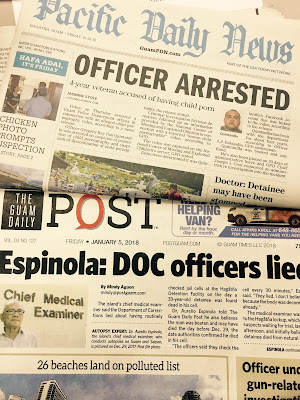
Media Shouldn't Defend Colonial Status Quoby Michael Lujan Bevacqua January 5, 2018 Pacific Daily News As we crawl out of the dumpster fire that was 2017 for much of the United States and its territories, we inch cautiously into 2018 and hope for the best.  As someone who has been working over the past few years to elevate the community consciousness about decolonization,  I am most interested in what the coming elections and federal cases will bring in terms of changing the island’s political status. What occupies my thought process is the role of the media in helping build that consciousness or impede it. The media institutions in any society don’t just exist to report or investigate. These institutions also, often in less perceptible ways, promote values and norms, usually on behalf of elite segments of society. In a colonial context, these roles gain a colonial dimension. Both institutions and individuals often will be compelled to defend and natur...

Adios Travis Coffman

Image
Travis Coffman, a notable figure in Marianas media over the past few decades passed away recently. He was best known for his role in talk radio in Guam at K57. And as such, he was someone that I would interact with quite frequently. I went on his show several times to be interviewed about various topics. He was always respectful to me in public, and I would sometimes see him at anime, manga and nerd conventions on the island. But for many Chamorro activists, they saw him as someone who could frequently be anti-Chamorro in his statements on the air. I definitely heard elements of that when he would be on the the radio, and I would sometimes get text messages or emails, telling me to listen to what Travis was saying today. When I say anti-Chamorro, what it usually boiled down to was being dismissing of Chamorro issues and Chamorro concerns, but not necessarily someone who would ever say that Chamorro culture sucks. But someone who would use his position to belittle activists fighting f...

Adventures of Akli'e' Book Launch

Image
Local children's book launches tomorrow by Andrew Roberto The Guam Daily Post December 15, 2017 Local author and activist Michael Lujan Bevacqua, through his publishing group The Guam Bus, hopes his latest project can get young and old readers alike to think more profoundly about Guam's culture. Titled "The Adventures of Akli'e'," the new bilingual project is one book made up of two stories: In the first story, the titular character spends a day with his great-grandfather, a master blacksmith, and imagines what it would be like to use the tools his great-grandfather forges every day. In the second story, the young Akli'e' listens to his great-grandmother's tales of CHamoru history and legend, bringing the stories to life in his imagination. Bevacqua said he took inspiration for the tales from his own life. The main character is named after his son, and his own grandfather is master blacksmith Joaquin Flores Lujan. Bevacqua sai...

History within the Chamorro Context

Image
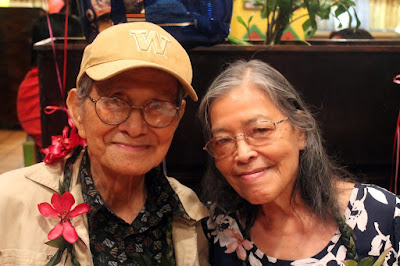
Rlene Santos Steffy published the article below during the summer as part of her iTintaotao Marianas feature series in The Guam Daily Post. I was honored to be included amongst so many other older and more esteemed activist and scholars. I conducted several long interviews with Rlene, some focusing on history and others on political status. I was surprised by her chosen route for this article, focusing on my learning the Chamorro language and my relationship to my grandparents. I was surprised, but not disappointed. The quote that she used at the start of the article is very much what I continue to feel about my Chamorro identity. Namely that if not for my grandparents, I wouldn't have much of a Chamorro identity and probably wouldn't speak Chamorro or care as much about the fate of the Chamorro people. Reading this article made me sen mahålang for my grandparents. I miss them every day, everytime I use the Chamorro language. Kada fumino' Chamorro nina'siente yu...

Anti-America, Anti-Colonial

Image
It is a strange paradox in a colony to consider the issue of patriotism and or lack thereof. On the one hand, as a colony you are being discriminated or marginalized in some way that is fundamental to your political relationship. Whether it be massacres and mass exploitation of resources or the creation of rules and laws that disenfranchise you and leave sovereign power over your lives and lands with those thousands of miles away. In this context, patriotism or devotion to the colonizer seems very unlikely in a colony. But this isn't really the case. Although the basis for patriotism is a reciprocal inclusion. It is not simply a unilateral love, but rather the relationship whereby your political love will be rewarded with a set of basic rights or forms of recognition. Despite the inequality or lack of a well-defined circle of recognized belonging, patriotism is still routinely found in the colonies, and even takes on superlative forms. Colonies are structured so that, there...