Posts

Showing posts with the label Chamoritta

Chamoru Love Sayings

Image
A student from my Zoom Chamoru classes recently asked me for some suggestions for some Chamoru sayings or words of wisdom that she could use for a speech she had to give for a friend's wedding.  I get this type of request pretty frequently and so over the years I have a number of lists of ways to say "I Love You" in Chamoru. For years that was one of the my most visited pages on this blog, a simple page that had more than a dozen different ways to say "Hu Guaiya Hao" ranging from the poetic and deep, to the silly and sexy.  When I looked at many of those lists, I realized that the majority of the ways love was expressed, was indeed written in Chamoru, but not necessarily rooted in Chamoru. What I mean by this, is that alot of the sayings were simply translated from English or variants of ways that love would be expressed in English.  For me, I am definitely in support of these sorts of things, I love having our language adapt and take on new forms, especially wh...
Aye na PÃ¥tgon

Image
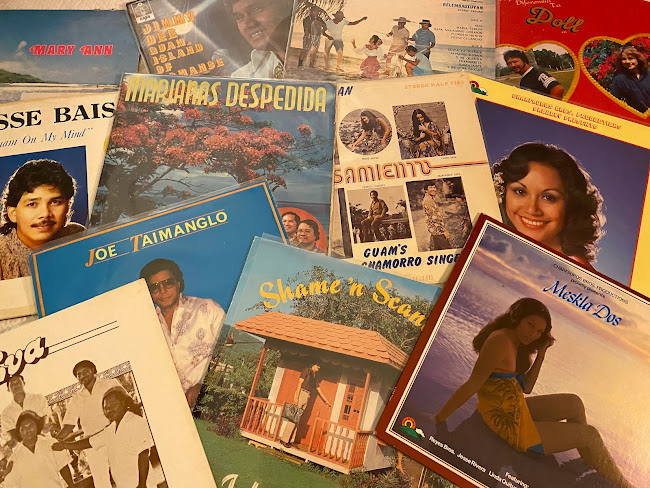
  When I first listened to this song more than 20 years ago, gi hinasso-ku gof na'chalek, lao ti hu komprende i tinahdong-ña gi kostumbren Chamoru. I was not aware when I first listened and translated to it, how much deeper the meaning is beyond the silly things described in the lyrics.   This song "Aye na PÃ¥tgon" from Johnny Sablan's album "My Marianas" describes a father taking his son to the ranch to try to teach him some basic life skills.  But for everything that he tells his son to do, his son does something different and sometimes nonsensically, as well as all around gago'.   For instance he tells his son to boil the papaya and the coconut and instead his son goes to pick berries.   He tells his son to go collect firewood but he doesn't actually come back until all the cooking is done.  The lyrics are silly and more about sounding fun or funny than actually depicting something real. But when I was younger I never connected this song to...

Pakaka Neni Famatkilu

Image
My time with Lulai Lumuhu is filled with dancing and singing. Desiree always said that she would pay attention to my voice while she was in the womb. When she heard others, like Sumåhi and Akli'e' she would kick and move. But when I was speaking to her she would stop and listen. Ti siguguro yu' esta på'go, kao este kumekeilekña na ya-ña i bos-hu pat ti ya-ña i bos-hu. Kao ha respepeta yu', pat kao inespåpanta? I try as much as possible to sing Chamoru songs to her, knowing that she'll hear English and other songs from just about everywhere else, she'll be hearing Chamoru from me. The song that soothes her the most is "I Puti'on." Akli'e' and I do a nice duet of the song for her to help calm her when she is cranky. Over the years I've collected several dozen Chamoru children's songs from before World War II, many of which are fragments. Songs then were different then the way we think about them now. People took tunes they liked a...

Tan Ding Gould

Image
Each month Independent GuÃ¥han honors a Maga'taotao or an elite, pioneering or noble person, who has fought hard in some way for the rights of the Chamorro people, especially in terms of self-determination. This month we are honoring the late Clotilde "Ding" Castro Gould who was a war-survivor, an educator, author, song-writer and a master story-teller. She is best known for her creation of the Chamorro language comic strip Juan Malimanga, which appears in the Pacific Daily News six times a week and her role in helping develop the bilingual and bicultural education program in Guam’s public school system. Tan Gould was also a member of PARA (People's Alliance for Responsible Alternatives) and OPI-R (Organization of People for Indigenous Rights), and as a political activist fought hard for the right to self-determination of the Chamorro people.  Para Guahu, there is an extra dimension to this honor, as I, through my work in the Chamorro Studies Program...

Cultural Integrity and Pacific Representations

Image
Earlier this year, as part of the annual Guam International Film Festival or GIFF festivities, longtime juror and supporter of the festival Tom Brislin, who is a professor of film at University of Hawai'i, Manoa gave a presentation on the need for Chamorros to join the larger conversation in the Pacific about preserving cultural intellectual property and also developing an infrastructure to help make future film project in the region more accountable to the lands and the lives of which they are making use. He referred to a number of issues in Hawai'i, New Zealand and Australia, where traditional culture was being snatched up and copyrighted by corporations such as Disney, and how the cultures of the Pacific continued to be portrayed in racist and orientalist ways, which can end up teaching those inside and outside of the Pacific terrible lessons. I really enjoyed his presentation and I'm hoping some students caught onto the conversation he was attempting to start locally...

Fino' Chamoru na Inadaggao Ta'lo

Image
I started a website five years ago titled " Fino' Chamoru na Inadaggao " meaning a forum for debating or discussing the Chamorro language. This was initially mean to be a website that would support a series of Chamoru Language Senatorial forums held during the 2010 Guam election. From October 19th - 21st that year, all the Guam Legislature hopefuls were invited to a forum where they would be asked questions in the Chamorro language and be encouraged to respond in the Chamorro language. Now as you might imagine/know, in 2010 and 2015 the overwhelming majority of local politicians, including those who are Chamorro, cannot speak the Chamorro language. Because of this, each participant was given the question ahead of time, so as to allow them time to translate the questions and prepare their answers in either English or Chamorro. Candidate were also allowed to have interpreters on stage with them, sitting behind them in case they had trouble following along or remembering w...

Kantan Guinaiya

Image
This year for the Inachaigen Fino' CHamoru or Chamorro Language Competition we tried out a new category, Kantan Chamorrita. This style is something unfamiliar to most on Guam today, but was an integral, constant and always oppan part of Chamorro life before the war and even for a few years afterwards. Kantan Chamorrita or Chamorrita refers to a style of social improvisational singing. A verse is started with a familiar tune, and another takes up the song by adding on a verse of their own. Each verse is supposed to be four lines. The tune is simple and doesn't move to fast, but each singer is expected to rhyme the last part of the 2nd and 4th line. In the days before radio was commonplace and stereos, walkmans or iPods existed, this was how people filled the gaps in the air and in time. Singing familiar songs, but making up your own songs with others was something you did while fishing, weaving, farming, partying and so on. But as audio distractions and diversions became eas...

Chamorro Public Service Post #24: Nobia Yanggen Para Un Hanao

Image
When I was doing oral histories on Guam, not too long ago, some of the most interesting stories were those of courtship and "dating" in pre-World War II Guam. As many manamko' state, there was no dating before the war, and this is no exaggeration. Young men and women were closely watched and restricted in their movements and activities. Men were given more freedom than women, but both were not allowed to freely associated with any person of the opposite sex to whom they were not closely related. With any such social prohibition there are plenty of sagas of the exceptions. These exceptions for the most part can be found in the tales of mythical others. People who bravely went against the times or were victimized by the times or who seemed to not belong in the time to which they were born. These people always exist, and are spoken about sometimes in disgust/distaste, sometimes with jealous admiration. But even if the person you are talking to may have had s...

Public Service Post #20: Guiya na Palao'an

Image
Hu sen guaiya dandan Chamoru. Whenever I'm asked what kind of music I enjoy, I can't really name many artists or styles that I really actually like that much, with the exception of Chamorro music. It doesn't really matter what kind of Chamorro music, so long as it uses the Chamorro language I always give it a chance. For instance I tend not to like country music, but I really enjoy Chamorro country music. One of the saddest things about the direction of the Chamorro  language is that since it is declining in use and basically ceasing to be a living language, that means that its chances at adapting and taking of new life are limited. For example, there are Chamorro musicians out there making every type of possible music. But as they branch out and expand their interests and abilities, chances are very slim that they know the language and even slimmer that they have any interest in using the Chamorro language in the new styles that they are playing or composing in. Th...