Posts

Showing posts with the label Ponedera

Issei, Nisei, Sansei

Image
 I recently worked on a few different research projects assisting scholars and news teams who were conducting research on the Chamoru-Japanese families in Guam.   Some of these projects focused on the waves of Japanese migration and how Japanese people were integrated or treated by the Spanish or American colonial administrations. Others focused on the Chamoru families that blended with the Japanese migrants and their experiences. Some of this interest was spurred by the publication last year of a book by Master of Chamoru Culture for Playwrighting Peter Onedera "A Borrowed Land."  I remember first encountering the sometimes complicated nature of their history, especially when it came to Guam's World War II period, when I was a young graduate student, just starting to do my oral history research. I was in Micronesian Studies at the University of Guam, traveling around, usually with my grandmother, visiting her friends and relatives, practicing my Chamoru, but also as...

Diasporic Projections

Image
The term Diaspora can be tricky, even if it is something that I use regularly and work with and around regularly, even more so during the pandemic.  The Chamoru diaspora used to be a divide. A fairly sharp divide where Chamorus on the island side were fundamentally different than those who were from the stateside. It would come about in an avalanche of anecdotes that could be heard from both ends of the Pacific. Chamorus in the states would complain that Chamorus on Guam were too backward thinking and stuck, not progressing and not advancing. Despite often very similar problems in their own areas in the US, they would speak about things like government corruption or inefficiency as if they were Guam-brand products and certainly didn't exist in the land of Olive Gardens and Costcos.  Chamorus from the island would speak about those from the states as if there had never been a tribe of people more stuck up and full of themselves. For everything back home, there were stories abou...

Poisonous Palåyi Waters

Image
I have been working for about two years now on a social studies textbook for UOG Press. This is a part of a project that aims to create locally and regionally focused social studies textbooks for each elementary school grade. In the past there have been a few different social studies textbooks, but often times they were aimed at multiple grades or were focused more on Guam History as opposed to being solid social studies texts. This project is exciting and challenging on many levels.  The grade I am working on is fourth grade, which is fortunate for me, since it is the grade when students are supposed to get their first focused taste of Guam History. It is, gi minagahet, very exciting. I get to use everything from Guam History, to Chamoru language, to legends and local parables to get students connected to the world around them and understand how to be an effective, productive and critical part of your community.  In the first two units, one thing that I have tried to use alot...

The Most Prolific Chamoru Writer

Image
For those wanting to learn more Chamoru or practice their Chamoru reading, the most prolific writer in the Chamoru language remains playwright and language teacher Pedro Onedera. He has written books, poetic collections, numerous plays and regularly publishes a column in the Pacific Daily News, which is written in Chamoru with an English translation. For those at the beginning of their Chamoru learning journey, his writings might be too difficult or complex. But for those who are already at the intermediate level of learning, they are a great way to push yourself in the language and really try to engulf yourself in a Chamoru narrative or series of argumentative points.  Here is his most recent column from this week talking about hÃ¥yi i gayu-ña gi i botasion guini giya GuÃ¥han guini na sÃ¥kkan.  ************************ Ti bai hu bota engkÃ¥men yan hagas hagas by Pedro Onedera Pacific Daily News August 5, 2020 PÃ¥’go na simÃ¥na na ma tutuhon i sanhal...

Lessons in Tinatse and Typhoon Etiquette

Image
When talking about legends many people become focused on what is true and what isn't true? What is authentic and what really happened? What can be determine from the story that is real and what isn't? These types of discussions may have some importance within a historical context, when trying to understand it from the perspective of aligning stories with a particular history or historical context. For example there are ways that you can look at the story of the Iliad from a historical perspective. There are ways you could try to draw out historical truths from it, and even if some of the details may not be real, you can nonetheless see larger societal dynamics at work in the poem. This is something to keep in mind when we look at Guam or Chamoru legends. Is that there are some ways to examine, analyze or understand them from a historical perspective, but this misses the larger point of their purpose. Legends serve a social or a culture purpose. They aren't meant to be p...

History within the Chamorro Context

Image
Rlene Santos Steffy published the article below during the summer as part of her iTintaotao Marianas feature series in The Guam Daily Post. I was honored to be included amongst so many other older and more esteemed activist and scholars. I conducted several long interviews with Rlene, some focusing on history and others on political status. I was surprised by her chosen route for this article, focusing on my learning the Chamorro language and my relationship to my grandparents. I was surprised, but not disappointed. The quote that she used at the start of the article is very much what I continue to feel about my Chamorro identity. Namely that if not for my grandparents, I wouldn't have much of a Chamorro identity and probably wouldn't speak Chamorro or care as much about the fate of the Chamorro people. Reading this article made me sen mahålang for my grandparents. I miss them every day, everytime I use the Chamorro language. Kada fumino' Chamorro nina'siente yu...

Kumision i Fino' CHamoru

Image
Esta kana' bente años na taigue i Kumision i Fino' CHamoru. Ma'establesi gui' fine'nina gi 1964. Lao mas sen matungo' gui' gi duranten i 1990s', pi'ot annai ha ketulaika i dinilitreha para i palåbra "Chamorro" asta "Chamoru" pat "CHamoru." I yinaoyao put i dinilitreha muna'påra i che'cho'-ña i kumision. Maolek na i ma'pos na Liheslaturan Guåhan yan ma na'lå'la' gui' ta'lo gi lai. Lao ta li'e' kao diferentes i tano' på'go pat parerehu ha'? Kao para u ma'aksepta i kumunidåt i tinago'-ña yan i disision-ña i kumision, pat kao para u ma'embeste ta'lo? *********************** CHamoru Language Commission re-established by Manny Cruz The Guam Daily Post May 9, 2017 For the first time in nearly 20 years, the CHamoru Language Commission became a functioning body once more on Monday. The commission's first order of business: Establish an explic...

Inadaggao Lengguahen Chamorro

Image
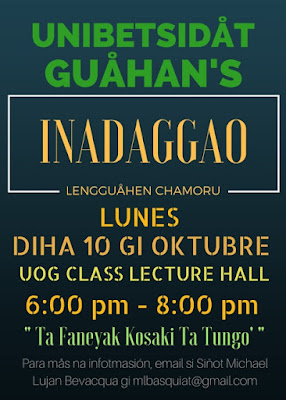
Six years ago under the guidance of Peter Onedera, the Chamorro language program at UOG held a Chamorro Language Forum, in which senatorial and gubernatorial candidates were asked questions in Chamorro about pertinent island issues. It was on one hand a great success. Students asked hundreds of questions to the candidates in the Chamorro language. But on the other hand, the format of the forum made it so that candidates didn't have to speak in Chamorro, they could just respond in English. I assisted Peter Onedera with these forums both as a student and a professor at UOG, and so I found it on the one hand inspiring to see a place where the Chamorro language was the focus for political discourse. But it was also so depressing to see so many leaders and would-be leaders not even trying to speak Chamorro, even though they were given the questions ahead of time and could have prepared answers. Fast forward six years and through my Chamoru Culture class at UOG, we have decided to br...

Neo gi Halom i Gima'yu'us

Image
Sometimes I get depressed about the state of the Chamorro language. Whenever I am talking to an elderly Chamorro about how our language is dying and the culture is being forgotten and I see them speaking to their grandchildren in English, it makes me want to explode. Everytime I hear elders complain about the young today and how soft and weak and spoiled they are, but who allow their children to be glued to iPads at dinner or in public, it makes me want to run away. When I sit in a meeting where everyone thinks that the solution to the saving of the language lies with an app, or software, but ignores that basic fact that what we really need is just more inter-generational use of Chamorro, the speaking of Chamorro not across a generation, but rather between generations, I want to set something on fire. Whenever I have a conversation with someone who tells me that Chamorro is only supposed to be used like this, or is only meant to talk about this or that, and doesn't want to expan...