Posts

Showing posts with the label Translation

Where the Wild Things Speak Chamoru

Image
  One of of my oldest child's Sumahi’s favorite books growing up was “Where the Wild Things Are” by Maurice Sendak.    She loved the artwork and the story and would sometimes request that we read it for several nights in a row. For those unfamiliar with the story, a young boy Max is causing so much havoc in the house that his mother sends him to his room without supper. While there he undertakes a journey that takes him over a great sea to the land of the wild things. He becomes the leader of the wild things and they dance and have a great time. Eventually Max grows tired of the freedom being a “wild one” gives him, and he decides to sail home. When he arrives in his room he finds he supper waiting for him; and it is still warm. Part of the difficulty with reading books to my kids is the fact that I only speak to both of them in Chamoru. Even if I am reading to them a book like “Where the Wild Things Are”  which is in English, I have to translate it as I’m readin...

Starting a Chamoru Language Podcast with My Teens

Image
   For all my children, since the moment they were born, no matter what the topic, I only speak to them in Chamoru. This doesn’t mean that every single word is in Chamoru, as sometimes English words, or other words must be used or translated into Chamoru. But given my commitment to perpetuating the native language of the indigenous people of the Marianas, it means we use Chamoru and adapt Chamoru, no matter what the topic or context. Language are however social organisms, which means that for most people, children included, even if you use it with them, unless it is reinforced, and there is a sense of community or value associated with it, keeping the language alive and in turn passing it on will be difficult. Even if you speak Chamoru to your own children, they might speak it back to you, but if they don’t perceive that others around them speak it or that it doesn’t have any value expect in the past or within very narrow means, there is a marginal chance they will ...

MÃ¥ngge si Levesque?

Image
 If anyone knows how I can contact Rodrigue Levesque, please let me know.  He researched, translated and published the History of Micronesia series, which is an amazing set of primary source documents dealing with Micronesia. It is a collection of information that has yet to be fully incorporated into how we tell the history of our islands.  The books, when they were published were gof guaguan, very expensive, at least $100 each. But they were massive. When I was a graduate student at UOG, spending time at the University of Guam Micronesian Area Research Center, I loved reading through the lepblon Levesque siha.  They featured completely different perspectives from the traditional or canonical history of the Marianas, but using not just the official histories or accounts of events, but also letters by priests, government officials, soldiers and sailors, that he was able to collect in his research.  A few years ago Levesque finished his History of Micronesia seri...

The Flow of I Fino'-ta

Image
One of the earliest Chamoru translations of an American pop song I ever did.  I came across it recently while I was searching on some old external hard drives.  It is to the tune of the Coldplay song "Clocks"which came out in 2002.  I remember I had started translating the song, working to come up with some basic lyrics.  I was hindered in my translation by the fact that the title frankly, gi minagahet was weird or sucked in Chamoru.  Clocks, didn't make sense in Chamoru. It may barely make sense in English for the song gi minagahet.  "Reloh siha" mungga yu' nu enao lol.  This was very early in my Chamoru learning journey, I was functionally fluent, but still making mistakes all the time and my Chamoru sounded like it was stiff and dry, straight out of a grammar book, because I lacked the basic organic feeling of being part of a language community.  The ways that emerge sometimes for an individual, a family, a village, a people to build off of the...

Nåpon Minahålang

Image
No one ever fully knows a language, and that is always an interesting way of reminding people that a language is, first and foremost, a social organism. It connects people. It exists to connect and express connections.  But as no one ever fully knows a language, it means that even those who use it everyday are always still learning in the language. There is always more to know, as a language is always belong what a single person can know or do. One way that I have continued to learn and grow in the language is by translating songs from English, regularly into Chamoru. At this point, I've translated hundreds of pop songs, rock songs, hip hop songs, country, punk, alternative, emo, ska, at this point just about any genre you can imagine, I've probably translated at least one song from it, into the Chamoru language.  Sometimes I try to keep the original intention and metaphor of the song, other times I completely abandon it. Sometimes even the tune of the song itself, its flow ge...

I Na'Ã¥n-mu

Image
  For fun, I used to take anime songs (gi Fino' Chapones) and translate them into Chamoru. Over the years I translated songs from Naruto, Gantz, Cromartie High School, Master Keaton, Evangelion, and Attack on Titan just to name a few. It was an exercise in expressing two things that I am very nerdy about. I hadn't thought about this in a long time though until earlier tonight when Youtube's next song randomness started playing anime theme songs. As I started to feel the chetnot nostalgia hit me, the kids asked what song is this? where is this from? When I described the plot of Evangelion to SumÃ¥hi, her review, "wow sen na'triste enao (wow that is like incredibly depressing)." I told the kids about how I used to translate songs like this into Chamoru. When they asked why, I said, "Ya-hu fino' Chamoru, ya-hu este na kÃ¥nta. Anggen hu pula' este gi mismo lenguahi-hu, hu na'latatahdong I siniente-ku put este. (I like Chamoru, I like this song. If I...

Si Dikike'

Image
I met someone recently who asked me if I had read the story Thumbelina, and I was certain I had but a long long time ago. I could remember faint details, but not much. She told me that she had read it when she was young and reread it throughout the years. Eventually as she got out of an abusive and toxic long-term relationship she began to see more and more of her life through the imagery and metaphors of the story. I decided this week to reread it (and maybe read it with my kids). Revisiting the story, I can see why she felt it resonated so much with her. I am mulling over whether I should translate the story into Chamoru. I think it might work rather well. I remember my grandmother telling me a story of her mother's, about a boy who fell asleep and woke up a butterfly living in a flower. I'd probably call it " Si Dikike'."  Ta li'e' buente.  ***************************** Thumbelina by Hans Christian Andersen (1835) THERE was once a...

The Parting Glass

Image
When my son Akli'e' and I played Assassin's Creed Black Flag (Ã…ttelong na Bandera) together, we were both touched by the game's ending ballad, "Parting Glass," a famous Scottish farewell song. Even  after  I stopped playing it years ago, we still find ourselves singing to it in the car and referencing his favorite line from the song "for want of wit." Este uno gof ya-hu na huegon bideo. Ya hu hasso gi finakpo' annai makÃ¥nta este na kÃ¥nta, kulang tumÃ¥tanges yu'.  Over the years when we sing this song, my kids and I eventually added in our own Chamoru lyrics for it. I've pasted them below.  As I reflect back on the year that was 2019; the love, the pain and everything in between, this song was a beautiful way to bid it adios. ************************* The Parting Glass Of all the money there ere I had I spent it in good company Put todu i salape’ ni’ hu chule’ I manabok-hu hu gastÃ¥yi And all the harm that ere I ...

Kichikichi yan Bukåyu

I haven't translated an English pop song into Chamorro in very long time. I was feeling nostalgic the other day and decided to translate "Sex and Candy" by Marcy's Playground. Note that the translation isn't meant to be literal and I changed things where I saw it appropriate in particular lines such as "disco candy" and "platform double suede." **************** --> Kichichi yan BukÃ¥yu Humahaggan yu’ Guahu na maisa Ã…pmam na tiempo Para bai fanhasso Put Guahu Ya desnek gui’ Kulang mesgo’ yan minangnge’ Hu’u ayugue Mannginge’ yu’ Kichikichi yan bukÃ¥yu HÃ¥yi matata’chong Gi siyÃ¥-hu? HÃ¥yi mana’atan bÃ¥ba giya Guahu NÃ¥na siempre Guinife ha’ este! Humahaggan yu’ Guahu na maisa Ya hu dafflokgue Kafe gumimen Ya duru manhasso yu’ Put Guahu Ya desnek gui’ Gi dogga’ na yore’ Hu’u ayugue Kulang tuban binakle Mannginge’ yu’ Kichikichi yan bukÃ¥yu HÃ¥yi matata’chong Gi siyÃ¥-hu? HÃ¥...

UOG Language(s) Drive

Image
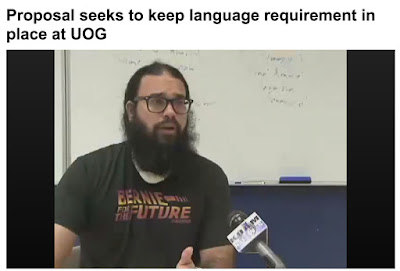
The petition drive to protect language learning at UOG continues.  If you haven't signed the petition yet, please do so at this link . Here is the website for the UOG Language Drive , which is being spearheaded by myself and other UOG faculty to protect language learning at UOG in the face of GE requirement changes which could drastically affect language programs at UOG, in particular my program, Chamorro Studies.  Below is the petition statement for the UOG Language Drive, in Chamorro, Japanese, Tagalog, French, Spanish, Mandarin and English. ***************************** Kinalamten para Lenguahi Siha gi UnibetsedÃ¥t Guahan  I hinangai-ña este para u na’adilÃ¥ntu yan u chonnek mo’na i fina’nÃ¥’guen lengguÃ¥hi siha gi UnibetsidÃ¥t GuÃ¥han. Manmama’nÃ¥nÃ¥’gue, manmane’eyak yan manmansesetbe i fafa’nÃ¥’gue siha yan i estudiÃ¥nte siha gi UOG para u manteteini i takhilo’ na minetgot-ñiha i kottura-ña siha yan i guinaha-ña iya Micronesia. Ginen este, ...