Posts

Showing posts with the label Decolonial Deadlock

Colonial Differences: Okinawa and Guam

Image
Over the years, as I’ve traveled around Asia and the Pacific, whether for research, for conferences, for solidarity actions, I’ve found a list of places similar to Guam, that you could call ambiguous. They belong to a certain country, but they don’t really feel like it at times. Okinawa is one such place. There is way that history and culture have combined to create a rift between Japan and Okinawa, that is invisible most of the time, but is the stark the next. There was a sense of pride and identity that could not be explained solely through references to regionalism or local love. It was something more, and something very similar to what we see on Guam. The particularities of history have created the situation where you can stand in either Guam or Okinawa and say with great force that these places are either American or Japanese. Colonialism and imperialism have taken these places and remade them. They might have said they did so for the benefit of the people there, but they noneth...
Tinestigu-hu

Image
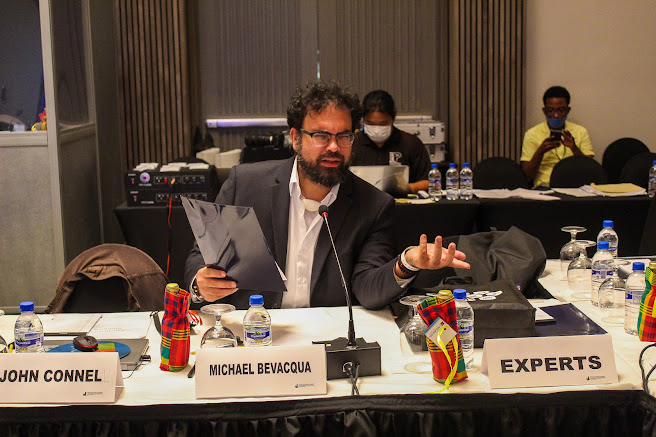
My testimony give last week to the United Nations Committee of 24 Regional Seminar on Decolonization held in St. Lucia. ***************** A Growing Foundation, but still an Uncertain Future for Guam’s Quest for Decolonization Michael Lujan Bevacqua, Ph.D. Co-Chair, Independent GuÃ¥han Curator, Guam Museum   Si Yu’os Ma’Ã¥se na makombibida yu’ mÃ¥gi ta’lo para bai hu saonao gi este matua na dinanña’. Gi tinestigu-hu pÃ¥’go, bai hu sangÃ¥ni hamyo put i halacha na hiniyong gi islÃ¥-ku yan i kinalamten-mÃ¥mi para in gi’ot i direchon-mÃ¥mi komo taotao.    Your Excellency Chairwoman Keisha McGuire, distinguished delegates, representatives and experts from fellow Non-Self-Governing Territories, I am honored to be here again speaking before you on the topic of Guam and its continuing quest for decolonization. I also want to thank the government and people of Saint Lucia for hosting us on their beautiful island.    In my statements today, I want to provide updates on important w...

Mensåhi Ginen i Gehilo' #26: Kao pau hånao ha' si Uncle Sam?

Image
"Kao pau hÃ¥nao ha' si Uncle Sam, anggen manindipendente hit?" Fihu hiningok-hu este na chathinasso ginen i kumunidÃ¥t. Anggen mamindipendente hit, u fanmalingu siempre todu i kosas motdeno. U hÃ¥nao ha’ si Uncle Sam, pau dingu hit ya pau laknos yan bo’ok todu i chinile’-ña mÃ¥gi. Ti magÃ¥het este. Fihu ti ya-ña i EstÃ¥dos Unidos umatmitde este, lao guaha obligasion-ña nu hita. Put i ha fitma i charter para i Unidos Nasiones, ha aksepta i responsibilidÃ¥t, este mafa’na’an “inanggokko sagrÃ¥du” a sacred trust. Na para u ga’chungi hit gi este na chÃ¥lan mo’na. Guaha meggai na klasen ayudu na ha oblibliga muna’guaha, lao para este na kuestion, uno mÃ¥s propiu para ta diskuti, i tiempon “transition.” Este na klasen kontrÃ¥tan, fihu masusedi gi taiguini na klasen tinilaikan pulitikÃ¥t gi otro na tÃ¥no’ lokkue’. Siña este na tiempon tinilaika tinaka’ uno año, tres años, dies años, pat bente pat trenta años. I inapmÃ¥m-ña ha dipepende gi hÃ¥fa diniside ni’ dos na n...

Media Resolutions for 2018

Image
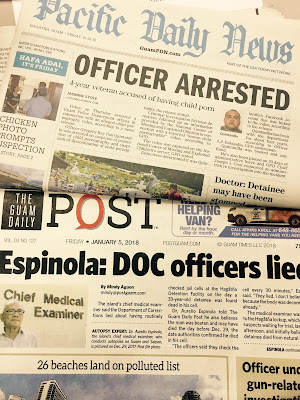
Media Shouldn't Defend Colonial Status Quoby Michael Lujan Bevacqua January 5, 2018 Pacific Daily News As we crawl out of the dumpster fire that was 2017 for much of the United States and its territories, we inch cautiously into 2018 and hope for the best.  As someone who has been working over the past few years to elevate the community consciousness about decolonization,  I am most interested in what the coming elections and federal cases will bring in terms of changing the island’s political status. What occupies my thought process is the role of the media in helping build that consciousness or impede it. The media institutions in any society don’t just exist to report or investigate. These institutions also, often in less perceptible ways, promote values and norms, usually on behalf of elite segments of society. In a colonial context, these roles gain a colonial dimension. Both institutions and individuals often will be compelled to defend and natur...

Oh Catalonia!

Image
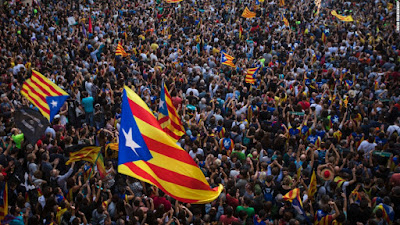
It is common in Guam to feel very alone in terms of decolonization. History books and political commentators tend to argue that the age of decolonization is over. It happened in the 1960s or 1970s, and that those who remain colonized missed the boat. They missed the decolonial sakman and are therefore stuck, in whatever political status they have. It is an intriguing way of justifying the status quo. A way of arguing that the current world order or framework isn't simply something that has happened. But rather the end. Teleological or evolutionary, but ultimately that an apex is reached and there can't be any further reconfiguration of power or reality.  In the 1980s this notion was called "The End of History" after Francis Fukuyama. It wasn't real or true, but it felt authentic, in the same way each epoch achieves a certain character or feeling of self-realization. We have seen History continue marching on. And those who still have claims ...

Decolonization in the Caribbean #17: Militarization and Decolonization

Image
At this year's Regional Seminar for the Committee of 24 in St. Vincent and the Grenadines, attendees were treated to two presentations by experts on decolonization from the UN perspective. I'll discuss both presentations through my "Decolonization in the Caribbean" posts, but today I wanted to focus on the remarks from Dr. Carlyle Corbin, from the US Virgin Islands, who is a longtime ally with Guam and the Chamorro people in their struggle for self-determination. He offered a number of recommendations that the Committee could take up in terms of moving ahead with its mission of eradicating colonialism from the world and assisting the remaining non-self-governing territories. What is refreshing in terms of the seminar overall is the way it mixes scholars and experts with diplomats or government reps. The debate or discussions between country representatives and committee members tends to move in familiar and sometimes frustrating directions. Regardless of what is t...

Decolonization in the Caribbean #8: Kuatro na Biahi

Image
The UN C24 Regional Seminar in St. Vincent and the Grenadines was my fourth occasion to testify as an expert in this setting. My first invitation was in Ecuador in 2013. This was followed by twice in Nicaragua in 2015 and 2016. After going through my old testimonies in preparation for this year's seminar I did not cringe, as I normally would when reviewing old work or writings. I noticed in my first instance of testifying that I was very general and almost theoretical. I was using elements of the dissertation in Ethnic Studies that I had just finished a few years earlier. In the years since I have shifted to providing more updates to the C24 and more facts about what is happening and the impediments that Chamorros and Guam face.  As a bit of nostalgia, I'll post here my testimony from the regional seminar in Quito, Ecuador. ************************ Statement to the Regional Seminar on the Implementation of the Third Decade for the Eradication of Colonialism Quito...