Saturday, February 28, 2009

Because the Hand that Gives, Rules

Just finished up another long day of writing about Chamorro sovereignty, political status and American colonialism. Five hours non-stop at Java Hut in Oka'. As I wrote last week, when I'm writing, music is essential in keeping me motivated and awake. Today, as I was writing one song in particular came on, and its lyrics clicked for me, with what I was writing.

The song was "The Hand that Feeds" by Nine Inch Nails. And as soon as my mind got coiled into the words, I was reminded of a certain quote from a Chamorro scholar. The song is all about somebody who is stuck in a position of subordination, kneeling before someone who controls them. They don't seem to know anything is wrong most of the time, but these position of being controlled actually leaves them hollow inside. The chorus calls upon the kneeling object of the song to rise up and to bite the hand that appears to feed it, to chew it up and reject their dominance and power.

This reminded me of a quote that I've often used in my work from Laura Souder's seminal article "Psyche Under Siege" which discusses the psychological dependency and feelings of loyalty that Chamorros feel for the United States, that trap them in a subordinate and feeble relationship with it. The quote is commensencial was strikes deep into the bone of every single Chamorro, it is a quote that dictates so much of our lives, how we see ourselves in the world, what we as a people or an island are or aren't capable of. It speaks so much to the predicament of the island today, why a massive unilateral military buildup, which could literally shatter the island, is welcomed and celebrated.

This the logic that pins us down, that insists that we continue to kiss the hand that feeds us, that we never question the mandates of that hand, that we never look past it, but continually submit to it, since there is nothing possible without it.

“Naughty, naughty, you should not bite the hand that feeds you. Remember, life boils down to this, he who holds the purse strings rules the roost.”

I know its impossible, but until the political status of Guam does change, I think that this should be our national anthem. We can even translate it into Chamorro and invite Nine Inch Nails to come and perform at Liberation Day!
Besides, most national anthems are pretty boring, they are sung like droning dirges. I think it would nice to have an anthem that taunts you as you sing it, such as the final verses of the song where shouts over and over "Will you stay down on your knees?"

************************************

The Hand that Feeds
Nine Inch Nails

You're keeping in step
In the line
Got your chin held high and you feel just fine
Because you do
What you're told
But inside your heart it is black and it's hollow and it's cold

Just how deep do you believe?
Will you bite the hand that feeds?
Will you chew until it bleeds?
Can you get up off your knees?
Are you brave enough to see?
Do you want to change it?

What if this whole crusade's
A charade
And behind it all there's a price to be paid
For the blood
On which we dine
Justified in the name of the holy and the divine

Just how deep do you believe?
Will you bite the hand that feeds?
Will you chew until it bleeds?
Can you get up off your knees?
Are you brave enough to see?
Do you want to change it?

So naive
I keep holding on to what I want to believe
I can see
But I keep holding on and on and on and on

Will you bite the hand that feeds you?
Will you stay down on your knees?


Thursday, February 26, 2009

Work in Progress #1 - A Pulpy Painting

Since I've come back to Guam I've been painting a lot more. I'm known on Guam as an artist in addition to be an activist, a writer, a scholar and the grandson of my grandparents. I sold at the Lunar Calendar Festival last month, and also gave out some free art at the Free Art Friday a few weeks ago. I've made about twenty small abstract pieces since the new year and I've already sold or given away half of them. I'm painting a few more this week, and getting them matted and ready for next week's 2nd Isla Art Fair at the University of Guam.

Since all this art stuff is going around in my mind and blood, and generally keeping me from writing my dissertation, I thought I'd share a piece I painted over the summer last year. But first some background.

The small art pieces I sell on Guam are different than what I've been painting over the past few years while living in San Diego. In the states, most everything I paint has been women's faces or sunsets. On Guam, I paint mainly because I am an artist here and I feel compelled to embody that role, to make art and share it, display it, sell it, give it. I feel like I play an important role here and so I make art which is smaller, cheaper and easier to disperse.

In the states, I usually painted as an escape. Occassionally I would paint for gifts, but most of the time I painted in order to escape the pressures of grad school, the pressures of grassroots activism. Over the course of last summer, as I was working on the first couple chapters of my dissertation, whatever time I found for leisure was spent vegetating or sleeping in front of a television. After I while though I grew sick of this and wanted to use my time more effectively and hopeless use my mind in such a way as to both relax and also make use of my mental facilities.

Thus each painting that I made during this period is a union of my multi-tasking and their titles reflect that. The painting I'm going to show you today, is titled "Yvette - Talk to Me."

The title is derived first from the name of the woman whom the image was inspired by (usually a photograph from a magazine or the internet) and also the title of a movie, which was playing in the background as I painted. Each painting was completed during the course of that movie, providing dialogue, music, drama, comedy which both nurtured and distracted me as I painted. This does not mean that each painting was created within the exact time of each film, as sometimes I would still be painting long after the credits had rolled and the DVD main menu had re-emerged, relentless starting itself over and over as kept painting. The film in question is Talk to Me staring Don Chealde and coolest-name-ever-Award winner Chiwetel Ejiofor, and chronicles the life of former Washington DC disc jockey Ralph "Petey" Greene.

The subject matter for all of these paintings was simple. A woman, with only her head and shoulders, with nondescript clothing and a necklace. Despite the simplicity of this scene, it represents a struggle that has followed me throughout my entire career as an artist, “What is a Chamorro artist?” and “What is Chamorro art?” Amidst an island art economy and imaginary which has long been dominated by over-simplistic ideas of what is Chamorro art, namely expected Chamorro images (latte or Chamorro warriors) or pretty landscapes or beachscapes, I have often struggled to assert what I create as Chamorro art. The orange spondylus necklace is added to each painting as an afterthought, both as a clear sign that this is “Chamorro art” but also a critique, a small commentary on the fact that the limits and categories of art are far from pre-determined, and never as certain or secure as we often assume. As art is just a collection of randomly or deliberately placed symbols, the smallest change can always shift its meaning.

Below I'm pasting photos taking during the course of the painting of Yvette - Talk to Me:

#1: The canvas used for the painting was initially another painting, which I had never finished and eventually used as a palette for other paintings. This is why within just a few minutes of starting the painting already looks like a chaotic mess. Although the photo quality is poor, you can see how I started the image, think black lines, some possible skin colors laid down and then lines in the face scratched out for reference as to where the eyes, nose and other facial contours will be. Prior to starting the painting there was already significant paint built up in certain areas, and so this later creates interesting texture, especially in the face.


2: Some tentative layers of color. Green was my inital choice for the shirt, and a light yellow with some orange mixed in an early choice for the background. A base skin tone was painted on to delinate the face and some basic lines in it.
#3: Here's a closer shot of the face to check out. At this point all of this is underpainting and so almost every inch that you see now will soon be covered up, or because of the way I paint, mixed and blended into the next layer on top. One thing that I've learned though is that often times, leaving particularly nice or beautiful spots from the previous layer to shine through or remain uncovered can often create great contrast or complement subsequent layers.
#4: The green shirt is still there, but the yellow background is starting to gross me out and as you can see I'm slowly painting over it with white, as I work to make the head not look so massive at the top. One of the things I always forget when painting faces is the ears, and so as you can see I'm already starting to put down real skin tones in the face, but I almost forgot about the ears and so all I've painted there was a quick washy white outline, so I don't completely ignore the area.
#5: The flesh tones in the face are interesting, since at this point I'm experimenting to see which unexpected color I should introduce in with the browns, pinks and whites, to give it more pop. From the darker, more shaded areas of the face, I'm already starting to use a purple blue mix and I'll probably end up using that throughout the face.
#6: Close to being done by now. The yellow in the background has been mixed with red, although you can still see some faint traces of it, it will most likely be swallowed up completely. The purple in the skin tone is now very obvious and very nicely contrasts with the reds, yellows and browns.
#7: The texture of the face makes it look as if its bruised. The brush strokes, are brutish and quick, and I chose to paint it like this not because I wanted to make her look like she'd been beaten up, but rather to match the texture that had been built up in the facial area from the previous painting on the canvas. In some places the paint buildup sticks out half an inch, and so no matter how hard I tried to paint around this, the pulpiness persisted, and eventually decided to try and work with it rather than try to hide it.


#8: Here's the final piece, and you can get a better sense of the texture. The way I painted the face makes it difficult to see where the buildup spots are, but if you look in the background, you can clear see the brush pulls, which look like ghost fingers, or the neglected dried mixing spots, which look like big zits. More purple has been added into the red in the background to make it match the purple in the face, but also to give the red a deeper feeling, since most of my paintings are horribly flat, as if, as one of my professors used to say, they are trapped in a Modernist nightmare. A few points in this painting were never touched throughout the entire course of its creation, and you can see them peak through in random spots. There are still hints of the previous yellow background around the edges of where her hair is falling beside her neck. There is also the white slash of color at the top of the green shirt, meant to give the impression of an undershirt, which other than the fact that a black line was added to its top, has changed much since I first began painting the green for the shirt.
I hope you enjoyed watching and reading this work in progress!

Tuesday, February 24, 2009

Democracy and Defense

I should be writing my dissertation, and dumiddide' dumiddide' I am, but there is so much going on Guam right now that always seems to keep me from it. So much of it is related to the military buildup that has been looming on the island's horizon since 2005.

A little more than a year from now, in the summer of 2010, the construction for the proposed military buildup of Guam will "officially" begin. The next few months are thus crucial since the Draft Environmental Impact Statement for that construction will soon be released and a short period will be provided during which we can make comments on the DEIS, and whether or not its realistic, whether or not its comprehensive or detailed enough and lastly whether or not their mitigation suggestions for the impacts that will be caused are worth the ink they are printed with.

Until the DEIS is released, there is plenty to do in terms of organizing events or possibly even protests. Getting the word out in different ways and hoping to educate people to imagine their island and its place in the world beyond the equation of "more military = more money." I'm involved in the planning of several things, most of which I can't mention yet, at least not until some of the plans become more concrete.

One recent Bill (#66) submitted to the Guam Legislature by Senator BJ Cruz is something that everyone should be paying attention to. The Bill calls for a special election to take place within 90 days from the bill's passage, whose intent would be to capture the overall public's opinion on the buildup. The ballot would feature two questions, the first, a short, simple, and yet still incredibly vague and ambiguous question as to whether you support the buildup or not. The second is a question much more focused and useful which asks, whether or not you believe that Chamorro Land Trust Land or Government of Guam land should be leased for use by the military.

The whole saga for the land use issue is a long one. At the early stages of this buildup process, the Department of Defense was adamant that they would stay within their existing footprint and not seek to acquire any new properties on the island. They already have close to 30%, they don't really need any more. In the first two years, following the announcement, this was one of the ways that the Camacho Administration would deflect criticism based on its weak-kneed and compliant position in relation to the military. As if Camacho could somehow take credit for something the military was claiming from the very start.

As time passed, and military, like some bileng burn out, started to really look at its footprint, and realize how small it is and how bigs it plans were, it started to think that it might need some new lands after all. The first land that they were assessing was in Finegayan as that will be a major site for the new construction for the incoming Marines' various facilities. Ironically one of the parcels that they would need was reportedly one that had just been returned to the family which had lost it sixty years earlier. Right now, the military is asking to lease 950 acres of government owned land in Yigo and Mangilao in order to establish at the minimum a live fire training range. This is a huge shift in their policy and this will most likely be followed by many more, as the date for the start of construction is getting closer and the planners and decision makers involved start to actually look at what they are proposing and what they need.

Be on the look out for legislative hearings on this bill in the coming weeks. I'll be sure to post them on this blog once I know.

Guam has always been one of those funny battlegrounds where America fights out the ideological debate between democracy and defense. In prewar Guam, Chamorros were deprived of the formalization of even the most basic civil rights because it was thought that giving them those privileges and rights would threaten America's military mission in the island and region. Today, Guam's ability to get money from the Federales, and its biggest obstruction in terms of decolonization is that military importance.

This referendum represents another battleground between defense and democracy in Guam. Does the American military have the right to do whatever it wants with Guam? Can you run a military, can you defend a nation, democratically? Should communities have the right to determine whether or not military and military weapons should be stationed or stored in their areas? In my opinion, absolutely, I don't see any problem with having this referendum and with letting the people decide if they want nuclear subs or 8,000 Marines in their territory, especially since any military presence, no matter how many computers it donates to local civilian schools, still has an adverse affect on the health and the environment of the people on and around the bases. Guam, as a small island which so many ongoing environmental disasters that the military plays a key historical and contemporary role in starting, should know this best of all.

But this sort of thinking is certainly not commonsensical or widely accepted. After all, there is no clear road map of what would happen next should the referendum on the buildup be negative. If its positive, everything continues to roll ahead. But if its negative, there's no readily available framework for what to do next. You can take the results to Obama, which is what the Bill in its first draft form requires, but thats all the weight that democracy has in this case? If this is so, then there really isn't any legitimacy to the vote, if it cannot in someway be expected to shape or dictate reality, then its pointless. Its a straw poll, its a public opinon poll, it is certainly not democracy in any governmental or meaningful sense.

************************************

Friday, February 20, 2009
Guam referendum needed on military buildup, lawmaker says
Friday, Feb. 20, 2009

AGANA (Kyodo) A Guam legislator has filed a bill calling for a referendum to ascertain whether the people of Guam approve the relocation of some 8,000 U.S. Marines from Okinawa to the U.S. territory.

Vice Speaker Benjamin J. F. Cruz introduced a measure this week that will give the people of Guam a voice on the U.S. military's plan to build up its forces on the island.

Cruz also said the referendum will determine whether to allow the Guam Ancestral Lands Commission to lease Ancestral and Spanish Crown lands and the Chamorro Land Trust Commission to lease Land Trust land to the U.S. armed forces.

"The legislature finds the people of Guam demand greater participation in matters that affect them," says Bill 66, which calls for a vote on military expansion.

The bill also calls for a special election to be conducted by the Guam Election Commission within 90 days from enactment of the measure.

Under the bill, the people of Guam will be asked only two "Yes-No" questions: "Do you support the military buildup on Guam?" and "Shall authority be given to GALC and CLTC to lease lands to the military?"

"My sense is there are many who support the military buildup but do not support the leasing of additional public lands belonging to our people,' Cruz said.

Sen. Judith Paulette Guthertz has also voiced concern over the plan to relocate some 8,000 U.S. Marines and their dependents from Japan by 2014 as part of the U.S. forces reorganization.

"Our primary responsibility will be to make sure that Guam truly benefits from the buildup, and the people receive the benefits and assistance that they deserve," she said. "We must not be forced into a situation that will end up hurting our people."

Guam Gov. Felix Camacho meanwhile said, "The buildup, I've always believed, will benefit Guam greatly."

Saturday, February 21, 2009

The Fantasy of Balance

Last month, my department at UCSD wrote a statement regarding the Israeli invasion into Gaza. It was posted on our department's website and within a few days our department chair was already getting "polite" harassing emails from pro-Israeli students who felt that their entire foundation in the universe had been shaken because somebody had dared to state a number of very obvious things about Israel and its colonial control over the Occupied Territories. Before continuing, I'm pasting below the statement in question:

Statement on Racial Violence in the Gaza Strip

The faculty and graduate students in the Department of Ethnic Studies at the University of California San Diego condemn the most recent actions by the State of Israel in the Gaza Strip, commencing with the air strikes that began on December 27, 2008 and the ground invasions, which started on January 4, 2009. Both have resulted in the death and mutilation of a large number of Palestinian civilians. While Israel argues that it is targeting Hamas militants, the astounding number of civilian deaths (exceeding 900 as of January 13, 2009) shows a blatant lack of concern for Palestinian lives. They result from Israel’s targeting of hospitals, mosques, schools, residential buildings and other civilian locations, a practice that cannot be supported by the self-defense argument reproduced by media outlets and endorsed by the US government.

As critical scholars in the field of racial and ethnic studies we interpret these violent actions as an indication of how, in the global order, people of color and the places they live are irrelevant to international legal instruments and moral principles. In short, the most recent deployment of the Israeli military arsenal constitutes nothing more nor less than another episode of racial violence. For this reason, we believe that the current military aggression cannot be divorced from Israel’s overall policy of violence against Palestinians, which includes the strategies deployed during periods of “cease fire” such as tactics that deny access to basic necessities including food, water and health care for the Palestinian residents of the Gaza strip. The recent aerial bombing and ground invasions further this systematic practice of racial violence preventing the Red Cross, the UN and other humanitarian organizations from providing urgently needed assistance to the people of Gaza.

In this unique historic moment, on the eve of the inauguration of the first African-American president, we expect the United States government and the American people to condemn such practices of racial violence in no uncertain terms. Unfortunately, we hear a repetition of the argument that Israel is exercising its right to self-defense. It is inconceivable that a society that prides itself on its respect for human rights, and now celebrates another milestone in the road towards racial justice, fails to recognize that Israel’s military objectives, the destruction of Hamas, cannot justify the indiscriminate killing of men and women, young and old, just because they live in the Gaza Strip, because they are Palestinians. This generalized construction of the enemy is at the core of racial violence. It criminalizes a whole population. It aliments existing representations of Arabs, Muslims, and Brown people in general as ‘criminal/terrorists.’ In sum, it justifies otherwise morally untenable acts of total violence.

We hope that the Obama administration will remain consistent with its call for change, that it will issue a forceful condemnation of Israel’s killing of Palestinians, and will review long-held US policies, cutting the military, economic, and political support that provide implicit and explicit backing of Israel’s practices of racial terror. We are convinced that only such a stance will reflect a true commitment to peace in the Middle East. More importantly, it will signal the seriousness of the call for change that is the hallmark of the incoming Obama administration. Any policy that accepts Israel’s right to self-defense as a justification for racial massacre, in this case the systematic extermination of Palestinians, favors complicity over change.

The department has written several statements over the years that I've been there, related to different current events or crises. In 2007 we wrote a statement regarding the fires in San Diego, and the racial ideology at work in the media's representation of California's (apa'ka)
success versus the (attelong) failures of New Orleans. In 2005, we also drafted a statement on Hurricane Katrina and the place of race in that crisis. There have also been statements on immigrants rights and academic freedom.

In order to keep our department chair from being a further target for rabid pro-Israel forces at UCSD, it was decided to create a department blog on which the statements could be posted and angry people directed to post their comments. A few weeks ago the blog was created and since, there has been a barrage of comments most starting with how people are dismayed or appalled that an academic department, full of supposedly educated people could ever say anything bad about Israel or what it does in the world. All the statements seem to tied together by the fact that, as educated people we are supposed to know that Israel is allowed to do whatever it likes, respond however it wants, and that any claims to it doing anything are supposed to be automatically rebuked through references to the Holocaust or anti-semitism. Perhaps, this is the curriculum in other departments, but I am grateful to be in a department concerned more with truth and analysis of power, rather than defense of America's racial and military allies.

There have been moments where I've wanted to intervene on the blog and join the discussion and try to instill a little bit of my perspective. It gets so irritating when people demand that an academic or a critical discussion has to be "balanced" and discuss both sides equally as if they are equals. While in every situation there are always at least two sides to consider, at least two, but always more, this in no way means that those sides are equal in terms of their meaning or power. Anytime some sort of violence like this erupts and there is a call to have things be balanced or unbiased or neutral, they make this call on behalf of the more powerful. It is a demand that benefits whoever is more powerful in the situation. Whoever has more troops, more forces, more bombs, more money, more resources, more influence.

I understand the desire to place this sort of framework on any given situation, to infuse some sort of sanity, to create a reasonable order, to be the rational observer who does not take sides in some bloody conflict. But to not take sides, to create this sort of equalized fantasy, is to take sides, it is to chose one over the other, it is to choose to stronger. To use an example, which I'm sure I am not at all supposed to use to make this point. In Nazi Germany, would it have been appropriate for me to say that the oppression and genocide of Jews by Germans was something that we needed to be neutral about and look at both sides of the issue, since there was blood on the hands of both? Most people I'm sure would shriek absolutely not, what a horrible thing to claim, completely inaccurate and false. Jews in Germany were part of this massive system of institutionalized victimization, marginalized, violence and death. They were up against this entire society that had basically colonized them and created the conditions through which they could legally and physically be controlled at almost all levels.

With some differences you have the same thing in Israel/Palestine today, and this is what is always left out or cast aside in all demands that we analyze or understand this conflict in a unbiased and balanced way. This is not a battle between two equally matched sides, but rather one in which one side overwhelmingly controls the other's territory, these two meet today as colonizer and colonized. We can say that blood is on the hands' of both, but so what? That does not erase Israel's colonial policies, which as anyone can see are the current root of tension in this conflict.

I'm grateful to my fellow grad students and ethnic studies scholars who wrote up our department's statement and who have been commenting on the blog and doing their best to push back against the commonsense ignorance that justifies all that Israel does (my favorite defense is that Israel should be unilaterally supported because its the only country in the Middle East where a woman can wear a bathing suit). The comments of one ally in particular i estaba nobia-hu Rashne, I'm going to paste below. I'm including also some remarks from her blog Sometime Maybe. She articulates very well the work that Ethnic Studies does and also attempts to help commentors on the blog understand what racial violence refers to.

***********************************

Ethnic Studies: Why Words Matter

One of the great things about being in an Ethnic Studies department is that when it comes to issues of understanding the functioning of power, people are generally (although definitely not always) on the same page. You don't often have to explain to your colleagues why something - an image, an act, a discourse, a policy - are "fucked up." People just tend to generally "get it." And that helps to create somewhat of a sense of community and solidarity.

This sense of community, however, is quite tenuous - tendentious and contingent. People do get caught up in their own little niches, their own compartmentalized battles, thereby losing sight of the bigger picture. And besides, people are ultimately vulnerable to their "human-ness," thus creating the situation for battles of wits and personalities. Consequently, as I was discussing with a friend today, the experience of being a scholar in the department can be quite violent. (Yes, violent. It is a running joke among some of friends now - my obsession with, and constant reference to, violence.) But though it is a rough, gut-wrenching, heart-breaking experience, most of us wouldn't exchange it for the world.

The times that my department comes together the most is a moments of social crisis. Thus, for instance, during events such as Katrina and the San Diego wildfires - incidents that were marked by the execution of racial power and racial violence - the department took public stands critiquing the action and rhetoric surrounding the event. It may appear to some that making a public statement is futile when it comes to the actual work of resistance and survival. However, as an academic department, it is imperative to seize these as moments of education so as to create the conditions of possibility for socio-structural change. (Those interested in the dynamics of "theory" and "practice" should read some of the works on hegemony by Antonio Gramsci.)

The most recent event that the department took a stand against, thereby causing a firestorm of criticism and controversy, was the recent Israeli war on Gaza. The statement, which was initially posted on the department's website, created an outrage among many students on campus. In response to their angry e-mails, the department decided to create a blog and post all its statements there, so as to enable a public debate regarding the merits and demerits of the statement. The statement and responses to it may be accessed here.

Besides the usual information/data war, and arguments about Israeli self-defense, one of the ideas most objected to was the use of the phrase "racial violence" in the statement. Here, the term "racial" was reduced to normative ideas of race, a reduction that produced the most disingenuous arguments. I have been following the responses to the statement on the blog for the past couple of weeks now, and was constantly disturbed by the way in which "racial violence" was being understood. I therefore decided last night to write a response that explained how I understood "racial violence" and thus, its pertinence to the statement. I am pasting my response below because I think that understanding what "racial power" and "racial violence" mean are so crucial to any social justice project.

*****************************************

This is a response to the objections raised as regards the use of the phrase “racial violence” in the statement above. Some commentators appear to reduce “racial violence” to the idea of racism; others find troubling the idea that the term “racial” is being applied to racially/ethnically diverse religious and national groups (i.e. Jewish, Israeli and Palestinian peoples). I would like to point out, therefore, that to read “racial violence” as such, is a complete misunderstanding of the phrase. Racial violence is a mode of power exercised – most often by a state, but often by other organized, militarized groups – in order to control, subjugate or exterminate a people due to the idea that the latter always already pose a threat to the civilization of the former. Thus, racial violence always follows the logic of self-defense and self-preservation against the always already threatening other.

Racial logic functions so that an entire people are made to signify deviance, irrationality, violence, etc. – in short, everything that runs counter to the presumed ideals of modernity, and the interests of “civilization” and “humanity.” I would therefore refer readers specifically to this excerpt from the statement: “…Israel’s military objectives, the destruction of Hamas, cannot justify the indiscriminate killing of men and women, young and old, just because they live in the Gaza Strip, because they are Palestinians. This generalized construction of the enemy is at the core of racial violence. It criminalizes a whole population. It aliments existing representations of Arabs, Muslims, and Brown people in general as ‘criminal/terrorists.’” Thus, every holocaust that history stands witness to – that of Native Americans in North America, of Armenians in Turkey, of Jews in Europe, of Muslims in Bosnia, of black Africans in the Sudan – are instances of racial violence. Slavery is an instance of racial violence. Colonialism is an instance of racial violence.

The argument about what constitutes a “race” here is impertinent and futile. Racial violence is not about “race” as is commonly understood – i.e. black, white, native, asian, latino, arab or whatever new racial groups the state decides to create – but about the process of racialization. Of casting an entire people as a deviant, threatening other. This is the project of Ethnic Studies. Ethnic Studies does not teach one about “different peoples,” “different cultures,” “different races,” “different nationalities.” It doesn’t merely teach about histories of oppression, struggle and resistance. It teaches how power operates in the production and execution of subjugation, violence, and death. The process of racialization, and the execution of racial violence, are thus integral to how Ethnic Studies views the execution of power. To consider the Ethnic Studies project as anything else, is to completely misunderstand the project. And this is the context that the statement above must be read in.

The statement condemns the use of racial power and racial violence (as defined above) by the state of Israel. It does not call Israelis or Jewish people racist. It recognizes the violent, death-dealing power executed by the state through its settler-colonialist status. The statement does not cast Israel alone as a state that executes racial violence – rather, it contextualizes the latest attacks on Gaza within the context of global/ized racial violence – whether it be the Iraq war, the criminalization and incarceration of people of color in the U.S., state-sponsored anti-Muslim violence in India, or state/legal violence against aboriginal peoples in Australia.

And finally, a note specifically to Ori. You wrote: “When September 11 happened in the US, airport security was insane, but as a US citizen, would anyone want anything less from their government?” To compare the lockdown on Gaza that Saif referred to in his poem, to the “insane” security at U.S. airports post-9/11 is a trivialization of the situation in Gaza that has me completely speechless. In my mind, it highlights the complete lack of understanding that generally haunts debates about Israeli self-defense against Palestinians. To compare an airport – a space generally marked by un-coerced, free movement – to Gaza, which is like being quite literally under house-arrest, with limited access to basic life-sustaining amenities, is quite shocking.

But you do point to one important thing about racial violence. Post 9/11 airports did in fact become a site for the exercise of racial power through the practice of state-sanctioned activities such as profiling, detention, and rendition.

Wednesday, February 18, 2009

Kuentos Geek Gi Fino' Chamoru - Rock Star Band

I am a geek and I am a geek about a lot of different things, comics, movies, manga, anime, video games. But the biggest thing that I am a geek about is Chamorro stuff. I love using the Chamorro language, writing in it, singing in it. I love learning all I can about Chamorro things, reading about them, writing about them. So I am un gof dongkalu na geek Chamoru.

But as a big fat Chamorro geek, I often find myself frustrated. Although there are plenty of young Chamorros out there that I can speak to about my geek loves, there is practically no one out there who I can speak to about these things in the Chamorro language. I can speak to my grand parents and plenty of older relatives in Chamorro about some things. For instance I can talk to them about the things they regularly discuss, such as the war (World War II), their childhoods, family stuff, or even The Young and the Restless. But if I want to have a discussion about which is the best Star Trek movie, or which English voice actor does the best dubbing for Jet Li in movies, hokkok i suette-ku, I’m out of luck. I’m sure, most of you can imagine what it might be like speaking to a 88 year old Chamorro man or woman about Star Trek. “Bar Peck? Hafa enao na Bar Peck?”

I dream about the revitalizing of the Chamorro language, not out of some abstract desire to have the language come back, but because frankly I’m usually pretty lonely in the language. I want to be able to speak in Chamorro to people my age, about the things that our age likes, loathes, gossips and banters about. In order for the language to really be embraced again by my generation and those after mine, I think we have to ground our speaking the language in this simple, selfish, everyday desire.

Teaching the language and preserving it in books is the easiest part of bringing a language back. Re-instilling a feeling of ownership however is much much harder. After decades of language barriers being set up between generations, today the Chamorro language is thought of as something that belongs to older people, to discuss old people things. It belongs to our grandparents or our parents when they are mad at us. It belongs to spaces like church, rosaries, funerals or the month of March.

The Chamorro language will never be taken up by younger generations unless they see it as something in which they themselves can own, something that they can use to discuss not only the worlds of their grandparents or great grandparents, but their worlds as well.

Something that has a place for them, their loves, hates, desires, longings, their needs. The language has to be something in which they can ground and find their own identities. This means that the language will change and grow, it has to or else it will die, I cannot sound like or be just the way it once was spoken, but has to sound, feel and be different!

And simply put, unless it finds a way to colonize the lives of younger people, it will remain vibrant only in the pages of books and the fading memories of our elders. For the language to thrive it has to be in the minds and mouths of our children and in the spaces that they build their relationships, identities and consciousness through. It has to be in the notes they get caught passing to each other in class, the blogs they write, the artwork they make their parents and friends, their text messages, or the comments they post for each other on Myspace or Facebook.

Today, I’d like to take some ownership over the Chamorro language, in the spirit of expanding what the Chamorro language can do, and use it to talk about one of my current favorite video games, Rock Star Band (I call it this, you probably call it Rock Band). So in order for you to see that it is possible to use the language to talk about video games, and also to help those who might be hoping to learn the language as well, I’ve prepared a dialogue in which four Chamorro speakers are playing the song “Run to the Hills” by Iron Maiden. This will hopefully be the first of many such geeky dialogues gi fino’ Chamoru.

(note: The Chamorro is in this dialogue is written by me and so it’s the way I speak, I don’t intend to represent this as the most authentic and best Chamorro, but it is simply the way I speak the language. Thus any grammatical or spelling errors are mine and I apologize ahead of time.)

************************************************

Miget: Hafa ta dandan pÃ¥’go?
(What will we play now?)

Francisco: Ei, mampos kinenne’ hao ni’ Rock Star Band Miget. Lao para Guahu kalang esta mata’pang.
(Man, you are really addicted to this game Miget. But for me, its already kind of boring.) NOTE: “Mata’pang” here means “without taste” as opposed to the usual “crazy” meaning associated with it.

Miget: Pakaka’!
(Shut up!)

Jose: Ayek i mas mappot. Este utimo na kanta gof faset. I bachet na biha gi i chalån-måmi siña ha igi.
(Pick the hardest song. The last one was too easy. The blind man on our street could beat it.)

Juan: Estague, este na kanta. “FalÃ¥gu para i Ekso Siha”
(Here, this song. “Run to the Hills.”)

Francisco: Ah, no way palau. Gaige yu’ gi tambot siha. Maolekña na un utot ha’ i kannai-hu pÃ¥’go. Fanayek otro.
(Absolutely not. I’m on the drums. Its better if you just chop off my fingers now. Pick another one.) NOTE: Some of you might remember the phrase “No Way Palau” from the infamous book English, the Chamorro Way.

Juan: Esta sala’ hao che’lu-hu.
(Too late my brother)

Jose: Laña, sa’ hafa tÃ¥ya’ Tinapu gi este na huegon video? Gos malago bei filak “Koronan Flores.” (Dammit, why is there no Tinapu songs in this game? I really want to play “Koronan Flores.” NOTE: “Filak” which literally means “to braid or thread” usually when talking about rope or hair, in this case is used in relation to playing the guitar, much like the word “shred” in English slang.

Francisco: “Un na’beste hao koronan flores, para i che’cho-mu…”
NOTE: Lyrics to the song “Koronan Flores

Miget: Yanggen mamÃ¥han hao Guitar Hero, siña un na’halom i dandÃ¥n-mu, lao HÃ¥gu debi di un fa’tinas i notas para kada i membro i inetno. Pues hu sangÃ¥ni i subrinu-hu, (sa’ mas kapas gui’ put musika). Bai fahÃ¥ni hao ni i kabÃ¥les na set yanggen un fa’tinÃ¥si yu’ ni’ Tres na Kantan J.D. Crutch.
(If you buy a copy of Guitar Hero, you can put in your own songs, but you have the be the one to make the notes for each band member. So I told my nephew (because he’s more apable when it comes to music (than I am)), I’ll buy you the whole set if you make me three J.D. Crutch songs.)

Jose: Gaibali enao. Na’halom lokkue’ noskuantos na kanta Jimmy Dee ya siempre i bihu-hu pau saonao hit lokkue’.
(That’s worth it. Put in a couple of Jimmy Dee songs and my grandfather will join us as well.)

Juan: Famåtkilu! Esta pau tutuhun.
(Quiet everyone, its about to start)

Jose: DeskÃ¥nsañaihon mañe’lu-hu, sa’ ti gos mappot i tinituhon.
(Rest a bit everyone because the beginning isn’t very hard)

Francisco: Pakaka’! Osino mangkinahñayi hit!
(Shut up or you’ll jinx us!) NOTE: The root word for “mangkinahñayi” is “kahñayi” which means to cast a spell or a hex upon.

Jose: Mambula’! Usa iyon-miyu “Fuetsan Estreyas!”
(We’re full! Use your star power!) NOTE: Directly translating things from one language to another like this “star power = fuetsan estreyas) is pretty silly and fun. You end up combining words and saying things you never would otherwise.

Francisco: Paire!
(Cool!) NOTE: I asked my grandfather how he would say “cool” in Chamorro, or how would he communicate the idea of “cool” in his Chamorro. This is what he came up with.

Miget: Hafa na hell? Mayuyulang i guitala-hu! Ti hu hulat umusa iyo-ku fuetsan estreyas!
(What the hell? My guitar is breaking. I can’t use my star power)

Juan: Na’salamanka!
(Flip it over!) NOTE: “Salamanka” can also mean “to trick” or “to slide or slip.” In this case it means to literally “flip the guitar head over heels.”

Jose: Na’atlibas brodie! Un na’batsasala pappa’ ham!
(Turn it upside down dumb ass. You’re dragging us down!) NOTE: “Batsala” means to literally drag something.

Miget: Atlibas!? Hafa hianssosso-mu? Ti Jimi Hendrix yu’!
(Upside down? What are you thinking? I’m not Jimi Hendrix!)

Francisco: Yute’ kontra i paddet!
(Throw it against the wall!) NOTE: “Paddet” only refers to concrete walls.

Miget: Pakaka’! Lakisao, ti siña yu’…laña’, matai ha’.
(Shut up! Shit, I can’t…damn, I just died)

Juan: Nangga un råtu, ya bai hu goggue hao.
(Wait a sec and I’ll save you.)

Jose: Hafa i sinienten-mimiyu mientras ta dandandan este na kanta?
(What are you guys feeling as we play this song?)

Francisco: Kalamle’le’le’.
(CRAMPING!)

Miget: Kalang mahlok i tatancho-ku.
(Like my pointer finger has been fractured)

Jose: Boyok ha’ brodie!
(Spit it out stupid!) NOTE: “Boyok” means to literally “spit out” like a mouthful of food.

Jose: Kao un tungo’ na este na kanta put i Mannatibu AmerikÃ¥nu annai i AmerkiÃ¥nu ma sagÃ¥yi i tano’-ñiha.
(Do you know that this song is about the Native Americans when the white Americans colonized their lands?)

Miget: Oh, ya kalang put Hita lokkue’? Sa’ mannatibu hit lokkue’?
(Oh, so you mean its kind of about us since we’re indigenous also?)

Jose: Fantrankilu! Estague iyo-ku “solo.”
(Settle down! Here’s my solo!)

Francisco: Mungga masulon!
(Don’t slip!) NOTE: The spirit of the comment is “don’t mess up” but sulon literally means “to slip, to slide.”

Juan: Poddong poddong! Guahlo’ guahlo’!
(Fall fall! Fail fail!)

Jose: Laña, ti ya-hu este na klasin kanta. Kulang manmatgan esta i kalulot-hu siha.
Shit, I hate this kind of song. Its like my fingers have already fallen off.)

Miget: Makpo’! Ya ma na’i hao ni’ “Maolek na solo” premu.
(Done! And look they gave you a “good solo” award)

Francisco: Mas kapas hao kinu Si Felix Camacho!
(You’re more capable then Felix Camacho!)

Jose: Ahe’ ti siña umbee. Guiya i ma’gas este na isla, yan i ma’gas mangguitatala lokkue’!
(No way, it can’t be. He’s the boss of this island and the boss of guitar playing too!)

Juan: Laña’! Asi’i yu’, ti hu hasngon umusa iyo-ku fuestsan estreyas.
(Crap, forgive me, I didn’t mean to use my star power)

Miget: TÃ¥ya’ guaha. Kana’ esta makpo’ este.
(Its ok, the song’s almost over)

Francisco: Atan ha’. Kuatro estreyas ha’ pÃ¥’go. Kao ta langak humagu’i singko?
(Look, we’re only four stars right now. Can we reach five?)

Jose: Dandan ha’, ya puede ha’ siña!
(Just play and hopefully we can!)

Juan: Sin mas linachi! Kontat ki mantailinachi hit siña ha’!
(No more mistakes! As long as we don’t screw up we’ll make it!)

Francisco: Kaksaka na Iron Maiden. Hu gof chatli’e hamyo!
(Cocksucking Iron Maiden. I really hate you!)

Jose: Hu konfotme nai. Nihi ta puno’ todu i ga-ñiha siha!
(I agree. Let’s kill all their animals!) NOTE: I was trying to think of what would be good lancheru hater slang, and this is what I came up with. It was inspired by the late Senator Alfred S.N. Flores. He ran for Senator based on his farming, grassroots experience and his most infamous slogan was “Bai Hu Puno’ I Toru” or “I Will Kill the Bull.”

Miget: Nooooo! Humaku i kalalot-hu siha. Ti siña hu konsigi’!
(Nooooo! My fingers are paralyzed! I can’t keep going!)

Juan: Laña’, taibali esta este!
(Shit this is worthless!)

Francisco: Makpo’! Ya yo’ase Si Yu’us sa’ manla’la’la’ ha’ hit!
(Finished! God is so merciful since we are all still alive!) NOTE: “Yo’ase” is a more intense and deeper version of “ma’ase” or “to be merciful” or “have mercy.” It is a word which at least in my experience most people reserve for “God-like” levels of mercy.

Jose: Kuatro na estreyas ha’! Hafa na klasin ti magÃ¥het na danderu hit?
(Four stars? What kind of fake musicians are we?)

Miget: Despensa yu’, agang magi i mediku!
(I’m sorry, please call a doctor!)

Juan: Un biahi ta’lo, pues bei agang i mediku. Debi di ta taka’ singko na estreyas!
(One more time and then I’ll call the doctor. We have to reach five stars!)

Miget: Pues nihi! Biba Rock Star Band!
(Ok, let’s do it! Long live Rock Star Band!)

Monday, February 16, 2009

Critiquing the Military Buildup of Guam Part 2

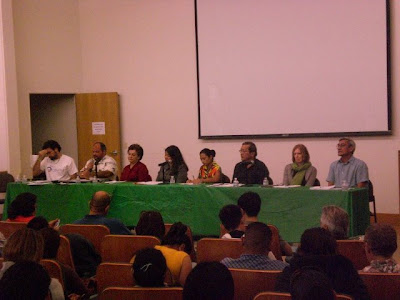
Next week on Tuesday, February 17, 2009, from 5:30 - 7:30 pm, the Univeristy of Guam will host its second "Critiquing the Military Buildup up Forum of Guahan," which brings together government officials and community representatives together to present, share and critique what the next few years and the planned military buildup hold in store for Guam.

I had the privilege of representing Famoksaiyan at the first meeting, and spoke primarily of the need to think through this entire buildup through the lens of colonialism, and hoped that people would stop seeing this has something that we are powerless against and can't do anything about. For more information on the first meeting click here.

For the upcoming forum, the list of presenters are: Representatives from the Governor’s Office, the Chairperson and Vice Chairperson of the Legislative Committee on the Military Build-Up, a UOG professor, and community action groups (I Nasion Chamoru and Conscious Living). As far as I know this means that Guam Senators Judith Guthertz and Rory Respecio will be there, as will Maga'haga' Debbie Quinata, Women and Gender Studies Instructor at UOG (yan i male'-hu) Nicole Santos, and finally Lisa Baza who works at the Court. I'm not sure who'll be there representing the Governor's Office.

Here's the info again. If you can make it please do, the discussion promises to be very lively and informative. Famoksaiyan will be having a table at the event where we'll be handing out literature and also hoping to help organize those interested in becoming more "activist" on the issues at hand.

February 17, 2009
CLASS Lecture Hall
University of Guam
5:30-7:30PM

I'm pasting below a couple of articles, which can give you a sense of the buildup and where its at right now, what are the issues involved that might come up and that you should know more about.

******************************************

Okinawa Calls for Revision of Accord on US Forces in Japan
AP
January 9, 2009

WASHINGTON, Jan. 9 (AP) - (Kyodo)—Okinawa Gov. Hirokazu Nakaima said Friday he urged the U.S. government to revise the Japan-U.S. Status of Forces Agreement in light of a string of crimes allegedly committed by U.S. servicemen.

He said he made the call for revisions to the SOFA, which governs U.S. military operations in Japan and legal arrangements for its personnel, when he met Deputy Assistant Secretary of Defense for East Asia David Sedney at the Pentagon.

But Nakaima told a news conference that Sedney's reply was to tackle such crimes through improved operation of the SOFA in accordance with the U.S. government's longtime official position on this issue.
"Operations of the SOFA are to be dictated by 'sympathetic consideration' on the U.S. part. In other words, there exist no clear- cut rules about how to operate it and everything is up to the U.S. side," he said. "We simply cannot go along with this situation."
The small Japanese island prefecture of Okinawa hosts the bulk of the U.S. military presence in Japan, equivalent to about three-quarters of all U.S. facilities in the country by area.
The SOFA gives virtual extraterritorial rights to U.S. personnel and there are growing calls for a revision to ensure that suspects are handed over to Japanese police.
Still, Sedney was quoted as saying the Pentagon will strive to meet Nakaima's wishes that crimes and accidents involving U.S. personnel are brought as close as possible to zero.
Nakaima is visiting the United States to tell the Americans about Okinawa's need for its heavy burden in hosting U.S. military forces to be lessened.
On the realignment of U.S. forces in Japan, he said he wants Okinawa's hopes regarding a plan to relocate the U.S. Marine Corps' Futemma Air Station within the prefecture to be reflected.
Japan's central government and Okinawa remain at odds over a plan to construct an airfield in Nago to which key functions of the Futemma base in Ginowan will be relocated in line with a Japan-U.S. accord reached in 2006.
Okinawa has demanded that the envisioned airfield with two 1,600-meter runways in a V-shape formation that will use part of the coast of the U.S. Marine Corps' Camp Schwab be moved offshore, citing concerns among residents over safety and noise.
Noting the ongoing environmental survey around the site will probably expose a host of problems, the governor said, "We hope such factors will be taken into account as much as possible."
The relocation of the Futemma base by 2014 is a key item of the 2006 realignment agreement. Japan and the United States also agreed that 8,000 Marines and 9,000 of their family members will be moved to Guam from Okinawa in connection with the Futemma base relocation.
Nakaima said he intends to visit again for further talks at an early date after the new U.S. administration of President-elect Barack Obama takes office on Jan. 20.

**********************************

Think tank proposes Guam as Iraqi refugee center
TUESDAY, 13 JANUARY 2009 22:31 BY GERARDO R. PARTIDO
VARIETY NEWS STAFF

An American think tank specializing in national security has released a study naming Guam as a possible relocation site for tens of thousands of Iraqis serving with the U.S. military and other U.S.-affiliated organizations.
The Center for American Progress or CAP, is a think tank headed by John D. Podesta, former chief of staff to President Bill Clinton and professor at the Georgetown University Center of Law.
Its study, entitled "Operation Safe Haven Iraq 2009: An Action Plan for Airlifting Endangered Iraqis Linked to the United States," warned that extremists and militia groups are now targeting the estimated 30,000 to 100,000 U.S.-affiliated Iraqis, describing them as traitors for working with Americans.
"In many cases, the lives of these Iraqis and their families are in imminent danger and many have become refugees or internally displaced persons within Iraq," CAP said.
The study concluded that these Iraqis urgently need and deserve America's help, and the Obama administration should act quickly to remove them from harm's way.GuamCAP said one possible location for processing these Iraqis is Guam, which already possesses pre-existing infrastructure and has status as a U.S. territory.
The study also pointed out that Guam already has experience in housing refugees during the aftermath of the Vietnam war as well as Operation Pacific Haven.
In 1996, the U.S. military set up a safe haven area in the Kurdish area of Iraq to protect civilians during the First Gulf War in 1991. The United States worked quickly to repatriate 6,600 Iraqi Kurds who first crossed the border into Turkey and were held briefly before being transported to Guam, with security screenings taking place prior to the airlift.
The Turkish government did not want this large number of Kurds in their territory, prompting the rapid U.S. airlift response. Operation Pacific Haven ran from September 16, 1996 to April 16, 1997.WavesThe study recalled that the military flew three groups of refugees to Guam in successive waves. Once in Guam, Iraqis lived on an annex of Andersen Air Force Base.
The United States provided food, housing, clothing, medical care, and assimilation classes. The asylum processing took place in Guam in an expedited fashion and involved lawyers, the Immigration and Naturalization Service, the State Department, and the Department of Health and Human Services. Screening consisted of background checks, medical examinations, and the designation of sponsors.
According to the study, the whole process took an average of 90 to 120 days and the cost of the Guam portion of the operation was approximately $10 million.
"A small caseload of approximately 80-90 Iraqis were problematic and thought to be double-agents. They were the last to be airlifted from Turkey and were stuck in Guam and/or kept in detention for a lengthy period of time before their cases were resolved," CAP said.StepsFor the current proposed refugee operation, CAP proposes the following six-step course of action for 2009 as modeled after current airlifts by coalition partners and best practices from past airlifts:
Step 1: Appoint a White House coordinator for Iraqi refugees and internally displaced persons. President-elect Obama should appoint a White House coordinator for Iraqi refugees and IDPs as outlined in the Kennedy-Biden-Durbin-Hagel-Smith legislation—a bill to develop a policy to address the critical needs of Iraqi refugees. The coordinator's responsibilities would include overseeing the airlift;
Step 2: Conduct an audit and review of current efforts. Full-time, dedicated embassy staff throughout the region from various U.S. government agencies must conduct a thorough audit and create a comprehensive list of U.S.-affiliated Iraqis through the SIV and traditional refugee assistance programs;
Step 3: Finalize security background checks. U.S. agencies should increase resources and personnel to conduct in-country security background checks of U.S.-affiliated Iraqis in Iraq and throughout the region;
Step 4: Order the commencement of the airlift. Once Iraqis are identified, the military should fly Iraqis in small, staggered groups to a third location;
Step 5: Implement and follow up on third-country expedited processing for Iraqi refugees. The White House coordinator should convene agencies such as the Department of Homeland Security, the Department of State, and the Department of Health and Human Services, which would be engaged in the expedited processing of U.S.-affiliated Iraqis and oversee smooth coordination between U.S. government agencies and the military; and
Step 6: Facilitate relocation and placement in the United States. U.S.-affiliated Iraqis should be flown to the United States, where some can be funneled into Arabic language-critical jobs. Once the situation in Iraq has improved and U.S.-affiliated Iraqis feel confident about their safety, the expectation is that some of them will return to Iraq.

*******************************

CLTC property eyed for military buildup
By Clynt Ridgell
KUAM News
Published Dec 8, 2008

There's evidence of what land the military may be looking at for use with the military buildup. On Friday Governor Felix Camacho blasted the Department of Defense, the Joint Guam Program Office, and the federal government as a whole for not letting Guam leaders in on the various plans for the Guam buildup. The governor said he believes that the feds expect to use Government of Guam land, more specifically Chamorro Land Trust Commission parcels.

CLTC Administrator Joe Borja said he hasn't received an official request by the military for the potential use of CLTC property but he does have an idea of properties that federal officials may be looking to use as part of the military buildup. "The military, I believe, does have enough land for what they want to do, enough acreage but I don't believe they're in the right places so purely for planning purposes we're looking for some areas that they might be interested in," Borja said.

The administrator pointed KUAM to three areas that he believes the military may be considering. Based on his conclusions on properties that would make logical sense for military use, Borja said he expects the military will want property that they used to own after the Korean War and property that is in a large enough unused area away from residents and businesses.

Borja believes a piece of property near the NCTAMS area is a prime example of property the military would be looking at using. While the Navy owns property to the North and South of former Crown land which is now under the Ancestral Lands Commission, he said it would make sense for the military to utilize the Crown land along the northwest which is roughly around 600 acres.

Borja noted though that it's not the biggest piece of land the military may be considering. "The military through their contractor sub contractor did ask for permission to conduct a superficial survey of properties up north to see, you know, what the conditions of the property up North are, but there's been no real formal request other than their request for access to do superficial survey of properties up in the northeastern part of Guam," he stated.

The property Borja is referring to lies along with eastern coast of Guam in Land Trust property that runs from the Marbo Cave area, past the 76/Circle K Guam Raceway Park. Raceway Park owner Henry Simpson said he's actually heard similar rumors for quite some time now. "Just recently it became kind of a little bit more than a rumor as they've hired engineers and various people to go out... They're measuring how many plants and animals and things on the property so it seems like they're becoming more serious about it," Simpson explained. He said although they've begun surveying the property around the raceway park, he, too, has yet to receive any official word.

"I'm not anti-military by any means but it seems like they don't need to play their cards that close to their chest they could let the community know that they want that property give us time to plan for other areas or give us some kind of an idea you know if their gonna replace what we've built out there it would be very discouraging to see that much time and effort go to waste and all the people that have been involved in it so that bothers us," Simpson said.

The area, according to Borja, is roughly around 2,000 acres but it's not the only CLTC land this size that the military is surveying. Borja said they've also begun surveying land in the South that lies adjacent to Naval Magazine and Fena Lake. This property is mostly in the village of Talofofo and is roughly around what's known as the Babulao area. It too is roughly 2,000 acres so although it is by no means official, the military is surveying large amounts of CLTC property in the South and North.

*********************************

Officials Offer Conflicting Views On Guam Military Build Up
Written by Stars & StripesSaturday, 07 February 2009 09:55Guam - (Stars & Stripes):
More officials are expressing concern that the planned move of some 8,000 Marines and their families from Okinawa to Guam could be delayed.
While Japanese and Pentagon officials are standing by the timetable in a bilateral agreement signed in May 2006 that the move will be completed in 2014, the commander of U.S. forces in the Pacific and a Guam senator say it may take a decade or more to accomplish.
One issue is a key provision of the agreement — a new Marine air facility to be built in rural northeast Okinawa on Camp Schwab to replace Marine Corps Air Station Futenma.
Okinawa officials want the plan revised to move runways for the new airport offshore. Their opposition has delayed the project.
Another sticking point is that Japanese taxpayers want assurances that money their country spends on the Guam end of the project will help Japan’s flagging economy.
"We are behind a timeline to achieve that goal of 8,000 [Marines] down to Guam, and we don’t have enough money to make it happen right now," U.S. Pacific Commander Adm. Timothy Keating told Reuters in Washington on Thursday.
"I don’t think it will happen on time," he was quoted as saying. "I think it will be more expensive."
However, the Reuters report quoted a Pentagon official as disagreeing with Keating.
"We have no reason to believe that we are not going to meet the timeline we have set out," Pentagon press secretary Geoff Morrell said. "He’s certainly entitled to his opinion on this matter. But, officially, we are committed to the roadmap as agreed."
Guam Sen. Benjamin J. Cruz was in Tokyo recently and met with a Japanese Diet member who he said also expressed reservations about the realignment plan.
"There are various issues that they’re trying to deal with, besides the Futenma project," Cruz, vice speaker of the Guam Assembly, said in a telephone interview Friday with Stars and Stripes. "One is getting the Japanese taxpayers to support paying for the relocation of a foreign force."
He said the $6 billion Japan agreed to contribute to the Guam project is contingent on being able to recoup the money by having Japanese companies and workers involved in the construction projects.
"But it’s my impression that the mood in the U.S. today, with the ever-increasing unemployment rate, is to use U.S. companies and workers," Cruz said. "And some Japanese are put off by what they believe are unreasonable estimates for some of the projects. They’re especially incredulous over the estimated $645,000 for each single-family home for military personnel. Frankly, I’m not even sure how the military arrived at that figure."
U.S. and Japanese officials have said from the beginning that the move of the Marines to Guam, including III Marine Expeditionary Force headquarters, hinges on the Futenma replacement project. Once the new Camp Schwab facility is built, the U.S. has promised to close Camp Kinser, MCAS Futenma, the rest of Camp Lester and part of Camp Foster.
In his interview with Reuters, Keating said there was no change under the Obama administration regarding the realignment plan. Secretary of State Hillary Clinton is expected to sign an agreement detailing specific guidelines for the project when she visits Tokyo later this month.
Keating told Reuters a delay doesn’t have to be a bad sign.
"A case can be made that a more measured, longer-term approach could be beneficial," he said.
A spokesman for Japan’s Ministry of Defense said Friday he believed the project was still on track.
"The Ministry of Defense has allocated 35.3 billion yen (about $392 million) to be spent for the project for fiscal year 2009," said Takashi Sekine, chief spokesman for the ministry’s International Public Relations Office. "In accordance with the [2006 agreement], and to reduce the burden of Okinawa, we will faithfully implement the plans to move Marines to Guam, aiming to complete it by 2014"

Friday, February 13, 2009

Congress Moves to Limit Obama's Executive Power

Fihu hu hungok na kalang mana'acha i Democrats yan i Republicans gi lagu. Esta hu tungo' na kalang mamparerehu i dos na ineto guini giya Guahan, lao gi lagu, sa' mas dongkalu i inteno siha yan i tano' siha, guaha diferensia.

Taitai este na tinige' gi pappa' ya puede ha' un komprende sa' hafa hu abobona i intenon Democrat kinu i intenon Republicans. Para ocho anos, i Republicans muna'lamon Si George W. Bush. Ma na'i gui' gusto gi todu i minalago-na. Sen magof hu na matulaika este.

*******************

Published on Thursday, February 12, 2009 by Salon.com
Congress Takes First Step to Impose Limits on Obama's Executive Power
by Glenn Greenwald

Earlier this week, I wrote about the State Secrets Protection Act of 2008, which was co-sponsored by numerous key Senators [including Joe Biden and Hillary Clinton, as well as the Senate Judiciary Committee's Chair (Pat Leahy) and ranking member (Arlen Specter)], and which was approved by the Judiciary Committee last year with all Democrats voting in favor. That bill, in essence, sought to ban the exact abuse of the State Secrets privilege which the Bush administration repeatedly invoked and which, now, the Obama administration has embraced: namely, as a weapon to conceal and immunize government lawbreaking (by compelling the dismissal of entire lawsuits in advance) rather than a limited, document-by-document evidentiary privilege.

Yesterday -- as an obvious response to the Obama DOJ's support for the Bush view of the privilege -- Leahy and Specter, along with Russ Feingold, Claire McCaskill, Sheldon Whitehouse and Ted Kennedy, re-introduced that bill in the Senate. When doing so, Leahy made clear that the bill was more needed than ever in light of the actions of the Obama administration:

During the Bush administration, the state secrets privilege was used to avoid judicial review and skirt accountability by ending cases without consideration of the merits [ed: exactly what the Obama DOJ endorsed this week]. It was used to stymie litigation at its very inception in cases alleging egregious Government misconduct, such as extraordinary rendition and warrantless eavesdropping on the communications of Americans [ed: exactly what the Obama DOJ endorsed this week]. . . .

We held a Committee hearing on this issue last year, and the appropriate use of this privilege remains an area of concern for me and for the cosponsors of this bill. In light of the pending cases where this privilege has been invoked, involving issues including torture, rendition and warrantless wiretapping, we can ill-afford to delay consideration of this important legislation.
Sen. Feingold explicitly criticized the Obama administration earlier this week for its endorsement of exactly these abusive theories. Several hours before the Senate bill was introduced, several key House Democrats introduced a similar bill in the House. The ACLU promptly endorsed the bill.

A President who seeks to aggrandize his own power through wildly expansive claims of executive authority ought to be vigorously criticized. But the ultimate responsibility to put a stop to that lies with the Congress (and the courts). More than anything else, it was the failure of the Congress to rein in the abuses of the Bush presidency (when they weren't actively endorsing those abuses) that was the ultimate enabling force of the extremism and destruction of the last eight years.

What we need far more than a benevolent and magnanimous President is a re-assertion of Congressional authority as a check on executive power. Even if Obama decided unilaterally to refrain from exercising some of the powers which the Bush administration seized, that would be a woefully insufficient check against future abuse, since it would mean that these liberties would be preserved only when a benevolent ruler occupies the White House (and, then, only when the benevolent occupant decides not to use the power). Acts of Congress -- along with meaningful, enforced oversight of the President -- are indispensable for preventing these abuses. And that's true whether or not one believes that the current occupant of the Oval Office is a good, kind and trustworthy ruler.

My time is limited this morning, but Chris in DC -- a Washington lawyer and regular commenter here -- elaborates on his own blog as to why it is a re-assertion of Congressional authority (not kind and good acts from Obama) that is the paramount priority:

What is often overlooked in all these discussions about the specific abuses of the Bush administration, amid all the resentment toward a particular president and his Republican party, is how much severe damage these excesses are doing to the very structure of our constitutional system. That corrosion of all sources of institutional (and popular) power other than the federal executive branch is, to me, far more egregious, more significant, and more difficult to reverse than the control and individual acts of a certain president or party in power at any given time.

As Marcy Wheeler notes, the co-sponsors of this bill are among the most influential in the Senate. The bill is endowed with the two most precious Beltway commodities -- bipartisanship (with Specter on board) and the blessing of a saintly "centrist" (McCaskill). It's a bill that is co-sponsored by the two leading Senators on the Senate Judiciary Committee as well as the Chairman of the House Judiciary Committee (Conyers). If they are serious about imposing meaningful limits on the Obama DOJ's attempt to shield the executive branch from judicial scrutiny, they will be able to move this bill quickly. I hope to have more shortly on ways to push that process along, but more vital even than limits on this privilege is having a Congress that once again acts as a meaningful check on executive transgressions. Restoration of that system is of far more enduring value than Obama's issuance of magnanimous and irrevocable-on-a-whim decrees.

* * * * *

In yesterday's post focusing on Marc Ambinder's "reporting" yesterday (Armando describes more accurately what it really is in the struck-through language), I made reference to Andrew Sullivan's immediate condemnation of the Obama DOJ's embrace of the Bush position on State Secrets and contrasted that to his defense of the Obama DOJ yesterday, noting that he appeared to have changed his views on this matter rather substantially in a short period of time. Last night, Andrew wrote that I misstated his position (emphasis in original):

For my part, I have not changed my mind and never, pace Glenn, stated that the Obama administration was complicit in torture. I said it should be very careful to avoid that.

I certainly didn't mean to misinterpret what he wrote, and don't think I did. Just compare what Andrew actually wrote to what I said he wrote (emphasis added):

Me yesterday: Andrew was "arguing just two days ago that Obama was becoming retroactively complicit in Bush's torture program as a result of shielding it from scrutiny."

Andrew on Sunday: "This is a depressing sign that the Obama administration will protect the Bush-Cheney torture regime from the light of day. And with each decision to cover for their predecessors, the Obamaites become retroactively complicit in them."

I tried to track his exact language in describing what he said, so it's difficult (at least for me) to see how I mischaracterized what he wrote. In any event, I agree with Andrew's general argument from Sunday that a form of complicity can arise if the Obama administration is too vigorous and dedicated to keeping Bush crimes concealed and protecting them from any scrutiny and accountability (and that complicity analysis should always begin with, and be grounded in, the United States' obligations under Articles 2, 4, 7 and 15 of the Convention Against Torture, to which Ronald Reagan bound the U.S. by signing it in 1988). It's far too early to declare that this has happened, but embracing the long-excoriated Bush view of the State Secrets privilege (and vesting power in people to implement views like this) are clearly ominous steps in that direction.


© 2009 Salon.com

Glenn Greenwald was previously a constitutional law and civil rights litigator in New York. He is the author of the New York Times Bestselling book "How Would a Patriot Act?," a critique of the Bush administration's use of executive power, released in May 2006. His second book, "A Tragic Legacy", examines the Bush legacy.

Wednesday, February 11, 2009

Free Art Friday

A few weeks ago I was forwarded this article from Dublin, Ireland by Fil Alcon, the owner of the Guam Gallery of Art at the Chamorro Village:

FREE ART FRIDAY.......
Out of cash? Pick up free art on streets of Dublin
Fri Jan 23, 2009 11:33am EST

DUBLIN (Reuters Life!) - The financial crisis has hit Ireland especially hard, so Dubliners will appreciate getting a little surprise for nothing. The "Free Art Friday" movement has reached the Irish capital.

The group, with "no known creators or hierarchy," asks established artists and amateurs to leave pieces of art at random places -- on benches, cash machines or telephone booths -- for the next passer-by to pick up and take home if they wish.

It is absolutely free but there is a note with an e-mail address at the back if they want to thank their donor.

"Free Art Friday is a terrific idea," said artist Sean Hillen, whose photo montage prints were among the hundreds of items scattered around the city throughout Friday.

"I'm a strong believer that art is really for everybody," Hillen told state television. "Ireland has only really come in in the last generation to the idea that people could have and should have original art in their homes."

(Reporting by Andras Gergely, editing by Paul Casciato)
© Thomson Reuters 2009 All rights reserved


From this inital article, and after a couple of discussions it was decided that the gallery and the Chamorro Artists Association would have a free art night of their own, a Free Art Friday to take place this Friday the 13th at the Guam Gallery of Art, 6:00 pm - 10:00 pm. At least 13 artists, myself included will take part in the event, and in some way create free, public art, whether by making something which will be placed in the world for all to see free of charge, or by creating a lot of something and then allowing people to take it free of charge.

The Marianas Variety published an article this morning on the event, noting that one local artist said that this sort of event devalues artists and that he or she would not participate. I can understand this point, but on the other hand, artists and art at their best are community servants, underpaid and often times under appreciated ones, but they are meant to help stoke the fires of a community's imagination. To keep them mentally on their toes, to help them appreciate the world, to give them something they wouldn't expect, something new, something different.

For me, giving away free artwork is easy, I don't make massive bronze sculptures or hulking oil paintings, for this sort of activity I'll make some simple small original abstract paintings. Quick paintings that only take a couple of minutes, but which might make someone's day, might unlock a corner of someone's mind, might become a gift to someone they love (or hate depending on what painting they take). My relationship to art and art buyers on Guam has been a tenuous one.

Ten years ago, while attending UOG as an undergrad I tried to also be a full time free lance artist. I sold my work at the Chamorro Village, usually on a table in front of my grandfather's shop, I attended whatever fairs or festivals I could, although often times the price of the table was more than I would make selling there. I had two solo exhibitions, both at CAHA's Two Lover's Point Gallery. Right now, there are literally hundreds of my pieces floating around Guam right now. Everyone once in a while I come across some.

But my prices were always so low, and my subject matter so "foreign," that it really did become about love and providing for the community. I could have set higher prices, but then frankly no one would have ever bought anything, and I would much rather have my work out there appreciated, even if by someone who only paid a couple of dollars for it, then sitting in my closet or the trunk of my car. My work at that time was very abstract and so most people on Guam were looking for trongkon niyok or latte when they went art shopping, and so although I did have some pieces which reminded people of latte or trongkon niyok they usually had titles like "coconut tree being swallowed up by the hole in the universe" or "an island's trauma as if it were a cracked latte stone."

For the Free Art Friday, I've made a lino cut block, which I'll then make prints from. In the past few years, my art has circled around three subject matter, women's faces, sunsets and abstract images. But for Free Art Friday I decided to take a break from these types of images and chose instead to do a quaint scene of a karabao relaxing in the ocean at night. I hagga-hu Sumahi desperately loves karabaos and yells "bao bao" everytime she sees one, and so like most everything nowadays, I did it with her in mind.

I'm pasting the image here, but you can get a free original printing of it yourself by coming down to the Gallery on Friday night.

**********************************

Finders, keepers
Tuesday, 10 February 2009 22:30
By Jennifer Gesick
Variety News Staff
Free Art Friday kicks off

STARTING Friday until the end of the month, you can own a piece of art-- for free. Hence Free Art Friday, a movement that started in Dublin, Ireland and has been adopted by Guam artists.

Free Art Friday is a simple concept where artists create a painting, sketch, sculpture or installation and leave it in public places or on the street. The artwork can be picked up by anyone who wants it, and finders are invited to email the artist.

For the artist, it gives them a chance to create work uninhibited by the requirements of commerce, because art is so often attached to a need by the artist to “make a living” and it is affected by gallery and dealer issues.

All artists whether producing static or removable art want to promote discussion.

“In Guam it always rains so we are going to put the art inside buildings,” said Filamore Palomo Alcon, owner/curator/artist of The Guam Gallery of Art in Chamorro Village and founder of the Chamorro Artist Association.

Free Art Friday will kick off this Friday at 6:30 p.m. at the Guam Gallery of Art in Chamorro Village. At least 14 artists, including Alcon, have confirmed their participation in the project. Other participating artists and photographers are Monica Baza, Viktoria Sayrs, Mar-vic Cagurangan, Moe Cotton, Jason Palmertree, Tessa Borja, Rolly Zepeda, Tina Zepeda, Kristin Zepeda, Jacqueline Hernandez, Tim Hanley, Al Lizama and Michael Lujan Bevaqua.

Alcon said there were some artists who are against the Free Art Friday concept. “One artist said he will not participate in this event because he believes it is devaluing his art.”

He disagrees: “It’s not devaluing art if anything it’s the opposite. It is a good way for people to promote their art, and what is wrong with giving something away when we give away lots of art to charities. Everything good that is given away comes back to you two fold,” Alcon said. (By Jennifer Gesick)

Monday, February 09, 2009

Kantan Tumutuge'

I've been working on my dissertation for about three years now, but have only spent the past year or so writing it. I could easily take another year to finish it, and sort of slowly and lazily work on it, but I'm in a hurry to get out of the graduate student phase of my life. Menha yu' ni' student debt, esta o'sun yu' nu i lina'la estudiante kolehu, ya guaha otro na malago bei cho'gue gi i lina'la'-hu.

So I'm pushing myself to finish and have a tentative date for the first week of June to actually defend this damn thing.

Right now I've written the first drafts of three chapters and am almost done with my fourth one. After that I've got one quick chapter left and then a conclusion and I have my sprawling, insane, crazily written first dissertation draft done. Este nai i guinife-hu, na bai hu (put fin) na'funhayan este na tinige', kosaki sina bai hu na'hanao mo'na i karrera-hu ta'lo.

A few months ago one my friends suggested that those of us in our department who are stuck in writing thesis(es), qualifying exams, or dissertations or prospectus(es), that we all join together and make a group blog on the dire straits, difficulties and insanities of writing these sorts of academic projects. She suggested "Dissertation Detritus" as a title for the blog. I was excited about the idea, since it would have meant more time taken away from my dissertation to work on other more interesting and exciting things. My life at this point is all about searching for distractions, reasons why I can't work on my dissertation today, and then achagigu remembering all the reasons as to why I have to finish it up, have to push myself, can't end up another Pacific Islander or Chamorro who couldn't finish their doctorate, because they came home ya kinenne' gui' ni' duendes gi halom tano'.

Writing my dissertation has been a struggle at times. I've been a grad student for so long, and have already written two master's thesis(es), several dozen conference papers, a handful of articles, and have endlessly blogged about academic issues. I've had to develop a lot of tricks in order to get myself to write, and also learn what my strength and weaknesses are when it comes to writing.

One thing that I've learned about myself is that I tend to write best, when I'm not paying attention to something around me. So classes, lectures, public meetings, etc. Group settings where someone is speaking or several people are speaking, are for some reason ideal for me to write, for me to work through ideas and come up with the first drafts of something. Ilek-na Si Rashne na i mina'taiguiguini yu' sa' "jerk" yu'.

Over last summer ended up taking several videos of myself out in the world writing. I've been cursed with an affliction whereby I have to hand write almost everything first, before it can go into the computer. For some reason any writing other than that which I'm blogging about, is incredibly hard for me on the computer. I ended up freezing up, distracting myself, loosing interest, getting upset and eventually spiraling into tano' taisetbe.


When it comes time to actually type up my endless pages, I can never do it at home or in any place near a bed, television or video games. All three of those things will lead me to sleep, watch or play. So since I've been on Guam I've found that certain coffee shops with nice aircon, free wireless and sometimes good food and drinks are my best typing environment.

The main thing though which has helped me through this dissertation writing process has been finding the right songs, that help make my mind click and for some reason help me focus. I first wrote about this in 2006 in my post "Soundtrack Lachadek." I was then working on finishing up my master's thesis in Ethnic Studies titled "Everything You Want to Know About Guam But Were Afraid to Ask Zizek."

I had found that certain songs helped motivate me or put me in the grove to write and so I eventually made my own writing soundtracks. Here's a sample of the ones I used to listen to, they were all pretty fast paced anime-inspired songs:

"Katayoku no Tenshi" (One Winged Angel) - From Final Fantasy VII
"Decisive Battle" - From Neon Genesis: Evangelion
"Katana Suite" - From Samurai Fiction
"Vagrancy" - From Samurai Champloo
"Terra's Theme" - From Final Fantasy III
"Kaneda" - From Akira
"Fumoffo Theme" - From Full Metal Panic! Fumoffo!
"What Planet is This?" - From Cowboy Bopeep/ Cowboy Bebop

As I'm writing my dissertation, my tastes are slightly different. I've definitely been heavily affected by Rock Star Band and Guitar Hero, in terms of what music can keep me motivated and make me tap my feet in my yoris while I write.

But in the hopes that there are others out there who are struggling with writing and looking for some dissertation soundtrack suggestions, here's the ones that use most. I've rated them in terms of how useful they've been to me.

*********************************************

1. Boston - "Foreplay/Longtime"


This song helped me write my entire first dissertation chapter. I just listened to it over and over and over and over and over again. Its actually two songs put together, and its almost eight minutes long. You could actually mark time in your life by this song. Just as progressive bloggers made "Friendman Units" of "F.U." equalling six months of time. You could easily use this song to do the same. Boston units to go along with Rush units.

2. Led Zeppelin - "Kashmir"


Even though I've listened to this song many many times, and it were essential in helping me get through the last few sections of my third chapter, I still don't understand why its called Kashmir, when its not about Kashmir the place, but actually about Morocco?

3. Rolling Stones - "Gimme Shelter"


My third favorite song to play on Rock Star Band part 1 (after "Don't Look Back in Anger" and "Creep). This song doesn't actually help me write very much, but when I hit a lull, ya tinemba yu', and I don't want to write anymore, I just want to curl up on the floor of the coffee shop and sleep, this is a song that helps get me back in the mood. Its one of Barack Obama's "favorite" songs on his ipod, and its guitar solos are so damn catchy. When I'm typing and then come on, sometimes I find my fingers tapping as if I'm playing the song on Rock Star Band.


4. The Castro Boyz - "Cha Cha Mix (Ta Fan Peska and Dinamita)

Another song which helps kick life into what usually around 4 pm has become a writing corpse. It is so damn catchy, and I usually end up doing a very bad stationary cha cha while I'm listening to this song and typing. I'm doing one right now. I think the table behind me is giggling at it. Lana.


5. Fall Out By - "Dead on Arrival"


A short song and there aren't alot of short songs on this list, since longer songs tend to wrap you up in a different universe where your thoughts flow out of your brain with greater ease. I found that when I listened to this song, I would actually type not easier, but much much faster. That I would be hurrying and typing at certain points in order to be done with a sentence or a paragraph so that at the right moments I can mouth to the lyrics "dead on arrival!" or "this is side one/flip me over." This was a very weird feeling when I realized this. Kind of like Pavlov's karaoke experiment, to go along with Pavlov's dog and cat.

6. Dragon Force - "Through the Fire and Flames."


An evil crazy song, that I once thought was cool until I attempted to play it on Hard on Guitar Hero III. Now this song is like the bane of my existence, one of the few songs that I couldn't beat on Hard or Expert in that game. This song is like a crossroads piece. I sometimes put it on when I reach a theoretical crossroads in my writing, where I could go two (or more) different ways in terms of getting my point across. This song is seven minutes long, which feels like alot of time, until you you spend it reading through pages of writing, drafts, articles, interviews and so on, hoping to figure out what course would be best. In that context, the song really sometimes feels like you are slowly being consumed by fire and flames, and Herman Lu's ti hongge'on na guitar playing is taunting you by your indecisiveness. By the end of the song you should have a decision, and if you don't, then you really feel like a failure when you have to listen to that long-ass song again.

7. Matala - "Leocadia/Tight Fit"


I saw a video of these songs played back to back by the band at a show at the UOG cafeteria, and I ended up favoriting it on youtube, and listening to it over and over while I was writing my second chapter. I eventually asked my brother to get me a copy of their CD (since he's in a band with people who are in Matala, or in bands with people who are in bands with people from Matala, actually for all I know both me and my brother are currently band members of Matala). "Leocadia" is just instrumental and comes on first and hypnotizes you, and then prepares you for the faster and harder music and lyrics of "Tight Fit." Both together they helped me get through the Chalmers Johnson section of my second chapter.

8. Red Hot Chili Peppers - "Can't Stop"


This song practically wrote my prospectus, the proposal you have to write and defend before you can become "ABD." I came across it on youtube while searching for Naruto fan made videos featuring the character Kisame. I found one called "The Kisame Incident" and it used this song as the soundtrack for the battle in Konoha of Kisame and Itachi vs. Kakashi, Kurenai and Asuma. I have no idea why this sound helped me write so much. But I would just click replay on this video for hours in the background of my prospectus file, and it just worked.

9. Oasis - "Masterplan"


Its getting harder and harder to write, even though I'm more than half-way there its been difficult in the past month to keep myself motivated. Too many distractions, too many other things that I could be involved in, working on, all of which seem more exciting and interesting than my dissertation. Even songs that have helped me before, don't seem to be helping me focus. One of the few songs that been working is "Masterplan" by Oasis. I don't know why, maybe I'm in a meloncholic mood and Oasis is appealing to the dejected, detatched, apathetic British brat in me? Hekkua'.

10. - Journey - "Don't Stop Believin"
This song doesn't really help me write that much. But sometimes when I do feel like I'll never finish or I'm gonna get stuck and never write again. This song makes me smile.

Sunday, February 08, 2009

Evaluations from the Center of Gravitas

From the Blog: Center of Gravitas:
Gos na'chalek este.

***********************************

My last post exposed some ambivalence among faculty about the role of “official” teaching evaluations from students. Most of us do want feedback on content, but there also seems to be a general consensus that the weight given to student evaluations is out of kilter with the actual hard work that goes into teaching. I also believe that most students are not well informed about the purpose of evaluations.As many of us are seeing last semester’s teaching evaluations return to us, let me help you read between the lines of those anonymous student comments that aren’t really about your teaching at all. It’s time for one of my favorite segments at CoG, “What They Say and What They Really Mean.”

What They Say in the Written Evaluation: “This class was one of the best classes that I have ever taken.”

What They Mean: “This class was one of the best classes that I have ever taken.”

***

What They Say: “This is the worst class that I have ever taken.”

What They Mean: “This class challenged many of my most basic assumptions and required me to work hard.”

***

What They Say: “This professor was really condescending.”

What They Mean: “I can’t take criticism.”

***

What They Say: “This class required too much reading.”

What They Mean: “To pass this class, I actually had to crack a book on my own time.”

***

What They Say: "This class was so easy it was a joke."

What They Mean: "After years of reading student complaints in evaluations, this professor has simply given up."

***

What They Say: "This professor is a leading scholar in the field."

What They Mean: "This professor assigned hir own book as required reading."


***

What They Say: “This was one of the funniest professors that I have ever had.”

What They Mean: “I didn't learn a damn thing, but the professor should be given a late-night talk show.”

***

What They Say: “This professor was filled with lots and lots of energy.”

What They Mean: “I think that this professor might have a cocaine problem.”


***

What They Say: “The professor should post the lecture notes on-line so that we can have something to follow in class.”

What They Mean: “The professor should post the lecture notes on-line so that we won’t have to go to class at all.”

***

What They Say: "This professor is a fool."

What They Really Mean: "My hubris as a first-semester freshman leads me to believe that I know more than the people who spent the past twenty years studying this topic."

***

What They Say: “Discussion during class was often filled with awkward silence.”

What They Mean: “My classmates didn’t do any of the reading and therefore had nothing to say.”

***

What They Say: “The professor has the worst taste in clothes that I have ever seen.”

What They Mean: “I have no idea about what constitutes an appropriate professional relationship and will probably be fired from my first job.”

***

What They Say: “This class should have had more films.”

What They Mean: “I was often too drunk to pay attention to the lectures.”

***

What They Say: “This class had a lot of films.”

What They mean: “The professor was often too drunk to lecture.”

***

What They Say: "This class involved a lot of discussion of the cultural significance of Wonder Woman."

What They Mean: "This class was taught by GayProf."


***

What They Say: “Grading for this class was totally unfair.”

What They Mean: “I am getting a ‘F’ in this class.”

***

What They Say: “Grading for this class was totally fair.”

What They mean: “I am getting an ‘A’ in this class.”


***

What They Say: “There was too much reading about women in this class.”

What They Mean: “I think women should be chained to the stove.”

***

What They Say: “This class was so unfair. I passed the AP test in this topic and yet I still ended up with a ‘C.’”

What They Mean: “I have confused high-school competence for university-level work.”

***

What They Say: “I was really disappointed that we didn’t talk more about battlefield strategies in this history class.”

What They Mean: “I get most of my information about the past from the History Channel.”

***

What They Say: “I was really disappointed that we didn’t talk about more contemporary novels in this literature class.”

What They Mean: “I think John Grishman is the pinnacle of American literature.”

***

What They Say: “This professor was too strict.”

What They Mean: “I had fantasies about this professor spanking me.”


***

What They Say: “This professor had a political agenda.”

What They Mean: “This professor didn’t allow me to spout off about my political agenda without evidence to support my point.”

***

What They Say: “I shouldn’t have to read about gay people in a class that is required for graduation.”

What They Mean: “My religion teaches me to think of gays and lesbians as less than human.”

***

What They Say: “The attendance policy for this class treats us like we are children.”

What They Mean: “I had to cancel a two-week vacation in Paris because attendance was required for this class.”

***

What They Say: “This class would have been better if taught by an American.”

What They Mean: “I am a member of the KKK.”

***

What They Say: “The lectures were monotonous and boring.”

What They Mean: “I have confused attending university with watching television.”

***

What They Say: “This woman (or African American, or Latino/a, or Asian) professor clearly favored women (or African American, or Latino, or Asian) students.”

What They Mean: “I don’t like taking classes that aren’t taught by a white man.”

***
What They Say: “This professor didn’t care at all about students and was really detached.”

What They Mean: “This professor expected us to be adults and do our work.”

***

What They Say: “This class really stimulated my interest in this topic. I frequently went to office hours just to talk more about the material. I have now declared this topic my major.”

What They Mean: “I am secretly in love with this professor.”

***

What They Say: The professor was often late to class.

What They Mean: This professor secretly fights crime on the side.

Friday, February 06, 2009

Indigenous and Ethnic Studies

Graduate students at my department at UCSD are right now working on a Ethnic Studies and Indigenous Studies symposium to take place in May of this year. This symposium is part of a long process over the past few years which includes last year's interdisciplinary conference Postcolonial Futures in a Not Yet Postcolonial World that I helped organize, an Indigenous Studies cluster hire that I helped write two years ago, and the Voicing Indigeneity Podcast that I used to help create with two other indigenous students in the department. The goal of the process was to create a more stable and productive space for those working on indigenous studies projects within Ethnic Studies.
For the upcoming symposium the organizers are looking to invite old scholars, new scholars and some graduate students who are all doing work at the intersections of these two discplines, either in their activism or in their academic work. I'm sure I'll have more details soon and there's also a good chance that I'll fly out to attend this conference.

For those interested in these sorts of discussions, American Quarterly, the flagship journal of American Studies, plans to do a special issue on the intersections of American Studies and Indigenous Studies. The deadline for submission of papers is September 1, 2009 for those who'd like to submit.

*********************************

American Quarterly Call for Papers
Alternative Contact: Indigeneity, Globalism, and American Studies
Paul Lai and Lindsey Claire Smith, Guest Editors

Within standard genealogies, Native studies and other racially based studies arose from a similar moment of empowerment in the struggles for racial and ethnic rights in the 1960s and 1970s, often in solidarity with Third World decolonization movements. Increasingly, Native American studies highlights connections between Native America and indigenous communities around the world, reframing questions of sovereignty and indigenous rights in international terms while continuing to challenge political discourses of the nation-state. Such work decenters paradigms of first contact with European colonial powers and subsequent domination by the United States military and government that have overshadowed discussions of native contact with peoples of other origins. This special issue explores transnational and cross-ethnic flows among indigenous peoples of the Americas, including the Caribbean and Pacific Islands, and these other peoples.

Such moments of alternative contact complicate and enrich our understanding of the links between U.S. colonial and imperial projects, sovereignty, and racial formation. Ultimately, this project seeks to theorize a more dynamic indigeneity that articulates new or overlooked connections among peoples, histories, cultures, and critical discourses within a global context.

We seek work that theorizes cosmopolitan indigeneities as the transnational movements of indigenous peoples and their governments, social and activist movements, arts, and critical discourse. We seek scholarship that identifies moments of contact among indigenous Americans and ethnic others in historically, geographically, and disciplinarily specific conjunctures and that highlights the dissonances as well as synergies produced by reconfiguring comparative ethnic studies work within the frameworks of transnational American studies and global indigenous movements. This work might offer new languages for discussing the global presence of indigeneity to counteract notions of unsophisticated or parochial Native communities and offer alternatives or rejoinders to the work of postcolonial studies by considering issues of continuing (neo)colonialism and the relation between indigenous peoples and state formations.

Framing such scholarship within globalism might build upon a long tradition in Latino/a studies of examining indigenous encounters with others and mixed-race subjectivities, query long-standing tensions between Asian Americans and native Pacific Islanders, and continue exploring histories of Native and African American connections. Additionally, we encourage submissions of papers that theorize less-studied contact, such as between Native American and Asian American bodies, communities, histories, literatures, visual arts, and politics. In these material and creative encounters, personal, political, collective, and global conceptions of sovereignty and citizenship point toward theoretical as well as practical implications for resisting empire.
Email essays by September 1, 2009, to aquarter@usc.edu. Information about American Quarterly and submission guidelines can be found on our Web site: www.americanquarterly.org.

Wednesday, February 04, 2009

Hayi i MLK Guini?

Martin Luther King Jr. Day passed recently, and this year it was very different, for obvious reasons. America saw the election of its first African American President, and so people are feeling like a lot is suddenly possible, as the symbolism of America has been rocked, as its status as a white souled nation challenged indirectly, even though Obama was hardly a card carrying member of the Black Panther Party.

As an Ethnic Studies scholar MLK Jr. is someone you always hear plenty about and always have to confront the ghost of. He is an inspiring figure, somebody who accomplished great things, who said many great things. Last year I went to the Martin Luther King Jr. historical district in Atlanta, Georgia, and saw his home as a child, and also different exhibits on the civil rights movement. Bai hu admite na guaha nai kana tumanges yu'. Manachu i taotao gi ayu na tiempo para i direchon-ñiha para u difende i tinaotaon-ñiha.

But apart from these incredible things, MLK is also something to be wary and cautious of, much in the same way that Barack Obama is.

The glorification of MLK threatens to mystify all of us and forget how movements and social change actually happen. They do not happen because of a single leader or inspirational figure. Those are always there, but there are always far more than the memorialization of an event or its canonization will allow. The stories of social change with a single great leader who embodies everything wonderful about said social change are all after the fact accounts. All simplifications, meant to make the writing and remembering of that event as easier, more palatable, more simple and in the case of struggles over racism and institutional violence, make them seem more inevitable. These sorts of hero building make it seem as if a Messiah will soon arrive who will magically organize and inspire people, who will alter the consciousness of the opposition and make things the way they were really supposed to be. All that racism stuff, all that oppression and marginalization was just a detour on the path to the ultimate fulfillment, in this instance of the true greatness of America: equality, even if its of the eventual, deferred for a few centuries kind.

But this is the danger in all larger than life figures. On the one hand they have the potential to animate us, to activate parts of our mind, inspire us and expand our imagination. This is the mainstream excitement over Barack Obama. He has now "opened up" the Presidency to all black people in America. It is now possible for a black child in America to think and believe that they can be President when they grow up. MLK and Barack Obama are now figures which push our imagination, that show us how things can change, and hopefully push us to be a part of that progressive momentum in our own lives.

But at the same time, these larger than life figures can make us forget that we do have a role in shaping our communities or determining our futures. With this hero-making, we can easily assume that it is actually these figures who do the improving, who are the ones who can actually change things. We can project onto them the responsibilities that we know we have. Instead of the mantra “we are the one’s we are waiting for,” it is very easy to assume that “those big shots, those heroes are the ones that we are all waiting for.” The making of heroes thus serves a conservative impulse, one for detachment and apathy. As if the responsibilities for improving our communities can be left to those larger than life figures, as if we need just have faith that they will arrive, and so long as we believe in them when they are here, everything will be fine.

So for every activist, someone like MLK is the dream that can help them connect to other people, communicate the need to act or provide them a history of progressive action, but also the bane of their existence, partially for the reason mentioned in the previous paragraph. But in another way, MLK can also be cited as an example of why no more action is necessary, a success who acts like capstone upon history. Barack Obama will no doubt soon function in the same way, that whenever arguments about racism in America are submitted, they can so incredibly easily be dismissed by simply saying the number “44.”

As I am a Chamorro activist (much to the dismay of various family members or friends), these sorts of issues aren’t just academic, but are a part of the how I engage with Chamorros and others living or tied to Guam. Chamorro culture and Guam culture are both frustratingly “laid back” and so conceiving either of them as having a history or legacy of activists or heroes in the vein of MLK is almost unbelievable. The natural way we are supposed to be on Guam is relaxed, not take things too seriously, not really stand up and fight for anything, but simply let it all wash over us, rolls past us.

Some of the tough work that I do is convince people otherwise, to make sure that they know that there is, like in any community a rich tradition of grass roots organizing, activism, people taking up critical causes, fighting the colonizers, fighting the power structure, etc. These are not just politicians, as often times leaders and heroes is automatically translated into i mampulitikat. But this tendency to overestimate the inspirational potential or society changing abilities of politicians isn’t the toughest part about being an activist invested in Guam’s decolonization. The toughest part is overcoming the mental colonization that manifests even in the way MLK is invoked on Guam.

Unfortunately, the minds of many Chamorros has become accustomed to looking to the United States first, even when it comes to defining themselves, or speaking from their own hearts about justice on Guam, and so MLK is thus something almost everyone on Guam is prone to cite even before considering somebody who is actually from Guam. Part of what I do is asking the simple question of, “who is Guam’s MLK?” Rather than accept MLK as the epitome of social movements, a fight for peace and justice or inspirational action, why not seek some of our own heroes to join MLK in the pantheon of progressive archetypes?

Knowing what I do about Guam’s history, I can come up with dozens, perhaps on a good day, hundreds of possible figures that could take on this role. Some alive today, others recently passed on, and some reduced to the robust imagery for t-shirts and tattoos. What are some that you can come up with?

Monday, February 02, 2009

Some Much Needed International Solidarity

Sometimes I wonder if any of the things that I do on the internet matter.

I write regularly on this blog, I have my zine Minagahet, I run or help run several different websites, such as Decolonize Guam or Chamorro.com. On all of these sites, I'm analyzing, cutting and pasting information about what's happening on Guam or what will soon happen to Guam. Because of this, a lot of people assume that I have a level of influence, that I'm not sure I actually do.

When I come across letters such as the one below however, I start to feel better.

Kulang magom yu'. Fihu hinasso-ku na taiga'chong i Chamoru siha gi este na mundo, sa' kalang todu ma aksesepta na i AmerikÃ¥nu siha i dueñu-ta. Lao este na taotao ha tutungo’ i minagahet. Kada na hu taitai este, hinassosso-ku, “taimanu na siña ta taka’ mas taotao?”

*********************************

BOSTON GLOBE - LETTER TO THE EDITOR
GUAM SHOULD BE WARY
January 11, 2009

"US PLANS for military buildup leave Guam wary" (Page A9, Jan. 4) reminded me why the Chamorro people are increasingly fearful of the destruction of their environment and culture, and why many are doing all they can to prevent the massive US military expansion in their occupied land.

Guam remains the colony designed to reinforce US dominance in Asia that William McKinley and Teddy Roosevelt envisioned when they seized it from Spain in 1898. Twenty-five years ago, members of the Guam Land Owners' Association worked with two maps. One depicted Guam's best fresh water supply, agricultural land, and fishing grounds. The other showed the US military bases in their homeland. The maps were nearly identical.

Now, with many Okinawans and other Japanese saying that they've had enough of US nuclear-powered ships based in their cities, and that they are fed up with the terrifying noise of night-landing and low-altitude flights and the seizure of their lands, the idea is to transfer some of this nightmare to Guam. Guam's isolated 155,000 people are a frail force to resist the imperium.

As a nation, we feel shame when we recall the genocide and cultural destruction of our country's first peoples. We should not repeat it with the military corruption and destruction of Guam.

Joseph Gerson
Director of programs
American Friends Service Committee
New England Region
Cambridge