Friday, March 30, 2007

What Lies at the Center of American Greatness? Taxes and 650,000 People

I had promised to write a letter to the editor of the Pacific Daily News several months ago, after it was announced that the five non-voting delegates to United States Congress (from Guam, The Virgin Islands, American Samoa, Puerto Rico and Washington D.C.) had suddenly become voting non-voting delegates!
Although I posted twice about this, I got sidetracked from writing the actual PDN letter because I decided to use the giving and taking away of these "symbolic" rights to articulate one of the ways in which the United States is dependent upon Guam, for the production of its sovereignty. I'm on break from school for a few days and so I've decided to finally get this letter out. I've got a long draft of it done, but just need to ribaha gui' esta ki 450-500 words. This is a very intriguing case which deserves more attention, both in Guam and elsewhere. If you are a patriotic American Chamorro, then your dreams are one step closer to being realized, if you are not, like myself then you have been literally handed another instance in which Chamorros and Guam is slapped in the face yan manmafa'ga'ga' ta'lo. Despite these facts, no one seems to really care about this.
For those interested, here's my draft so far:

In case many of you missed it, several months back, Guam joined Iraq and Afghanistan as another place which the United States has recently spread Democracy too! Through a change of the House of Representative rules, the five non-voting delegates from the territories/colonies of the United States are now voting non-voting delegates! The vote is symbolic yes, but we shouldn’t think of symbolic here as “ideal” “inspiring” or “hopeful” but rather concur with the U.S. District Court which heard the case of these voting rights first in 1993, which upheld the Constitutionality of the rights because symbolic here means “meaningless.”

In the limited way that the delegates are allowed to vote, if their vote affects the outcome, they the vote will be thrown out, and another vote will take place with those whose votes really count. Basically, for those enamored with the flashiness of having American greatness and democracy flashed before you eyes, we have moved from not having a vote, to having a vote that doesn’t count!

Democrats made this change initially in 1993 and Republicans challenged it in court, lost, but removed the rule when they came into power in 1995. Democrats vowed to bring back these symbolic rights if they regained the majority, claiming that they only want to spread a “sense” of democracy to those who are already American. Republicans have vowed to once again take this issue to court, asserting that only those who are truly American, meaning pay taxes or have at least 650,000 people in their districts should be allowed to have a voice in Congress.

Although we generally tend to think about discussions about Guam's political status as divided into two positions (those who heroically and patriotically want the status quo against those who maladjustedly and crazily advocate the island's decolonization), there are in reality three basic positions one can take. You can either want to move close to the United States or further away, or you can take the position that Guam and Chamorros are fundamentally inferior to the rest of the world, do not deserve to be equal among states or nations and should remain a colony.

If you are one of those people who believe that Guam is nothing but a backwater colony, a strategically important dot on the map until the rising tide of global warming swallows the island up, then the recent gift of this symbolic vote in Congress is something worth celebrating. If however, you are serious about Guam's just or ideal future being closer to the US or further away, then this voting rights issues should make you sick to your stomach, it should make you feel outrage and anger.

If you want Guam to move further away from the United States, and want our relationship with it to be less paternalistic, patronizing and exploitative, then this change is an obvious drawback. This change, the symbolic vote, while meaning nothing in terms of our power in the governing of the United States or determining its policy towards Guam (we are still just a lobbyist with no money), will have huge effects on the pysche of Chamorros and others on Guam, in making us think we are more American than we really are, or that Americanization or more America (in whatever form it is perceived to be) is the answer to all of life's problem.

If you love the United States, and want to be one with it, and believe that Chamorros have been historically very patriotic and suffered for the United States, then let me ask you a simple question: Is the pain of World War II, the loss of thousands of Chamorro lives in American wars, and the loss of so much land, language, culture and history worth a fake vote? If you believe in the greatness of the United States, then why can then not recognize that all of this sacrifice for them, why can they not give us not just a simple vote in the House of Representatives, but two Senators as well? Why is all of this pain and patriotism not worth incorporation, or even a real vote in Congress, and how much more pain and patriotism will it take?

And if your response is a pragmatic, we don’t pay taxes or aren’t large enough, then you are making the same arguments as Republicans in the House who have protested this symbolic vote, claiming that voting is only for real Americans. Their criteria for those who count as “real Americans” is simple, you pay taxes and you be a part of a district which has at least 650,000 people in it. If this however is what truly defines both America and Americans, then where is the greatness that we are so interested in having?

If it is true as Bordallo and other Democrats have asserted, that these symbolic votes help manifest and realize the greatness of the United States and its history and tendencies to spread and defend democracy, then we must recognize that this "symbolism" or this meaninglessness that we find in these votes, is not simply isolated in these fake votes that our delegate is to be given. This stupidity, this emptiness spreads to the core of what the United States is supposed to be, revealing the ridiculous character is its "greatness." What were once tales of American exceptionalism and moral superiority, have now been exposed as mere fictions, lies which Americans don't just tell others, but most importantly tell themselves.

Wednesday, March 28, 2007

Manifest Destiny, 300 and the Collective White American "We"

I wrote a few days ago about Manifest Destiny while talking about the new movie 300, and its role as a very potent site of white mythology, or a means by which the "exceptional" nature of whiteness and the whiteness of the United States can be explained and justified. This mythology has a number of different forms, but it is crucially dependent upon history being twisted into a gruesome, hopelessly random bricolage of historical events, figures, concepts, which only looks coherent, complete, and obvious to those who are invested in it reproducing their identities, privilege or whiteness.

In the case of 300 for instance, we can find this in the idea that the United States today is somehow the chosen/destined vessel for the historical transmission of the greatest principles of Spartan and Greek civilization. In the film the greatness, successes and fearsome overpowering positive charateristics of the Spartans become the property of the United States through the echoing of particular phrases and buzzwords, which seem to create the links of continuity from yesterday to today. The most inamous phrase which made me and my friends I saw the film with cringe, that so deadly and so painfully patriotic mantra, "freedom isn't free." As the Spartans use their reason and belief in justice and liberty to fight off annihilation from aliens who are ruled by mysticism and believe in tyranny, that phrase, spoken from that position of being besieged and embattled, which I see everyday on bumper sticker or from chain mails in my inbox, gives me the right to claim that moment as mine, the position, their positive qualities of the Spartans as my own, and furthermore gives me the right as the "victor" in and of history, to name and define those who are the "losers."

It is important to remember that the Asia and Europe, and "white" of the world of 300, and the reasons, freedom and justice are not the Asia, reason, freedom and justice of today. Yet they resonate in the minds of people today as "historical evidence" or ethnic/racial explainations as to the state of the world today. If you are like most people and have vague idea of what "the clash of civilizations" is between East and West, which is mostly propped up by the idea that because we simply are different, or because they are so violent, the behavior of the "hordes" of Asia in 300 carry alot of weight in making the clash make sense, even if its simply not true.


On Guam we can find this stupidity clearly in the way archeological and anthropological evidence about the "origins" of Chamorros are interpreted. Too often, upon finding out that Chamorros might have migrated from the area which are now called the Philippines, South East Asia, Taiwan or Indonesia, people will respond and make flash contemporary judgments about what Chamorros are today. "Oh so, you're not really Pacific Islander, you're Asian." or "Oh so you're not really Chamorro, you're Filipino."

For those who think that this is a simple, abstract and meaningless point, let's see how this plays out on a very popular website called Urban Dictionary. This online dictionary is very similar to Wikipedia, in that it is audience made, edited and supported. People "define their world" through the defining of "obscene" non-formal speech, which is still governed by rules, but seems to be outside of the realm of formal, clear and correct language, and so therefore appears to be the language which you can make truly yours. For the word Chamorro the website has more than a dozen definitions. The definitions range in content, taking different cultural, geographic and linguistic forms. The #1 definition however, makes clearly my point, I'll paste it below:

People. Indigenous to Guam and a couple of islands north of the Philipines. Kind of lacking in cultural identity. They are basically Filipinos that speak english, but are kind of Hawaii wanabes. Pretty decent folks unless addicted to ice or some other shit.

The claim that Chamorros are "actually" or "really" or "basically" Filipinos is a common one, and is supported by the mere proximity of Guam to Asia (it is often referred to as America in Asia), the appearance of many Chamorros, the large numbers of Filipinos living on Guam, the fact that Chamorros not being Polynesian are therefore inauthentic because they don't quite fit within the Hawaiian hegemony that hangs over the Pacific. It is also related, most importantly locally to the notion that the Chamorros ultimately came from somewhere else and so their political claims to being "indigenous" to Guam or having a viable contemporary claim to the island is suspect.

While one can claim that this definition is simply written by an idiot or someone who hates Chamorros or has no respect or knowledge about them, the website, because it has a sense of democracy to it, allows a feature by which people can give a definition a thumbs up or a thumbs down. While the majority of the rest of the definitions which take seriously the task of defining who or what Chamorros are received more positive votes than negative votes, this first definition when I saw it earlier today, had received by far the most votes overall, and 120 thumbs up and 63 thumbs down.

Returning to white mythology, what it is fundamental about the way I am speaking about mythology is that it is ultimately a network of meanings, concepts and historical happenings which give the illusion that the beneficiary of this mythology has the right or ability to pick and choose what is their historical inheritence and what isn't. In an excellent article by Gary Younge from The Nation titled "White History 101" we find a perfect example of how this works.

When it comes to excelling at military conflict, everyone lays claim to their national identity; people will say, "We won World War II." By contrast, those who say "we" raped black slaves, massacred Indians or excluded Jews from higher education are hard to come by. You cannot, it appears, hold anyone responsible for what their ancestors did that was bad or the privileges they enjoy as a result. Whoever it was, it definitely wasn't "us."

Although Younge is referring specifically to the way national subjects protect themselves from the dangerous violent truths of how their nation was formed (they displace it onto some abstract other), it has relevance in how white mythology is formed as well.

Because of the prevalance of multi-culturalism today, in which each culture is supposedly equal and deserving of respect and recognition, ethnic groups, their practices, rituals and histories can have important public value, but always cultural value, not political value. It is common for both white and non-white people to remark that white people "have no culture." In the multicultural framework of the United States today, those racialized as white do not have "a culture" they have THE culture, the political culture, which is central and all else subordinate to.

The thing which is supposed to truly make the United States unique is not its wealth, its military might or its cultural influence, but rather its success in "perfecting" democracy and then spreading it to the rest of the world and helping "end History." Whiteness in the United States is not simply white people, but this privilege to assert oneself as the just and destined heir to that grand and exceptional origin. That privilege is the one which might exempt you from the fun particularitic games of "culture," but gives you the ability to determine what the limits of the cultural are, and where their rights to make political statements based on their histories and contemporary experiences of oppression, colonization, slavery, genocide, imperialism and mercantilism begin and end. Given that multiculturalism is a framework that says that anyone can sit at the table so long as they accept certain political and cultural divisions which ultimately work to make impossible your ability to change the basic structure of meaning in society, or which seek to extract any political potential from the things you say, the things you embody and the things you want. You can have holidays, but not your language. You can have a month of the year for your race, but no justice. You can have welfare, but not sovereignty. You can practice your culture up until the point where it makes people uncomfortable, or makes things inefficient.

We can find an example of this division from a terribly racist letter to The Marianas Variety a few months ago from racist apa'ka Dave Davis. In this letter, Davis is responding to attempts to bring issues of colonization by the United States in Guam, and the prevention of Chamorros and others on Guam the right to exercise any rights to self-determination. As the Chamorro seeks leave its exile in the cultural and transgress into the political, and change the shape of how things are understood in Guam, most notably the decolonial deadlock where the Chamorro is impossible without the benevolence of the United States, Davis asserts the greatness of the United States or the "modern world," and their ability to determine the way things should work today, through the reduction of the Chamorro to simple culture, incapable of much of anything, both in history and most importantly today:

WE note that Mr. Jose U. Garrido (a.k.a. Joe Garrido, chairman of Guam’s Decolonization Commission’s free association task force) is again clamoring to part company with the United States of America — espousing Chamorro sovereignty, as it were.

As with dogs that chase cars — if he somehow managed to catch it, what would he do with it? Revert, perhaps, to the raw fish and grass hut societal mode? That’s what the Spaniards found in Guam 500 years ago: a Stone Age society distinguished mostly by several thousand years of no significant change or progress.

In other words, a stagnant and unremarkable Neolithic culture, indistinguishable in most respects from the multitude of similar tribes throughout the Pacific and other tropical climes.It seems that most modern Chamorros aspire to something quite different: government jobs, flush toilets, SUVs and nice housing.

What animates this exchange, what makes Davis' point is that the Chamorro which Garrido is invoking, a sovereign one, is in conflict with the United States, and first, what it wants for Guam, and furthermore its implicit assertions that it is what is best for Guam and for the rest of the world. In the language I am using for this post, we can reformulate Davis' stupid tirade in these terms "how dare you assert yourself in a political way! That is whiteness, made by white-wigged and white-skinned men in 1776, that is my domain! You have crossed the line! Need I remind you that you are nothing but culture, and because you are only that, you are nothing!"

Returning to Younge's point, the positive aspects of the wealth of the past, are brought together to form a great white collective "We." This "we" perfected democracy, or perhaps invented or created it. This "we" saved the world in two world wars, and this "we" is leading today's War of Terror.

But mythology is also invested in finding the enemies, or finding the bodies onto which the less than stellar aspects of a nation's or a race's history can be displaced onto. The not so nice violence, racism, evil, oppression, exploitation has to go somewhere, but must not taint this whiteness, must belong to someone else. So in the film 300 as the Spartans provide the white vehicle through which Americans and Europeans today can take credit for reason, democracy, rationality, justice, liberty, and the ability to adapt, change and break with evil or corrupting traditions, the negative parts of the binary, namely the mysticism, the foolish beliefs, the inability to adapt, to change, to see the way the world really is, or make use of reason and logic is displaced onto a civilization (the east), particular bodies (black and brown/and feminized/homosexual) and regions (Asia/Africa and the Middle East). Or in the Iraq War, we have all liberated Iraq, but a few bad apples whether they be in the President's Cabinet or National Guardsmen are responsible for the torture or excessive violence and atrocities, or for poor prosecution of the war.

My reason for returning to the issue of Manifest Destiny has to do with a short but very insightful article I came across from The Nation written by Air America Radio's Laura Flanders. In just a few paragraphs it deals very effectively with the issue of American exceptionalism today. For those interested in the origins of Manifest Destiny and the mechanics of how it was created and gained hegemonic traction in the 19th century you should check out this book, Race and Manifest Destiny by Reginald Horsman.

******************

Published on Tuesday, March 27, 2007 by The Nation
No Special Rights
Laura Flanders

Nonbinding this and that, deadline lah-di-dah, Bush/Cheney are going to ignore the mandate of the midterm elections and every pressure from Congress on Iraq, because Bush/Cheney know their opponents’ bark has no bite. And that’s because those opponents have yet to renounce the Bush/Cheney vision of US supremacy in the world. In fact, mostly, they share it.

William Pfaff writes about US Manifest Destiny in the New York Review of Books: “It is something like heresy to suggest that the US does not have a unique moral status and role to play in the history of nations,” he writes. Bush/Cheney tap into a belief that’s as old as the state itself. (Pfaff quotes Paine: “The case and circumstances of America present themselves as in the beginning of the world… We are as if we we had lived in the beginning of time.”)

Belief in US “exceptionalism” is the hop-skip-jump that led to US intervention in Korea, Vietnam, Iran, Central America–and now Iraq. It’s the “exception” that okays the breaking of global rules, from the Geneva Convention, to the conventions against torture to the chucking-out of Habeas Corpus. Like Dirty Harry, Bush knows Americans believe “good” cops can break the rules if they’re on a mission to save the world from terror, evil, tyranny.

Neo-cons came up with the chilling phrase “The New American Century,” but even their critics accept the concept. In his testimony to Congress on global warming, Al Gore referred not once but a handful of times to the US “unique” role to save the planet.

At the risk of being burnt at the stake I’d like to suggest that this month provides a special chance to review all this stuff about specialness. March 25 marked the 200th anniversary of the British Parliament’s abolition of the trans-Atlantic slave trade. (A US law took effect in 1808.)

To take a second look at the foundations of the country is to be reminded of the reality behind the rhetoric.

The New World wasn’t so new. Ask the people who lived here. Slavery wasn’t a new beginning. It was ancient. The first place to throw off slavery was Haiti in 1801, sixty-three years ahead of the United States. That makes Haiti special. Does it give Haiti a unique role in the world, to invade other countries and pursue a Project for a New Haitian Century?

We’ve got the brawn, but does that give us the right or the responsibility to rule the world? The problem isn’t this deadline or that. The problem is the ideology of supremacy. The same ideology (that some are by nature better, or more valuable than others) that undergirded slavery in the first place.

Laura Flanders is the author of BLUE GRIT: True Democrats Take Back Politics from the Politicians, forthcoming April 9, from The Penguin Press.

© Copyright 2007 The Nation

Sunday, March 25, 2007

Tentative Famoksaiyan Session List

I just wanted to give everyone an update on the Famoksaiyan 'Our Time to Paddle Forward:' Summit on Decolonization and Native Self-Determination. The date is still set for next April 20-22 with the program on the 21st taking place in Oakland at a place called SMAAC. On the 22nd the program will be taking place at UC Berkeley in Barrows Hall.
The schedule for presentations and sessions is filling up fast and we have a very exciting lineup so far. I'll have more details and descriptions later, but for now, I'll just list the titles. Remember, if you are intereted in attending or want to know more, just email me.
Information Sessions:
Marianas History
Getting to Know The Department of Interior
10 Books About Guam That You Should Own or Know
Overcoming the Activist Label
Workshops:
Writing for Social Change
Guahan Economic Sustainability Working Group
Collaborating on Chamorro.com
Campus Organizing for Pacific Islander Students
Chamorro Language Introduction
Presentations:
Chamorro Cultural Fair (SDCCC)
reading, supporting, writing and publishing pacific poetry


*****************

Ti sina hu na'tungo' hamyo iyo-ku excitement put este na dinana! Hu hahasso ha' i "energy" ginnen i ma'pos na biahi na mandana ham todu.

For those of you unfamiliar with Famoksaiyan, here's some links where you can learn more about what we've done so far and where we're hopefully headed. I'm also pasting below the call for presentations for the upcoming conference.


****************
FAMOKSAIYAN: “Our Time to Paddle Forward”
Summit on Decolonization and Native Self-Determination
April 20-22, 2007

History:
On 14 & 15 April 2006 more than 100 Chamorro scholars, activists, and community leaders gathered at the Sons and Daughters of Guam Club in San Diego to share their work and research, and to participate in discussions relating to the future of their people and native homelands. The name of this gathering was Famoksaiyan: Decolonizing Chamorro Histories, Identities and Futures. This initial meeting of native leaders inspired such a great deal of research questions and possibilities that concrete action plans were soon implemented on an international forum.
Over the past year we have held regional meetings in Berkeley, Long Beach, Oakland, Camas, and Guam and helped plan a number of historic events. In October of 2006, several members of Famoksaiyan organized a trip to New York City to testify before the United Nations Committee on Decolonization, about the question of Guam’s continuing colonial status. During that same month a representative of Famoksaiyan presented at the National Pacific American Leadership Institute before a delegation of three hundred distinguished leaders and professionals in Hawai’i.
In November 2007 a town hall forum and report on the United Nation’s trip called “Remembering Our Roots: Decolonization in Guahan” was held in Berkeley, and was attended by Berkeley students and bay area residents interested in learning more about Chamorros and their struggles. In January of this year, Famoksaiyan participated in and helped coordinate the forum “Decolonizing Our Lives: A Progress Report on the Status of Human Rights on Guam” which brought more than 250 community members together at the University of Guam, to learn what different organizations are doing to facilitate Guam’s political and cultural decolonization.

The Future:
As part of Famoksaiyan’s continuing commitment to building progressive networks within the Chamorro community and among Pacific Islander, Native American, Puerto Rican and Chicano organizations throughout the world, with the shared goals of decolonization and self determination, we are pleased to announce:

Famoksaiyan: Summit on Decolonization and Native Self-Determination
April 20 -22, 2007 in Berkeley and Oakland, California.

This year we are interested in strengthening existing networks, building new ones, and more importantly, giving those interested the skills to promote the work of decolonization and cultural and historical revitalization in their politics, their creative work and everyday interactions. We are pleased to announce that this year’s conference will include: Chicanos, Pacific Islanders, Puerto Ricans, Native Americans and others interested in improving the opportunities and life conditions of indigenous peoples throughout the world. The conference is open to the public, and there is no fee to attend.
We therefore invite individuals or organizations to submit proposals for workshops, presentations or working groups related, but not limited to the following suggested formats:
1). A workshop designed to teach important skills: creative writing, how to talk to your family about decolonization, web development or graphic design, Chamorro language, etc.
2). An informational session designed to teach attendees or enhance their understanding about historical or contemporary issues such as: Guam history, the military build up in Guam, the state of Guam’s environment, US/Guam territorial relations, etc.
3). A working group which will strategize or develop plans and goals around a particular topic or issue such as: sustainable economics, how to reform media, how to revitalize Chamorro language, coalition building with other Pacific Islander groups, etc.
4). Updates on ongoing artistic or community projects such as films, research studies, events, grants, etc.
Your submission should include a proposal (no more than one page), describing the nature of the working group or panel presentation that you intend to organize, along with your contact information (mailing address, telephone and email). Please list which topic most appropriately describes your presentation:

1) Decolonization 2) Self Determination 3) Education 4) Research 5) Healthcare 6) Public Policy 7) Law 8) Employment 9) Community Activism 10) Stewardship/Leadership 11) Cultural Preservation 12) Language
The deadline for submissions is April 1, 2007. Proposals will be accepted after this date, only if space is available. Please email your submissions and any questions to Miget (Michael) Lujan Bevacqua at mbevacqua@ucsd.edu or to Migetu (Michael) Tuncap kupua@berkeley.edu

Si Yu’us Ma’ase. Biba i mannatibu! Biba Chamoru! Na’la’l’a mo’ña i taotao Marianas!


Homo Sacer and Torture

Put este na klasin tinige' siha, gof ya-hu Si Zizek. Malate' na taotao gui', ya magahet na gof grabu na isao este, na sina ta diskuti gi publiko'

Put este na klasin tinige’ siha, gof ya-hu Si Zizek. Malate’ na taotao gui’ ya magåhet na gof gråbu este na tinilaika, na pa’go siña ta diskuti gi publiko “torture” kulang tåya’, kalang tåya’ guaha.

Gi i ma’pos na simåna, gi iyo-ña show “Real Time” ilek-ña Si Bill Maher,


“Liberals have to stop saying that President Bush hasn’t asked Americans to sacrifice for the War on Terror. On the contrary, he’s asked us to sacrifice something enormous, our civil rights.”

Sigun Zizek, mas ki este ha', na ha na'fansakrifisio hit.

**************

Knight of the Living Dead
By Slavoj Zizek
The New York Times
March 24, 2007

SINCE the release of Khalid Shaikh Mohammed’s dramatic confessions, moral outrage at the extent of his crimes has been mixed with doubts. Can his claims be trusted? What if he confessed to more than he really did, either because of a vain desire to be remembered as the big terrorist mastermind, or because he was ready to confess anything in order to stop the water boarding and other “enhanced interrogation techniques”?

If there was one surprising aspect to this situation it has less to do with the confessions themselves than with the fact that for the first time in a great many years, torture was normalized — presented as something acceptable. The ethical consequences of it should worry us all.

While the scope of Mr. Mohammed’s crimes is clear and horrifying, it is worth noting that the United States seems incapable of treating him even as it would the hardest criminal — in the civilized Western world, even the most depraved child murderer gets judged and punished. But any legal trial and punishment of Mr. Mohammed is now impossible — no court that operates within the frames of Western legal systems can deal with illegal detentions, confessions obtained by torture and the like. (And this conforms, perversely, to Mr. Mohammed’s desire to be treated as an enemy rather than a criminal.)

It is as if not only the terrorists themselves, but also the fight against them, now has to proceed in a gray zone of legality. We thus have de facto “legal” and “illegal” criminals: those who are to be treated with legal procedures (using lawyers and the like), and those who are outside legality, subject to military tribunals or seemingly endless incarceration.

Mr. Mohammed has become what the Italian political philosopher Giorgio Agamben calls “homo sacer”: a creature legally dead while biologically still alive. And he’s not the only one living in an in-between world. The American authorities who deal with detainees have become a sort of counterpart to homo sacer: acting as a legal power, they operate in an empty space that is sustained by the law and yet not regulated by the rule of law.

Some don’t find this troubling. The realistic counterargument goes: The war on terrorism is dirty, one is put in situations where the lives of thousands may depend on information we can get from our prisoners, and one must take extreme steps. As Alan Dershowitz of Harvard Law School puts it: “I’m not in favor of torture, but if you’re going to have it, it should damn well have court approval.” Well, if this is “honesty,” I think I’ll stick with hypocrisy.

Yes, most of us can imagine a singular situation in which we might resort to torture — to save a loved one from immediate, unspeakable harm perhaps. I can. In such a case, however, it is crucial that I do not elevate this desperate choice into a universal principle. In the unavoidable brutal urgency of the moment, I should simply do it. But it cannot become an acceptable standard; I must retain the proper sense of the horror of what I did. And when torture becomes just another in the list of counterterrorism techniques, all sense of horror is lost.

When, in the fifth season of the TV show “24,” it became clear that the mastermind behind the terrorist plot was none other than the president himself, many of us were eagerly waiting to see whether Jack Bauer would apply to the “leader of the free world” his standard technique in dealing with terrorists who do not want to divulge a secret that may save thousands. Will he torture the president?

Reality has now surpassed TV. What “24” still had the decency to present as Jack Bauer’s disturbing and desperate choice is now rendered business as usual.

In a way, those who refuse to advocate torture outright but still accept it as a legitimate topic of debate are more dangerous than those who explicitly endorse it. Morality is never just a matter of individual conscience. It thrives only if it is sustained by what Hegel called “objective spirit,” the set of unwritten rules that form the background of every individual’s activity, telling us what is acceptable and what is unacceptable.

For example, a clear sign of progress in Western society is that one does not need to argue against rape: it is “dogmatically” clear to everyone that rape is wrong. If someone were to advocate the legitimacy of rape, he would appear so ridiculous as to disqualify himself from any further consideration. And the same should hold for torture.

Are we aware what lies at the end of the road opened up by the normalization of torture? A significant detail of Mr. Mohammed’s confession gives a hint. It was reported that the interrogators submitted to waterboarding and were able to endure it for less than 15 seconds on average before being ready to confess anything and everything. Mr. Mohammed, however, gained their grudging admiration by enduring it for two and a half minutes.

Are we aware that the last time such things were part of public discourse was back in the late Middle Ages, when torture was still a public spectacle, an honorable way to test a captured enemy who might gain the admiration of the crowd if he bore the pain with dignity? Do we really want to return to this kind of primitive warrior ethics?

This is why, in the end, the greatest victims of torture-as-usual are the rest of us, the informed public. A precious part of our collective identity has been irretrievably lost. We are in the middle of a process of moral corruption: those in power are literally trying to break a part of our ethical backbone, to dampen and undo what is arguably our civilization’s greatest achievement, the growth of our spontaneous moral sensitivity.


Slavoj Zizek, the international director of the Birkbeck Institute for the Humanities, is the author, most recently, of “The Parallax View.”

Thursday, March 22, 2007

Mina'Dos na Konfrensian Chamoru

Ginnen i Saipan Tribune
Friday, December 22, 2006
Giya Luta guatu i Mina'dos na Konferensi'an Chamorro

Sumen na'magof i monhayan-esta i masilebran i ofisi'at na mababan i Sentron Kuttura giya Luta gi ma'pos na Simana, Disiembre diha 13 yan 14, 2006. I kumabesasayi yan mumaneneha este na aktibidat giya Luta i Direktoran I Ofisinan Asunton Kominidat yan Kottura as Sinora Lourdes T. Manglona, gi papa' i direksi'on i Atkaden Munisipalidat Luta as Onorable Joseph S. Inos.

Despues de monhayan i na'magof, gatbo yan tai'acha'igua na okasi'on i mababan i Sentron Kottura, makontinuha i hunta put i planu yan areklamiento siha para i Mina'dos na Konferensi'an Chamorro. I primet na dinana' para u maplanuyi i Minados na Konferensi'an Chamorro masuseddi giya Saipan gi Oktubre diha 18, 2006. Ginen este na hunta na madisidi ni gurupu na u mafaisen Luta ya ayu guatu i dinana' i Mina'dos na Konferensi'an Chamorro. Si Direktora as Lourdes T. Manglona sen magof para u anunsia gi huntan i gurupu gi Disiembre diha 15, 2007, ana i Atkaden Luta as Onorable Joseph S. Inos, en kuenta i kominat yan taotao Luta, magof ya ha cha'lao yan ha kombibida i dinana' i Mina'dos na Konferensi'an Chamorro giya Luta.

“FANU'I YAN UMENTAYI” ma proklama na thema para u giha mo'na i planu yan aktibidat i Minados na Konferensi'a. I Finene'na na Konferensi'a masuseddi giya Guhan ya i theman i Finene'na na Konferensi'an - “Fanachu”! La'yiyi i intensi'on i Konferensi'a para u guaha dinanna' todu taotao Chamorro gi island Marianas siha, put para u guaha unu yan metgot na siniente yan ina'ayuda gi inatbansan i ma'usa-na i lengguahi yan kotturan Chamorro, gi bandan edukasi'on, pattisipasi'on famili'a yan kominidat siha, okasi'on kutturan natibu siha, yan u guaha mas prinikura para u madukumenta tiningo' mangguelo'-ta yan mangguela'-ta siha, ni hagas mapraktitika ya esta mamafnas ma'usa-na. Ya ginen este siha na finacho'cho', u masodda' hulo' siha ni famagu'on tiningo' yan minagahet put taotao yan lingguahen Chamorro

I maplaplanu para i Mina'dos na Konferensi'a para u na'guaha siha kuatket na inegga' yan prisentasi'on put kuttura yan lengguahen natibu. Gaige gi planu lokkue' na para u guaha fieria gi duranten este na Konferensi'an put para u guaha acha'ikak put tiningo' yan prinaktikan lengguahi yan kotturan Chamorro. Mememggai-na aktibidat para u masusedi gi Sentron Kuttura giya Songsong. Gaige este gi lagon i gima'Yu'us San Francisco de Borja gi kanton tasi. Sieptembre diha 27-29 I fecha ni ma'apunta para este na dankolo yan na'magof okasi'on natibu giya Luta! Gi mamamaila' siha na meses nai siempre manhuhuyong siha mas infotmasi'on put I Mina'dos na Konferensi'a.

Wednesday, March 21, 2007

A Little Reminder...

The fourth year anniversary of the invasion of Iraq has just passed, and in honor of the occasion I thought I'd post this letter, which was written by the editors of The Nation magazine, on the eve of the Congressional vote to authorize the President of the United States the use of force. History is being twisted around quite a bit as I write this, as different sides argue what exactly this resolution authorized. Republicans and the administration are arguing that this resolution is open-ended, a resolution which formalized a state of exception, so that the President could fight the War of Terror wherever he needed to. Since 2003 its been in Iraq, but if the President did feel the need to invade another country, such as Iran, it would be covered under the resolution as well. Democrats and more sane parties are arguing that this resolution was directed towards Iraq and Saddam only, nothing more.

I think that it would be productive for those who support or are against this war to actually go into the discourse that has been produced around it and produced to justify or contest it. By now we are all used to the soundbyte style journalism, where the reason that Vice President Dick Cheney is so lousy and losing his clout is because his statements about the United States being "greeted as liberators" and the insurgency being in its "last throes." This of course allows the game of politics to simply go on, with no real bumps in the road. Cheney's "evil" and his attacks are deflected with simple rebuttals by people like Jimmy Carter or John Murtha, of "has anyone in the history of the world been more wrong more times?" (Well maybe Bill Kristol.)

As more and more revelations come out about the corruption and incompetence of the corporations which were tasked with the plundering and reconstruction of Iraq, and the role of Dick Cheney in helping create the 100,00+ mercenaries which are operating in the country right now, that ridiculous gotcha-style of journalism is particularly disheartening.

If we conceive of the media as working in this way, then the apparent implosion or inherent inconsistency in John Kerry during his 2004 Presidential campaign makes sense. If we think of his campain through those soundbyte sign posts, then he was a valiant Vietnam war hero, a radical anti-war protestor, who voted for the Iraq War and then protested it. Even just from this skeletal outline, if we assume that as Bush used to claim, before opinion polls turned against him, that consistency equal victory (meaning "Stay the Course") then the transformation from soldier to protestor, from war voter to war protestor, means icky inconsistency, which means a lack of power, authority and credibility. The learning of lessons, the coming into consciousness naturally falls between these points, into the cracks, impossible to represent when things must be reduced to those precious soundbytes. This is of course why Bush, for all his taihinasso is perfect for this sort of framework. He seems to operate without thought or thinking, and within this form of reporting, there is no space for someone to be thinking.

Thinking, here will depend upon going at least a little beyond the soundbytes and the talking points. In this spirit then, in addition to the letter from The Nation editors, I'm also attaching a number of other documents or videos.


***************


Boston attorney John Bonifaz of afterdowningstreet.org calls for the impeachment of George Bush at the Downing Street Memo hearings at the Capitol in June of 2005.


Bush's statement after he signed the resolution.

For another look at the force resolution and the role of Congress in times of war check out this Keith Olbermann video from Countdown.

A tragic and depressing editorial rewriting of the present and propagandistic fear-mongering by Condoleezza Rice from January 2003.

A New York Times article on 3 Generals who were warning of "the peril" in attacking Iraq without the United Nations.

A 2002 article by former Secretary of State James Baker.

A timeline from the website Downing Street Memo, which provides a very clear image of the Bush Administrations different manipulations in order to push the United States into the Iraq War.

For those interested in the actual text of the resolution, click here.

An article on the Downing Street Memo from The New York Review of Books.

Here is Senator from Wisconsin Russ Feingold's speech before the vote. And here is New York Senator Hillary Clinton's.

Lastly, from Youtube, former CIA specialist Ray McGovern giving a powerful speech on pre-war intelligence and what people in the U.S. should do to defend the Constitution.


********************

An Open Letter to the Members of Congress
From The Nation
September 25, 2002

Soon, you will be asked to vote on a resolution authorizing the United States to overthrow the government of Iraq by military force. Its passage, we read on all sides, is a foregone conclusion, as if what the country now faces is not a decision but the disclosure of a fate. The nation marches as if in a trance to war. In the House, twenty of your number, led by Dennis Kucinich, have announced their opposition to the war. In the Senate, Robert Byrd has mounted a campaign against the version of the resolution already proposed by the Bush Administration. He has said that the resolution's unconstitutionality will prevent him from voting for it. "But I am finding," he adds, "that the Constitution is irrelevant to people of this Administration." The Joint Chiefs of Staff, according to the Washington Post, oppose the war. Telephone calls and the mail to your offices run strongly against it. Polls and news stories reveal a divided and uncertain public. Yet debate in your chambers is restricted to peripheral questions, such as the timing of the vote, or the resolution's precise scope. You are a deliberative body, but you do not deliberate. You are representatives, but you do not represent.

The silence of those of you in the Democratic Party is especially troubling. You are the opposition party, but you do not oppose. Raising the subject of the war, your political advisers tell you, will distract from the domestic issues that favor the party's chances in the forthcoming Congressional election. In the face of the Administration's pre-emptive war, your leaders have resorted to pre-emptive surrender. For the sake of staying in power, you are told, you must not exercise the power you have in the matter of the war. What, then, is the purpose of your re-election? If you succeed, you will already have thrown away the power you supposedly have won. You will be members of Congress, but Congress will not be Congress. Even the fortunes of the domestic causes you favor will depend far more on the decision on the war than on the outcome of the election.

On April 4, 1967, as the war in Vietnam was reaching its full fury, Martin Luther King Jr. said, "A time comes when silence is betrayal." And he said, "Some of us who have already begun to break the silence of the night have found that the calling to speak is often a vocation of agony, but we must speak. We must speak with all the humility that is appropriate to our limited vision, but we must speak."

Now the time to speak has come again. We urge you to speak--and, when the time comes, to vote--against the war on Iraq.

The case against the war is simple, clear and strong. The Administration calls it a chapter in the war on terror, but Iraq has no demonstrated ties either to the September 11 attack on the United States or to the Al Qaeda network that launched it. The aim of the war is to deprive President Saddam Hussein of weapons of mass destruction, but the extent of his program for building these weapons, if it still exists, is murky. Still less clear is any intention on his part to use such weapons. To do so would be suicide, as he well knows. Democratic Representative Anna Eshoo of California has reported that in closed session Administration officials have been asked several times whether they have evidence of an imminent threat from Saddam against the United States and have answered no. She elaborated, "Not 'no, but' or 'maybe,' but 'no.'" On the other hand, if he does have them, and faces his overthrow and possible death at the hands of US forces, he might well use them--or, more likely, give them to terrorist groups to use after his fall. He may be doing so even now.

Some observers have likened the resolution under discussion to the Gulf of Tonkin resolution of 1964 authorizing President Johnson to use force in Vietnam. But that was passed only after a report was received of two attacks on US naval forces. (We now know that the first attack was provoked by a prior secret American attack and the second was nonexistent.) The new resolution, which alleges no attack, not even a fictional one, goes a step further. It is a Tonkin Gulf resolution without a Tonkin Gulf incident.

Even if Saddam possesses weapons of mass destruction and wishes to use them, a policy of deterrence would appear perfectly adequate to stop him, just as it was adequate a half-century ago to stop a much more fearsome dictator, Joseph Stalin. It is not true that military force is the only means of preventing the proliferation of these weapons, whether to Iraq or other countries. An alternative path is clearly available. In the short run it passes through the United Nations and its system of inspections, now more promising than before because Iraq, responding to US pressure, has opened itself unconditionally to inspectors. At the very least, this path should be fully explored before military action--the traditional last resort--is even considered. Such a choice in favor of multilateralism, diplomacy and treaty agreements should be part of a much broader policy of nonproliferation and disarmament of the kind that has already enjoyed great success over the past several decades. Under the Treaty on the Non-Proliferation of Nuclear Weapons, for example, 182 nations have agreed to do without nuclear weapons. The larger issue is whether proliferation--not just to Iraq but to many other countries as well--is best addressed by military or political means.

But the decision to go to war has a significance that goes far beyond the war. The war is the product of a broader policy that has been spelled out in the clearest possible terms by the Bush Administration. Two other countries with nuclear programs--Iran and North Korea--have already been identified by the President as potential targets for military attack. The Administration's recently published "National Security Strategy of the United States" sets forth even larger ambitions. It declares a policy of military supremacy over the entire earth--an objective never before attained by any power. Military programs are meanwhile forbidden to other countries, all of whom are to be prevented from "surpassing or equaling" the United States. China is singled out for a warning that by "pursuing advanced military capabilities," it is following an "outdated path" that "threaten[s] its neighbors." The new policy reverses a long American tradition of contempt for unprovoked attacks. It gives the United States the unrestricted right to attack nations even when it has not been attacked by them and is not about to be attacked by them. It trades deterrence for pre-emption--in plain English, aggression. It accords the United States the right to overthrow any regime--like the one in Iraq--it decides should be overthrown. (The President would like international support and he would like Congressional support but asserts his right to wage war without either.) It declares that the defense of the United States and the world against nuclear proliferation is military force. It is an imperial policy--more ambitious than ancient Rome's, which, after all, extended only to the Mediterranean and European world. Nelson Mandela recently said of the Administration, "They think they're the only power in the world.... One country wants to bully the world."

A vote for the war in Iraq is a vote for this policy. The most important of the questions raised by the war, however, is larger still. It is what sort of country the United States wants to be in the twenty-first century. The genius of the American form of government was the creation of a system of institutions to check and balance government power and so render it accountable to the people. Today that system is threatened by a monster of unbalanced and unaccountable power--a new Leviathan--that is taking shape among us in the executive branch of the government. This Leviathan--concealed in an ever-deepening, self-created secrecy and fed by streams of money from corporations that, as scandal after scandal has shown, have themselves broken free of elementary accountability--menaces civil liberties even as it threatens endless, unprovoked war. As disrespectful of the Constitution as it is of the UN Charter, the Administration has turned away from law in all its manifestations and placed its reliance on overwhelming force to achieve its ends.

In pursuit of empire abroad, it endangers the Republic at home. The bully of the world threatens to become the bully of Americans, too. Already, the Justice Department claims the right to jail American citizens indefinitely on the sole ground that a bureaucrat in the Pentagon has labeled them something called an "enemy combatant." Even the domestic electoral system has been compromised by the debacle in Florida. Nor has the shadow cast on democracy by that election yet been lifted. Election reform has not occurred. Modest campaign reform designed to slow the flood of corporate cash into politics, even after passage in Congress, is being eviscerated by executive decisions. More important, this year's Congressional campaign, by shunning debate on the fundamental issue of war and peace, has signaled to the public that even in the most important matters facing the country neither it nor its representatives decide; only the executive does.

Members of Congress! Be faithful to your oaths of office and to the traditions of your branch of government. Think of the country, not of your re-election. Assert your power. Stand up for the prerogatives of Congress. Defend the Constitution. Reject the arrogance--and the ignorance--of power. Show respect for your constituents--they require your honest judgment, not capitulation to the executive. Say no to empire. Affirm the Republic. Preserve the peace. Vote against war in Iraq.

Monday, March 19, 2007

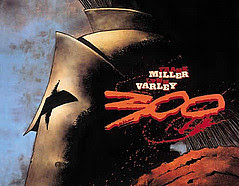
The White Mythology of 300

I am very very conflicted over the film 300. As a comic book geek, who has lost the direct passion for comics, but is still infected with heavy nostalgia and fidelity for comics, this film looks awesome!
But as a Ethnic Studies scholar and someone who has learned the importance of being vigilante to the ways that race, racialization and racism play out at multiple levels at every moment, this movie both scared the crap out of me, and really pissed me off.

When I watched Oliver Stone’s film Alexander last year, I enjoyed some parts of it, but one part in particular struck me. During the philosophical discussions with a young Alexander and an aging Aristotle, the glories of Greek civilization are laid out for all to see and learn, and for the viewing audience of today, to make continuity to the present. After watching this section, my reading of the film, which is also my reading for 300 can be encapsulated in two words, white mythology. Or the development of truth claims, which create a circular self-aggrandizing relationship between an infinite number of historical moments and a particular version of the present, meant to both explain the whiteness of the present, and infuse that newly whitened present with an authority, eternal viability, and the ability to act as the edge of History.

To paraphrase the Celion Dion song, white mythology is a collection of songs which are odes to why this whiteness, this white moment is the best evolutionary creation, and furthermore why this whiteness should go on.

Manifest Destiny is the most well known and established instance of this in the United States, but we can literally see it everywhere. Manifest Destiny did not come into being with the stroke of a pen, or the simple publishing of a book. It came from a number of different yearnings for power, wealth, sovereignty, exceptionalism. The nation, as an organism is always trapped in a contradiction. It is a consistently modern thing, captivated by a progressive, moral soul, which constantly pushes it forward in time. Yet at the same time, it cannot simply celebrate this youth, its power and ability to capture the future and to embody the apex of the present depends upon a tenuous genealogy, a skeletal chronology, through which that same good national soul has been sighted repeatedly, unfolded and revealed occasionally, and manifested proudly in this moment!

For Manifest Destiny, the progressive power and authority of the United States was traced back into different pockets of white mythology, and that collection of different ancient and modern European cultural developments, victories and evolutionarily divine mandates, was meant to create a spirit of blinding obvious, destiny and power!

To see a very simple way how this works, how one accumulates this sort of force, how you become simply a wave which has built in intensity from the millions of waves that have pushed you into existence, with a particular mandate, read the following quote from a 19th century US Senator. Writing in an 1895 article titled “Our Blundering Foreign Policy” Henry Cabot Lodge stated about the United States and its need to embody this imperialist and ferocious destiny which is so so manifest, “We have a record of conquest, colonization and expansion unequalled by any people in the Nineteenth Century. We are not about to be curbed now.”

Films such as Alexander and 300 are glorified instances of white mythology because of the way they provide images and can give life to empty and hollow claims of the eternal and far reaching greatness of the “Western” and “white” civilization. They make history real not only in the sense of “real in that time” but more so “real in this time.” In the ways that history can never remains in the pages that it is confined to by deaths and dates, the traces of any film touch us today, and if we are not careful can find ways of making concrete and natural the most grotesque, in this instance, racial ideologies.

Everyone in life is on a trip to search for an absent and never fully realized origin. Although you may have come from a family, a nation, a house, a school, etc, pieces of you always seem to stretch into realms and world beyond what seems possible and what can be readily explained. Thus all of life is about filling in the spaces for our always absent origins and sources. This doesn’t mean that what we fill in those spaces has no meaning, but only that the meaning they have is always open, is subject to change, contestation, rejection.

In the explanation for the present moment, for the way things are now, there are a multitude of potential answers. In the case of the United States, “western” and European societies, which seem to hold privileged positions in the running of the world, or the foundation for the prevailing global frameworks (human rights, Washington Consensus, democracy) life seems to be a dangerous game in which one must constantly either search for ways in which one is simply not complicit with the violence and inequalities either in their societies or around the world, or find reasons for which their exceptional and privileged positions are correct, just and appropriate.

So for instance, the claim made by both Republicans and Democrats that it is in the American character to spread democracy to the world, and that we are a just and moral civilization who has the monopoly on this particular “universal” commodity, finds consistency, solvency and safety, yes, in a text such as Samuel Huntington’s The Clash of Civilizations, but more so, and on a wider and more dangerous scale, a films like Alexander and 300.

In the conflicts in these films which naturally curiously echo the conflicts of today, the most base fears in a First World subject, or a middle class subject come to life. In both of these positions, that subject possesses something special which is always about to be lost and always the envy of all others. This feeling animates the self-aggrandizement of all First World subjects, propping up the stupid notion that people from around the world want to come to their country simply because its awesome or opportunity is only found there. This discourse of course completely ignores the realities of the world, most prominently their country’s complicity, either through colonialism, war, or economic mercantilism which ravages foreign economies and displaces populations.

So this incredible thing which the First World subject possesses is so awesome and powerful that everything either wants it or wants to destroy it. This is one of the reasons that Bush’s rhetoric after 9/11 had so much power. He didn’t only promise everyone war and violence against those who had toppled the World Trade Center. He also informed everyone as to why these attacks had taken place. But because of the way his rationalization touched this incredible national thing, it didn’t so much as inform them, but remind them about its existence, its potency, power and the fact that it is always under threat. Bush reminded everyone that these attackers hate our freedoms, our ways of life. The New York Times chimed in on September 16th, 2001 that, further enhancing Bush’s point that, “the perpetrators acted out of hatred for the values cherished in the West, such as freedom, tolerance, prosperity, religious pluralism and universal suffrage.”
My point in this tangent is that in the film 300 in particular, the Spartans are embattled, surrounded on all sides by a dark, angry, blood thirsty horde whose arrows threaten to blot out the sun. In differing ways, the Spartans wrap themselves (in very paradoxical ways) in the language of individual rights, freedom from tyranny, democracy, paladins for an endangered civilization and so on, and therefore seem like ideal positions of identification for your average First World subject who is looking for random, colorful, hi-tech and bloody ways in which his persistent fear of foreigners and ludicrous belief in his nation’s sublime power can make some sense. To quote the actor Gerard Butler who plays King of the Spartans Leonidas in the film, “I felt like it was my destiny to play Leonidas." In order to preserve myself, and to assure myself that I am indeed the recipient of a great legacy of democracy spreading, I feel that am destined too, to defend democracy and freedom, these precious national things, from the black, savage hordes, or in this case, the Middle East.

I think I’m done with this post for today, but I have plenty more to say. From what I have been reading and hearing about the film in the news, internet and just random conversations, this film is very frightening, precisely because it an apolitical and therefore ideal piece of white mythology. This characteristic making it perfect for those who wish to argue that civilizations around the world are clashing.

Feds Seeking Input on Military Increases

Gof na'chalek yan na'triste este na tinige' ginnen i PDN. Gigon hu taitai este fumuffo' yu', sa' taibali. Hafa pau faloffan (pau ma cho'gue) yanggen ta alok na taya' mas militat i minalago-ta? Kao pau ma respetu iyo-ta "input" yanggen "negative?" Ekungok nu hafa ma sangani i militat put este, ya gi i mamaila na sakkan siha, tufong gi todu na asunto siha ni' ma na'tungo' i militat, kuantos ma aksepta gi minagahet, ya ma tulaika i planu-niha, ya kuantos ma fa'ga'ga' hit.


Feds seek local input on Marine relocation
By David V. Crisostomo
dcrisostomo@guampdn.com
and Steve Limtiaco
Pacific Daily News

As the region's chief executives prepare to gather in Saipan for their annual summit next week to discuss the military buildup and other shared issues, federal officials have opened the public comment window on the Marine relocation to Guam as part of the first step to the pending buildup -- the environmental impact study.

While the buildup links the regional summit and the federal environmental impact study, both events also provide local communities -- from Guam and Saipan to Palau and Yap -- an opportunity to add their voices and express their concerns about the buildup and its potential ripple effect, Gov. Felix Camacho said yesterday.

The military needs to enlarge and improve its facilities on Guam to support the transfer of 8,000 U.S. Marines from Okinawa, but it will take about two years of environmental studies here and in the Commonwealth of the Northern Mariana Islands before the first shovel of dirt is turned in connection with the move, military leaders have said.

The U.S. Navy yesterday took the first step, announcing its intent to prepare an environmental impact statement. The areas and issues to be examined in the study will be determined, in part, by information gathered from Guam, Tinian and Saipan residents and government officials during public "open houses" next month.

"This is the one chance for our people to come and speak," said Camacho of next month's federal public scoping meetings on Guam, Saipan and Tinian.

"This is an extremely crucial part of the process -- this window of opportunity," Camacho said. The governor called the impact study "the first step in the many moves that we have to undergo."
Guam and the federal government aren't the only players in the largest restructuring of U.S. forces in the Pacific, Camacho said.

At least $15 billion is expected to flow into Guam alone over a period of 10 years as the Marine relocation is completed. The players in this process, Camacho said, occupy the local, regional, national and international stages.

Public involvement
The environmental impact study, the public meetings and the public comment period provide residents an opportunity to recommend alternative sites for military facilities here.

"This is one of the ways the public can start getting involved in this," said Navy Capt. Robert Lee, commander of Navy region Marianas. The date of the meetings has been set for early April, but the time and place have not been determined.

U.S. Pacific Command last September released a 91-page military development plan for Guam, stating the possible location and scope of military increases here, including: the construction of a Marine Corps base and training area in the NCTAMS region of Dededo; improving the Navy's port in order to support the Marines and other military activity; and the creation of an Army base at Radio Barrigada to provide missile defense for the island.

According to the Navy, the environmental statement will examine all of those possibilities.

Yesterday's announcement provides even more information about the proposed military increase, stating, for example, that the proposed Army base would have 630 soldiers and 950 family members.

Naval facilities need to be improved to better accommodate transient nuclear-powered aircraft carriers, the announcement states.

"The proposed action includes rehabilitation or construction of operational facilities, support facilities (such as housing), and training areas on Guam and other locations within the Mariana Islands," the environmental announcement, which was published in the Federal Register, states.

Air Force Lt. Gen. Daniel Leaf, deputy commander of U.S. Pacific Command, last September said military construction is expected to begin with two years, which means environmental assessments must begin this year. The first major movement of personnel is not expected for at least six years, he said.

Camacho yesterday encouraged all community members on Guam and the island's Pacific island neighbors to take advantage of the opportunity to speak out during the comment period and next month's meetings.

Executive summit
The military buildup on Guam and its impact to this region will be central to discussions between Camacho and other regional chief executives during the seventh annual Western Micronesian Chief Executive Summit in Saipan next week.

Also expected to attend are: CNMI Gov. Benigno R. Fitial, Republic of Palau President Tommy E. Remengesau Jr. and Yap Gov. Sebastian Anefal representing the Federated States of Micronesia.

This summit will be an opportunity for Guam and its neighbors to agree on how they can collectively join the international players at the buildup "table" so their communities can benefit from the dollars and development expected from the buildup process, Camacho said.

One key topic is meeting the buildup's labor demand and the employment opportunities for residents in Guam and the CNMI to Palau and the FSM, the governor said.

Camacho said he and the other chiefs also are expected to discuss a wide range of shared issues during the summit, which begin on Tuesday.

The chiefs are expected to reach agreements on regional work-force strategies, recycling initiatives, cooperative efforts to address invasive species and strategies on meeting their communities' health-care challenges.

Saturday, March 17, 2007

Graduate of University of San Diego Opposed to US Military Redeployment?

I'm in the middle of the last session of my Discourse Analysis class at UCSD, bored yan yayas didide' and taking advantage of the excellent wireless in the Communications building, to google random things.

I googled "Bordallo Video Congress" and came up with a few interesting things which I'll be posting about later and hopefully putting onto Youtube.

I also googled "turn my headphones up" because I want to find the video for the Dave Chapelle sketch about the hot new rapper, Fistacuffs who was shot six times in the ear, and can only rap when all the conditions are perfect.

Then I googled "pentagon friendly Guam base overseas" in hopes of finding this article "Looking for Friendly Overseas Base, Pentagon Finds it Already Has One." This article along with many others are crucial for my dissertation that I'm currently working on. This article along with many others which refer to Guam in less than respectful ways, casually conflates the military base with the rest of the island and refers to it only through the needs and interests of the base. This article though has inspired me to come up with a new tourist label for Guam, "Guam: What the Pentagon Forgets That It Already Has!"

Eventually through my google adventures I stumbled across this article which I had posted on my blog several months ago, Natives of Guam Decry US Expansion Plan, which included statements by me and several members of Famoksaiyan about the impending militarization of Guam. The article, written by Aaron Glantz was a big deal for our struggles because it was circulated on websites such as Anti-war and Buzzflash and picked up by several blogs such as The Western Confucian and de toto como en botica.

When I had originally posted this article on my blog I had found a German translation of it and pasted it as well. This time around though I was able to find a French version! Before I clicked on this version however my eyes caught the "translate" function on google. Unable to speak French and knowing what the basic tone and content of the article was, I decided to see how google would translate the piece. As you'll see from what I've posted below, the translation is hysterical! Sen na'chalek!

Here is my original statement in English:

"Guam has basically no say...So the U.S. has the right to bring in whatever they want, and there is no framework that Guam can make demands or negotiate with the U.S. military. The Pentagon and the United States Congress are the sovereign owners, and they act like that. There is no relationship that says we have to listen to your feedback or we have to listen to your demands."

And my statement translated from French by google:

“Guam does not have anything to say, the United States have the right to bring what they want and no framework envisages of the negotiations with the American army."

People often speak about the impossibility of translation, yet difficult truths nonetheless seem to emerge, as you'll see in the article.

***************

L’île de Guam s’oppose au redéploiement militaire US
SAN FRANCISCO, 13 december 2006 (IPS) - Le projet du Pentagone d’augmenter sa présence militaire sur l’île de Guam, dans le Pacifique, rencontre la résistance des populations autochtones, les Chamorros, et de la diaspora installée aux Etats-Unis.

Selon l’American Enterprise Institue, proche des néo-conservateurs, le Pentagone a déjà déplacé des sous-marins d’attaque et des missiles de croisière sur l’île de Guam, située dans l’archipel des Mariannes. Ce territoire a été cédé aux Etats-Unis à la fin de la guerre hispano-américaine, en 1898.

Le département américain de la Défense a annoncé cette année son intention de rapatrier sur l’île 8.000 Marines et 9.000 de ses militaires basés à Okinawa, au Japon. La construction d’une nouvelle base militaire américaine devrait débuter en 2010, l’arrivée des troupes étant prévue un an plus tard.

Ceux qui s’opposent à ce redéploiement craignent que l’île, dont la population est de 168.000 habitants, ne soit envahie par cette présence militaire. « Guam n’a rien à dire, les Etats-Unis ont le droit d’amener ce qu’ils veulent et aucun cadre ne prévoit des négociations avec l’armée américaine », explique Michael Lujan Bevacqua, diplômé de l’Université de San Diego.

Il note que ce redéploiement intervient après de nombreuses oppositions à la présence militaire américaine en Corée du Sud et à Okinawa, au Japon. Dans ces deux pays, les Etats-Unis opèrent sous des règles strictes, négociées sous la forme d’un accord sur le statut des forces (SOFA), dont l’armée US n’aura pas besoin à Guam.

D’autres, comme Madeline Bardallo, déléguée de l’île Guam au Congrès américain, mais ne disposant pas du droit de vote, soutiennent l’arrivée de ces troupes. « Lorsque les Japonais ont attaqué Pearl Harbour, ils ont envahi l’île par la même occasion. Aujourd’hui, la situation entre la Corée du Nord et du Sud, ou entre la Chine et Taiwan, est incertaine. Nombre d’entre nous se souviennent de cette occupation et ne veulent pas que cela se reproduise », explique-t-elle.

Pour les opposants, une large présence américaine n’est toutefois pas dans l’intérêt des habitants de Guam. « S’il y a confrontation entre les Etats-Unis et la Corée du Nord, les Coréens ne bombarderont pas le continent américain, mais chercheront un endroit proche, facile à atteindre, et ce sera Guam », estime Sabina Perez, membre de l’organisation International Peoples Coalition against military Pollution. (FIN/IPS/2006)

Categoriën: Politics - Asia and pacific - Guam

Auteur: Aaron Glantz.

********

The island of Guam is opposed to the US military redeployment
San Francisco, 13 december 2006 (IPS) - the project of the Pentagon to increase its military presence on the island of Guam, in the Pacific, meets the resistance of the populations autochtones, Chamorros, and of the diaspora installed in the United States.

According to American Enterprise Institutes, near to the néo-conservatives, the Pentagon already moved submarines of attack and cruise missiles on the island of Guam, located in the archipelago of Mariannes. This territory was yielded to the United States at the end of the war Spanish-American, in 1898.

The American department of Defense announced this year its intention to repatriate on the island 8.000 Marines and 9.000 of its soldiers based with Okinawa, in Japan. The construction of a new American military base should begin in 2010, the arrival of the troops being envisaged one year later.

Those which are opposed to this redeployment fear that the island, whose population is of 168.000 inhabitants, is not invaded by this military presence. “Guam does not have anything to say, the United States have the right to bring what they want and no framework envisages of the negotiations with the American army”, explains Michael Lujan Bevacqua, graduate of the University of San Diego.

It notes that this redeployment intervenes after many oppositions to the American military presence in South Korea and Okinawa, in Japan. In these two countries, the United States operates under strict rules, negotiated in the form of an agreement on the statute of the forces (SOFA), which the US army will not need with Guam.

Others, like Madeline Bardallo, deputy of the Guam island to the American Congress, but not having the voting rights, support the arrival of these troops. “When the Japanese attacked Pearl Harbour, they invaded the island consequently occasion. Today, the situation between the North Korea and of the South, or between China and Taiwan, is dubious. Numbers among us remember this occupation and do not want that that reproduces”, explains it.

For the opponents, a broad American presence is not however in the interest of the inhabitants of Guam. “If there is confrontation between the United States and the North Korea, the Koreans will not bombard the American continent, but will seek a place close, easy to reach, and it will be Guam”, estimates Sabina Perez, member of the organization International Peoples Coalition against military Pollution. (FIN/IPS/2006)

Categoriën: Politics - Asia and pacific - Guam

Author: Aaron Glantz.

Thursday, March 15, 2007

My Favorite Network

Gof magof hu na hu fakcha'i este na tinige'...put fin!!!! O'sun yu' put i invisiblity-ta yan banality-ta.

From http://www.commondreams.org
A New Network Forms to Close U.S. Overseas Military Bases
by Medea Benjamin

In a new surge of energy for the global struggle against militarism, some 400 activists from 40 countries came together in Ecuador from March 5-9 to form a network to fight against foreign military bases. The conference began in Quito, then participants traveled in an 8-bus caravan across the country, culminating in a spirited protest at the city of Manta, site of a U.S. base.

While a few other countries such as England, Russia, China, Italy and France have bases outside their territory, the United States is responsible for 95% of foreign bases. According to U.S. government figures, the U.S. military maintains some 737 bases in 130 countries, although many estimate the true number to be over 1,000.

A network of local groups fighting the huge U.S. military complex is indeed an “asymmetrical struggle,” but communities have been trying for decades to close U.S. military bases on their soil. Their concerns range from the destruction of the environment, the confiscation of farmlands, the abuse of women, the repression of local struggles, the control of resources and a broader concern about military and economic domination.

The Ecuadorian groups who agreed the host the international meeting had been fighting against a U.S. base in the town of Manta. The U.S. and Ecuadorian governments had signed a base agreement in 1999, renewable after 10 years. The purpose of the base was supposed to be drug interdiction, but instead it has provided logistical support for the counterinsurgency war in Colombia, placing Ecuador in a dangerous position of interfering in the internal affairs of its neighbor. The base has also affected the livelihoods of local fishermen and farmers and brought an increase in sex workers, while the promised surge in economic development has not materialized.

During Ecuador’s presidential race in November 2006, candidate Rafael Correa criticized the base and after winning the election he quipped, “We can negotiate with the U.S. about a base in Manta, if they let us put a military base in Miami.” His comment displayed the stunning hypocrisy of the U.S. government, a government that would never deign to have a foreign base on its soil but expects over 100 countries to host U.S. bases.

In a great boost to the newly-formed network to close foreign bases, President Correa sent high-level representatives to the conference to express support, and he himself, together with the Ministers of Defense and Foreign Relations, met with delegates from the network to express their commitment to closing the Manta base when it comes up for renewal in 2009.

But the Ecuadorian government’s courageous stand is unfortunately not echoed in most countries, where anti-bases activists usually find themselves fighting against both the U.S. bases and their government’s collusion.

Indigenous representatives attending the conference talked about the destruction of indigenous lands to make way for bases. In the island of Diego Garcia, the indigenous Chagossian people have been driven off their lands, as have the Chamorros from Guam and the Inuit from Greenland. Kyle Kajihiro, director of the organization Area Hawaii, explained that the U.S. military occupies vast areas of Hawaiian territory, territory which was once public land used for indigenous reserves, agricultural production, schools and public parks.

The delegation from Okinawa, Japan, has been trying to dismantle the U.S. bases for the past 50 years. One of their main complaints has been the violence against women. Suzuyo Takazato, the director of Okinawa Women Act Against Military Violence, has compiled a chilling chronology of sexual abuse against Okinawan women by U.S. soldiers, including the rape of a nine-month old baby and a six-year-old girl. “We publish these horrible crimes to break the silence and impunity of U.S. soldiers who, according to the base treaty, cannot be judged in Okinawa.” Even when groups are not successful in closing the bases, at least they are pushing for U.S. soldiers to be subject to the laws of the host country.

The representative from Guam talked about the environmental devastation—the dumping of PCBs, Agent Orange, DDT, heavy metals and munitions, as well as fallout from the detonation of 168 nuclear bombs in the North western Pacific between 1946 and 1958, leading to high rates of radiation-linked cancers on his island. Activists who have been successful in closing bases warned that it is critical to force the U.S. to clean up before leaving. The Filipinos who won the closure of the Subic and Clark bases in 1992 after years of popular pressure are still fighting to force the U.S. military to clean the site and compensate the affected population.

One of the most compelling success stories came from Vieques, Puerto Rico, where a U.S. base was installed in 1948 in this island paradise of lagoons and sand beaches. The military used the base to build, store and test bombs and chemical substances, like cancer-causing Agent Orange. For decades the local people, especially the fisherman, protested the base, but the anti-base struggle was catalyzed in 1999 when a bomb killed a local civilian, David, Sanes. Activist Nilda Medina spoke with great passion about how they set up permanent protest camps, thousands performed acts of civil disobedience, and others went on hunger strikes. After residents occupied the test area for 13 months, the Navy finally agreed to close the base in May 1, 2003. Now the local people, as in so many other sites, are fighting to clean up the land and treat those who have been exposed to harmful chemicals.” We’re so proud of what we accomplished and want to tell our story to encourage others,” said Nilda Medina. “We understand that this is part of a worldwide struggle against the militarization of our planet.”

Post-9/11, this militarization has become even more entrenched as part of the “war on terror.” Representatives from Cuba at the conference complained bitterly about the use of the Guantanamo base as a center for illegal detention and abuse of prisoners. Activists from Japan, Turkey, Italy and Germany said their countries had been used to facilitate the invasions and ongoing occupations of Iraq and Afghanistan. Delegates from Germany said they have 81 U.S. bases, more than anywhere in the world, and that Germany had became a central rotation point for U.S. soldiers on their way to and from Iraq. They complained that the use of U.S. bases as a launching pad for hostile military operations makes their country vulnerable to terrorist attacks.

This is why over 100,000 people came out for a demonstration in February 2007 in the Italian town of Vicenza against a proposed new military base. “We don’t want the noise, the pollution, the taxing of our infrastructure,” said local organized Cinzia Bottene. “But most of all, we don’t want to be accomplices to Bush’s war and a target for reprisals.”

Many U.S. groups sent representatives to the conference, including the Fellowship of Reconciliation, AFSC, United for Peace and Justice, Southwest Workers Union, WILPF, Global Exchange, CODEPINK and the Marin Interfaith Task Force. U.S. delegates said that the bases did not make them more secure; just the contrary. “One of the reasons the U.S. was attacked on September 11 was because of U.S. foreign bases in Saudi Arabia,” explained Joe Gerson of AFSC. “But while the U.S. military has since abandoned the bases in Saudi Arabia, it has replaced them with even more bases throughout the region, creating more animosity towards Americans.” The U.S. delegates made it clear that the network to close U.S. foreign bases was in line with the efforts of the U.S. peace movement, which would like to see our military used for defensive, not offensive purposes. U.S. delegates also emphasized how the billions of dollars now being spent to maintain this empire of bases would be better invested in people’s needs for health, education and housing.

The new global network will help local groups share experiences, learn from one another, and provide support for the local efforts. It will conduct research, maintain a global website (no-bases.org), publish an e-newsletter, and convoke regular international meetings to assess progress.

Luis Angel Saavedra, head of one of the Ecuadorian organizations sponsoring the conference, was thrilled with the outcome. “We’ve been working against the base in Manta for the past seven years, and this conference feels like the culmination of this entire campaign,” he said. “It will strengthen President Correa’s position to close the base. Our people are better educated after all the publicity we’ve received. And we now have a network to exchange strategies and experiences with people all over the world. I’d call that a great success.”

Medea Benjamin is cofounder of Global Exchange and CODEPINK: Women for Peace. To learn more about the Network to Abolish Foreign Military Bases, go to www.no-bases.org.

Tuesday, March 13, 2007

The Rubin Lake Incident

I wrote a few years ago a letter to the PDN which asked that those of us on Guam please rethink our relationship to the United States. I noted that the best time to reposition, rearticulate and rework this relationship was when, despite the powerfully charged rhetoric of Guam’s Americaness and patriotism and partnership with the US, we get slapped in the face with our colonial existence, our subordinate status. I called this moments “scandals.”

One common response that I receive from this point, is that no such scandals exist, that I was merely making it up. The relationship between Guam and America is as smooth and equitable as ever. In exchange for not paying taxes, and not being able to have any sovereignty, we get to enjoy being a strategically important appendage of the greatest country left in the world! If that can’t explain the high levels of Chamorro patriotism towards the United States, then nothing can!

Naturally, this isn’t the case. Life as a semi-American in Guam is a tenuous, delicate and scandal-ridden exist. On a regular basis, the desire you feel for America, to be American is rejected. Sometimes at the level of Federal-territorial relations and communication. Sometimes in the form of media, popular cultural, books, comic books. Sometimes in the form of military speech and policy.

Being from a colony today, we probably have the worst memories of all, and so these scandals do not stay with us. We struggle to forget everything, about our past and the damage that has been done and the things lost or destroyed, and only to look to the future which is sold to us by the United States. This amnesia is tragically productive. Released from the wisdom of any textured history, we find it easy to comprehend and live with the fact that our future at present exists to be determined by another, and that we shouldn’t simply accept this fact, but rather celebrate it!
Several decades ago, during the “age of decolonization,” a common mantra was “good government is no substitute for self-government.” Today in Guam, just like those who remain colonized, trapped in nation-within nation or dependent nations, completely obscene relationships, we cling to the inversion of that mantra, “self-government is no substitute for good government.” Stuck, forced into a position of powerlessness, we on Guam tend to accept as our only strategy, a rejoicing and glorifying of that powerlessness. What else, can really explain the disgusting celebration, by many of Guam’s leaders, of Guam’s impending militarization, without any comment on the negative impacts that will necessarily accompany it?

In Guam today, our constant amnesia is connected to denying the colonial difference, to finding patriotic or forgetful ways around the racist, paternalistic and exploitative relationship that continues to exist between us and “Uncle Sam.”

But the body and often the land itself remembers. When a scandal erupts, it is history and truth returning from its exile, to lay waste to the fantasies that we have built, to raze the illusions which we have conjured up in our desperate attempts to feel more American.

My point remains the same on the importance of these scandals. We should not use them as a podium from which we will scream that “WE’RE AMERICANS TOO!” We should instead take them seriously, and investigate what this difference means, which takes so many different forms and refuses to disappear no matter how may flags we wave in front of it or car magnets we suffocate it with.

In an effort to keep fresh the memories of an island which too often seems to me determined to forget everything which might shed a negative light on our colonizer, allow me to recount one such scandal which too many people assert, never happen.

In 1994 during a press conference organized by the Christian Science Monitor News Service to cover an upcoming Asia-Pacific Economic Cooperation (APEC) forum, two of Bill Clinton’s advisors were asked a simple question about Guam. As APEC was designed not to be a cooperative of nations, but of economies, a reporter from Gannet, which owns The Pacific Daily News on Guam, asked whether or not it was possible for Guam to join this organization. As Ronald Stade notes in Pacific Passages, “the response to the question was a round of laughter.”

The reporter attempted to reformat and explain his question, noting that other “colonies” such as Hong Kong were allowed to join, and Guam’s economic and population size either exceeds or is equal to a number of APEC’s existing members. This question was met by Anthony Lake, assistant to the president for national security affairs and Robert Rubin, assistant to the president for economic policy with more laughter, giggles and smiles, and the final formal answer of “I guess I could say that the negotiations have not gotten to that point.”

In this moment, the patriotic, colonial and wishful fictions that bind Guam and the United States together through touching metaphors of willing partners, patriotic brothers, uncles to nephews, father to son, etc. all fall away. There are a number of formal answers which could have covered over this obscenity, substituted this revelation. Guam is too small, Guam is part of the United States, Guam is not mature enough, Guam is not economically developed enough, etc. Instead, the prospect of Guam being recognized in such a way, as a partner among nations, produces for those who represent its colonizer, laughter. In the words of the Governor of the Guam at the time Joseph Ada in his letter of outrage to President Bill Clinton, “The response was not an explanation, not a U.S. position but laughter.”

Large protests followed, and Democrats, Republicans, Chamorros, Filipinos and even manapå’ka all magically seemed to join together in unity behind the insult of this scandal, and both the news media and the gates to Guam’s military bases were flooded with demands for apologies and other angry demonstrations.

As I constantly reiterate, this instance was not unique or special, scandals like this take place all the time, but many of them don’t reach this sort of island-wide level, but rather move within certain circles and groups. But the problem with our historical amnesia is that when subsequent scandals take place, they are not connected to the previous moments, previous scandals, not organized or conceived of as part of a pattern, but are instead felt as intense and horrifying, because they always seem like the first instance this has happened.

In the hopes that these scandals are no longer conceived of as ephemeral or exceptional moments which just pass by and mean nothing, I want to present an artifact to remind us all about the Rubin Lake Affair.

I’m posting below the letter that Joe Ada wrote to Bill Clinton in 1994 a few days after the incident where the prospect of Guam joining the community of nations and world economic was laughed at, requesting and demanding an apology. This is a rare instance where outrage and anger, led to the realization that we on Guam are not simply dependent, not simply a footnote to something greater, but that we have power in this relation, if we are willing to make demands and assert things. It is a lesson which I wish more of our leaders today would learn.


**********
14 November 1994

Dear Mr. President:

I would like to call to you attention the recent insult to Guam proffered by the National Security Advisor and the Economic Council Advisor during a press breakfast hosted by Godfrey Sperling of the Christian Science Monitor on November 10, 1994. In response to a reporter’s questions about Guam’s possible role in APEC, (and follow up questions) laughter was your advisors’ response. The response was not an explanation, not a U.S. position but laughter.

As you may be aware, both I and Guam’s Congressional delegate, The Honorable Robert A. Underwood have sought a role for Guam in APEC. The British Crown Colony of Hong Kong is allowed to attend. Countries with populations similar to our own are in attendance and in a parallel meeting of the Summit of the Americas, Puerto Rico is invited to attend. Although we are small, Guam procures over $1 billion of goods from the United States annually. In fact, we purchase more U.S. goods than all of the small island states of Oceania combined. Our trade with Asian countries is even greater. The impacts of Asian interests in our economy amounts to over $2 billion per year.

Guam is a major hub of telecommunications in the region and is poised to be a regional aviation hub with the closure of the Naval Air Station in Agaña. We don’t think our economic interests are a joke and we think that a U.S. position which treats it as such is myopic and not in the United States best interests. Perhaps what is most disturbing about the demeaning treatment of Guam’s desire to be heard is the fact that the National Security Advisor contributed to the “comedy” of Guam. Of all people, he should be aware of the longstanding U.S. military presence on our island and the fact that one-third of our people’s land is held by the U.S. government. If the National Security Advisor had any notion of the nature of these interests, and growing local sentiment against the way U.S. policy arbitrarily treats our land needs, he should have known the folly of belittling the people who have been patient in their hosting of such facilities.

The people of Guam are deserving of an apology from Mr. Lake and Mr. Rubin or to hear of their termination. The absence of an apology within twenty-four (24) hours will likely result in actions of civil disobedience directed at military installations as has occurred in Guam today.

The U.S. has interests in Guam, and our island’s economic future is in the Asian region. There is ample room for our partnership of interests to be manageable, but only if our interests are respected. I look forward to your expeditious reply.

Sunday, March 11, 2007

Save Mount Carmel

Estague un tinige’ i atungo’-hu Si Stephanie Marie Mansfield. Eståba fafana’gue gui’ giya I Eskuelan Mount Carmel, ya mina’tuge’ este put i siña mahuhuchom I eskuela. Sigun i Obispo Guahan, (ni’ chumochonnek este na hinichom) maulailaika i tiempo siha, ya ti guailåyi pa’go un eskuela para i sanhaya na banda. Ti nahong i estudiante, ti nahong i salåpe.

Sigun i gof maolek na sainå-hu Zita Pangelinan, Manmana’i siha esta ki 15th April, para u na’siguru este tres nap unto.


1) Guaha ad'minis'trdoro/ra para otro sakan.
2) Ma establisa i Endowment/Alumni Foundation.
3) Guaha 150 na famaguon man fitme na ma "register" yan man ma apasi.


Yanggen manmataka’ i tres pues siña masatba i eskuela.

Bai hu na’chetton guini mågi i tinige’ Stephanie Marie yan tres na kachido ginnen Youtube. Yanggen malago hao umayuda este na eskuela taitai i tinige’ Stephanie Maria ya egga’ ko’lo’lo’na i kachido siha. Gi i kachido siha pon eyak mas put i estoria i eskuela yan i sinisedi i famagu’on.


~Stephanie wrote:

As many of you know I have been working at Mt. Carmel Catholic School in Agat, Guam for the past year. We recieved news from the Archdiocese that they will be closing our school come the end of this school year.

Mt Carmel School was founded in the village of Agat by the School Sisters of Notre Dame nearly 50 years ago. MCCS has educated generations of family members. To this day you can hear stories from grandparents picking up their 5 or 6 year old grandchildren, with a look of nostalgia in their eyes, when they start the story with "I remember when..." They often have stories of how the campus has changed so much over the years. I remember one such story from the grandfather of a student. He was reminicing with Sister Regina Paulino. He looked up at the convent and said the words of every grandparent - "I remember when..." He told the story of how he remembered there was only one building with a hot-tin roof when he attended Mt Carmel School nearly 40 years ago. He had a hint of disconnection in his voice as he became lost in his memory, continuing on, he remembered doing fundraisers outside of this one building just so the school would be able to purchase an air conditioner.

I feel so blessed for having been there to listen to his story. I am sure that there are countless others with stories of their own that they would one day like to pass on to their children. I know I have already begun writing mine.

Thank You


~Esther Ninete wrote:

I took over Stephanie's class about 3 weeks ago. It didn't take me even a day to see the beauty in Mt. Carmel School. Everyone acts as a family. In fact, many of the students, faculty, and staff members are family.

I love seeing my godchildren at school; how they are flourishing academically, spiritually, and socially.

Mt. Carmel reminds me of better times. It reminds me of times when children could be chilren and not worry about problems that plague other schools in this day and age (for example: drugs, violence, peer pressure, and most recently in the spotlight, bullying). It is an ideal learning enviroment, warm and welcoming.

And the teachers! You just can't find teachers anymore like you do at Mt. Carmel. They are experienced AND caring. They are there for the children first and foremost. Where can you find that now adays?

Ensuring a proper education is important, of course, but to be able to ensure a proper education with faith at its core - now that is exceptional!

Why is a school with an exceptional learning environment with exceptional teachers being closed?

PLEASE, SAVE MT. CARMEL SCHOOL!

Friday, March 09, 2007

Abolition of Foreign Military Bases

There is a very important conference taking place right now in Ecuador about the status of foreign military bases around the world. I am excited and grateful that three Chamorros will be there in order to testify and inform others about the situation in Guam, where because of the simple fact that Guam is not completely "foreign" but neither "domestic," this ambiguous political status somehow becomes transformed into the right of the United States to do whatever it wants to Guam. I'm attaching below a press release from the conference as well as the statement from I Nasion Chamoru put i estao militat giya Guahan pa'go.

Magof hu na manggaige hamyo na tres guenao, ya en tachuchuyi ham. Na'tungo' i otro na mannatibu yan i otro na nasion-siha put i estao-ta, ya tungo' nai na gaige ha' giya Hamyo todu tiempo i espiritun i taotao-ta.


***********

Declaration:

International Conference for the Abolition of Foreign Military Bases, March 5 to 9, 2007

Quito and Manta, Ecuador

We come together from 40 countries as grassroots activists from groups that promote women’s rights, indigenous sovereignty, environmental justice, human rights, and social justice. We come from social movements, peace movements, faith-based organizations, youth organizations, trade unions, and indigenous communities. We come from local, national, and international formations.
United by our struggle for justice, peace, self-determination of peoples and ecological sustainability, we have founded a network animated by the principles of solidarity, equality, openness, and respect for diversity.

Foreign military bases and all other infrastructure used for wars of aggression violate human rights; oppress all people, particularly indigenous peoples, African descendants, women and children; and destroy communities and the environment. They exact immeasurable consequences on the spiritual and psychological wellbeing of humankind. They are instruments of war that entrench militarization, colonialism, imperial policy, patriarchy, and racism. The United States-led illegal invasions and ongoing occupations of Iraq and Afghanistan were launched from and enabled by such bases. We call for the immediate withdrawal of all foreign troops from these lands and reject any planned attack against Iran.

We denounce the primary responsibility of the U.S. in the proliferation of foreign military bases, as well as the role of NATO, the European Union and other countries that have or host foreign military bases.

We call for the total abolition of all foreign military bases and all other infrastructure used for wars of aggression, including military operations, maneuvers, trainings, exercises, agreements, weapons in space, military laboratories and other forms of military interventions.

We demand an end to both the construction of new bases and the reinforcement of existing bases; an end to and cleanup of environmental contamination; an end to legal immunity and other privileges of foreign military personnel. We demand integral restauration and full and just compensation for social and environmental damages caused by these bases.

Our first act as an international network is to strengthen Ecuador’s commitment to terminate the agreement that permits the U.S. military to use the base in Manta beyond 2009. We commit to remain vigilant to ensure this victory.

We support and stand in solidarity with those who struggle for the abolition of all foreign military bases worldwide.

Foreign Military Bases Out Now!

Manta Si! Bases No!

******

I NASION CHAMORU, ON THE U.S. MILITARIZATION OF GUAM

…for the International Conference for the Abolition of Foreign Military Bases, Ecuador 2007

Today, the indigenous Chamoru people of Guam are bracing our selves against a storm of manic U.S. military buildup. Beginning this year, 2007, the U.S. will flood Guam―its colony―with 35,000 additional U.S. military personnel, half a dozen nuclear submarines, a strike and intelligence surveillance hub, fighter jets, B-2 bombers, Global Hawk aircraft, 20,000 foreign laborers on military contracts, and, inevitably, toxins to add to the array of cancerous contamination that have already claimed the lives of Chamoru people at record rates.

Guam is one of the few remaining colonies of the world. It exists today in a political nether zone as an unincorporated territory of the U.S., administered by the U.S. Interior Department. Today, we approach 500 years of colonization. Colonized by Spain for more than 300 years and the U.S. for more than a century (save a bloody three-year stint by Japan in the last world war), Guam today is the lamb tied closest to the war the white house is provoking in the Asia-Pacific region.

Two weeks ago, it was announced that the world's biggest anti-terrorism exercise will be held this year in Guam, underscoring yet again our thirty-mile island's strategic value to Empire.
Exercise TopOff4 is part of a series of large-scale maneuvers established to strengthen U.S. ability to respond to "terrorist" attacks involving weapons of mass destruction. It is being celebrated as the super-sized version of last year's Valiant Shield war games―also played in Guam waters―wherein the U.S. mobilized 22,000 U.S. military personnel, 280 aircraft, and 30 ships. Valiant Shield was already the largest joint military exercise since the Vietnam War. That weekend, water was cut off to a number of the villages on the Navy water line. The people of those villages went some thirty out of sixty days without running water.

At the center of this muscle flexing is the scheduled transfer of 8,000 U.S. Marines from Okinawa to Guam.

Of the 10.3 billion dollars tied to the transfer, exactly zero dollars have been allocated to development of the local community outside the U.S. bases. Meeting after meeting with the U.S. Department of Defense officials have proved empty, as senior military officers repeat only that they lack the authority to commit to anything or answer our questions.

Recent testing has revealed high levels of agent-orange and purple exposure, radiation exposure, and illegal dumping of chemicals throughout the island as manifested in PCBs found in Apra Harbor and Cocos Lagoon. The Environmental Protection Agency continues to issue public warnings to avoid eating fish caught in the southern waters of Guam due to dangerous levels of radioactive poison in the area. A renowned physician and professor at the University of Guam has recently received death threats and other harassment for publicly exposing the documented connections between U.S. dumping of radioactive waste and the extraordinarily high rates of cancers, dementia, and neurological diseases among Chamorus.

Meanwhile, the U.S. military has made clear its intention to proceed with the development of a global reconnaissance hub at Andersen Air Force Base on the northern end of Guam in direct violation of the U.S. Environmental Protection Agency and its own national environmental laws. It also plans to proceed with the construction of a landfill over seven natural rivers in the south of Guam, which will harm if not eliminate endangered species in the area.

Guam is called the land of the rosaries. She is a land littered with cemeteries. But her people have wrestled a truth to the ground: that what we love we can save.

For more information, please feel free to contact Debbie Quinata at dquinata@gmail.com, Lisa Natividad at lisanati@yahoo.com, or Julian Aguon at julianaguon@gmail.com.

Wednesday, March 07, 2007

Indigenous Voices Strike Back

Me, Angie (taotao Natibu Amerikanu) and Madel (taotao Belau) are up to our old voicing indigeneity tricks. After a month-long break in December and January, we started recording again our infamously unknown podcast Voicing Indigeneity. I'm just kidding about the infamously unknown part, in actuality, we have a fairly loyal listener-ship. The blog itself gets around 10-20 hits per day, and from the email that I've gotten from when we started, we have fans from around the United States, west, east, north and south, but also get regular listeners from Taiwan, Australia, Hawai'i, Japan and even a guy from France.

We recorded our most recent podcast Harry Potter and the 45th Generation Roman at the 2007 Crossing Borders Conference: Ghosts Monsters and the Dead, last weekend at UCSD. I'll post more about this conference soon, it was quite an experience. As one of its organizers, my main relief though is that it went well.

For those of you who are unfamiliar with our podcast and its blog, it serves a number of purposes. Although it was originally started as an assignment that Angie was doing in her communications methods class, it has evolved into an important part of me, Angie and Madel's lives and our emerging intellectual projects. It is on a personal level, a place where the three of us can discuss the difficulties we are facing in our lives, the excitement that we can barely contain, whether in our departments or elsewhere. For instance, for most people in my department they learned that I was going to be a father next month, by listening to our episode, Harry Potter and the Indigenous of Azkaban.

(otro fino'-ta: para hamyo ni' ti en tingo' sa' hafa in ayek este na na'an siha para i podcasts-mami, its simple. (fa'na'an sigi ha' hinasso-mu "sa' hafa este na na'an? Ti sina hu komprende este) Kada na podcast, antes di in tituhun, manmanayek ham kachido (mubi), ya pues in tahgue unu na palabra yan i palabras "natibu" pat "indigenous.")

But these podcasts, more prominently are an important part of the intellectual development for the three of us. Last year I wrote along with Madel and Angie's help our so called "Declaration of Indigeneity," which outlined our theoretical and critical rationale for making the podcasts, and our relationship to the discipline the three of us are in, Ethnic Studies. That document later became part of the intellectual foundation for the academic panel that we will be on at the Indigenous Studies Conference taking place on May 3-5, 2007 at the University of Oklahoma.
Talking or being forced to articulate your academic projects is a very important tool in the actual writing of your projects. We are all learning this, as the podcast has been invaluable in helping us through the difficult often isolating experiences of writing.

We're supposed to be recording another podcat tomorrow morning, with the three of us and Ross Frank, the chair of our department and a member of all of our academic committees. He has been bravely spearheading over the past year a cluster hire at UCSD for indigenous studies faculty. I'm sure he'll give us an update tomorrow, and I'll write about it later as well.


In the meantime, I just want to share with you, a fragment from one of our podcasts. Titled Onward Indigenous Solider, it was recorded a few weeks ago, with the theme of religion in mind. During the podcast, I had a brief moment of clarity, where something which had been creeping and crawling around inside of my head, erupted from my throat, in semi-coherent form. Check out the transcript below.

There's always in native communities (in the United State and its Empire) this strong discourse, especially amongst intellectuals that religion cancels out the prospects for decolonization, or that religion continues the cycles of colonization. I remember one time when I was in a class at the University of Guam, and this one Chamorro scholar she came up and she basically said, Chamorros today who are Catholics are fools. They just continue the colonization, they are just dupes. Because now we know that it was forced on us, and so now those who continue to go to church and continue to do these things are just colonizing themselves.

In one way of thinking, sure she's absolutely right. This was imposed on Chamorros and stuff. but then the basis for her logic is that the real Chamorro existed at that point prior to the imposition of religion, of this Catholic religion, and so therefore decolonization is only about that one point. And anything which doesn't have fidelity, loyalty or doesn't do justice to that one point isn't decolonization, its just continuing colonization.

I remember telling people when they were talking about that, thinking yeah, what's this, this is kind of true. I remember saying, that decolonization is a multitude of processes, and it can work different ways. And so decolonization is also about tampering with that logic, that says that decolonization is about that point way back in time. And if you can break that logic, then you can do far more, then getting rid of Catholicism from the island. Because if you can break that logic that says that you only existed at that one point, or that thats the only point at which you ever really existed in an authentic state, then you can basically open up the future to you.

Because on Guam, and I write about this, but its hard to talk to people about this, but if you look at the way Chamorro identities are, its really the United States. Like patriotism towards the United States is the religion now. Its what governs and structure life, so that you have this loyalty to the United States. It liberated you, it gave you life, it gives you happiness, it gives you indoor plumbing, it gives you electricity, it gives you education, it gives you hygenie. Without the United States, how would you brush your teeth? Seriously, how?

And so this relationship to the United States is structured almost as if its a religious experience, cause if you think about Catholic religious processions that take place, and still take place on Guam, there's also the procession of Liberation Day on Guam. Where this massive parade, and there's the spectacles of carnivals and beauty pageants, to celebrate the United States return in World War II.

And so, basically, I'm more interested in, rather than in terms of getting rid of religion, is getting rid of that point where the United States sits at the end of history, as the God that dictates future. The God that controls future. The one that says that you are ready for sovereignty, you are ready to be prosperous now, you are ready for life.

And the only way that you can do that, is by breaking and decolonizing that logic that says decolonization or decolonizing experience is about retrieving that point way back in the past, where anthropologists, where historians, where sociologists, where whoever says that you actually existed.

Monday, March 05, 2007

Famoksaiyan Hugua

FAMOKSAIYAN: “Our Time to Paddle Forward”
Summit on Decolonization and Native Self-Determination

April 20-22, 2007

History:
On 14 & 15 April 2006 more than 100 Chamorro scholars, activists, and community leaders gathered at the Sons and Daughters of Guam Club in San Diego to share their work and research, and to participate in discussions relating to the future of their people and native homelands. The name of this gathering was Famoksaiyan: Decolonizing Chamorro Histories, Identities and Futures. This initial meeting of native leaders inspired such a great deal of research questions and possibilities that concrete action plans were soon implemented on an international forum.

Over the past year we have held regional meetings in Berkeley, Long Beach, Oakland and Guam and helped plan a number of historic events. In October of 2006, several members of Famoksaiyan organized a trip to New York City to testify before the United Nations Committee on Decolonization, about the question of Guam’s continuing colonial status. During that same month a representative of Famoksaiyan presented at the National Pacific American Leadership Institute before a delegation of three hundred distinguished leaders and professionals in Hawai’i.
In November 2007 a town hall forum and report on the United Nation’s trip called “Remembering Our Roots: Decolonization in Guahan” was held in Berkeley, and was attended by Berkeley students and bay area residents interested in learning more about Chamorros and their struggles. In January of this year, Famoksaiyan participated in and helped coordinate the forum “Decolonizing Our Lives: A Progress Report on the Status of Human Rights on Guam” which brought more than 250 community members together at the University of Guam, to learn what different organizations are doing to facilitate Guam’s political and cultural decolonization.

The Future:
As part of Famoksaiyan’s continuing commitment to building progressive networks within the Chamorro community and among Pacific Islander, Native American, Puerto Rican and Chicano organizations throughout the world, with the shared goals of decolonization and self determination, we are pleased to announce:

Famoksaiyan:
Summit on Decolonization and Native Self-Determination
April 20 -22, 2007 in Berkeley and Oakland, California.

This year we are interested in strengthening existing networks, building new ones, and more importantly, giving those interested the skills to promote the work of decolonization and cultural and historical revitalization in their politics, their creative work and everyday interactions. We are pleased to announce that this year’s conference will include: Chicanos, Pacific Islanders, Puerto Ricans, Native Americans and others interested in improving the opportunities and life conditions of indigenous peoples throughout the world. The conference is open to the public, and there is no fee to attend.

We therefore invite individuals or organizations to submit proposals for workshops, presentations or working groups related, but not limited to the following suggested formats:

1). A workshop designed to teach important skills: creative writing, how to talk to your family about decolonization, web development or graphic design, Chamorro language, etc.
2). An informational session designed to teach attendees or enhance their understanding about historical or contemporary issues such as: Guam history, the military build up in Guam, the state of Guam’s environment, US/Guam territorial relations, etc.
3). A working group which will strategize or develop plans and goals around a particular topic or issue such as: sustainable economics, how to reform media, how to revitalize Chamorro language, coalition building with other Pacific Islander groups, etc.
4). Updates on ongoing artistic or community projects such as films, research studies, events, grants, etc.

Your submission should include a proposal (no more than one page), describing the nature of the working group or panel presentation that you intend to organize, along with your contact information (mailing address, telephone and email). Please list which topic most appropriately describes your presentation:

1) Decolonization 2) Self Determination 3) Education 4) Research 5) Healthcare 6) Public Policy 7) Law 8) Employment 9) Community Activism 10) Stewardship/Leadership 11) Cultural Preservation 12) Language

The deadline for submissions is April 1, 2007. Proposals will be accepted after this date, only if space is available. Please email your submissions and any questions to Miget (Michael) Lujan Bevacqua at mbevacqua@ucsd.edu or to Migetu (Michael) Tuncap kupua@berkeley.edu

Si Yu’us Ma’ase. Biba i mannatibu! Biba Chamoru! Na’la’l’a mo’ña i taotao Marianas!

Sunday, March 04, 2007

Why Words Matter

Published on Wednesday, February 28, 2007 by CommonDreams.org
The Words None Dare Say: Nuclear War
by George Lakoff

"The elimination of Natanz would be a major setback for Iran's nuclear ambitions, but the conventional weapons in the American arsenal could not insure the destruction of facilities under seventy-five feet of earth and rock, especially if they are reinforced with concrete."—Seymour Hersh, The New Yorker, April 17, 2006

"The second concern is that if an underground laboratory is deeply buried, that can also confound conventional weapons. But the depth of the Natanz facility - reports place the ceiling roughly 30 feet underground - is not prohibitive. The American GBU-28 weapon - the so-called bunker buster - can pierce about 23 feet of concrete and 100 feet of soil. Unless the cover over the Natanz lab is almost entirely rock, bunker busters should be able to reach it. That said, some chance remains that a single strike would fail."—Michael Levi, New York Times, April 18, 2006

A familiar means of denying a reality is to refuse to use the words that describe that reality. A common form of propaganda is to keep reality from being described.

In such circumstances, silence and euphemism are forms of complicity both in propaganda and in the denial of reality. And the media, as well as the major presidential candidates, are now complicit.

The stories in the major media suggest that an attack against Iran is a real possibility and that the Natanz nuclear development site is the number one target. As the above quotes from two of our best sources note, military experts say that conventional "bunker-busters" like the GBU-28 might be able to destroy the Natanz facility, especially with repeated bombings. But on the other hand, they also say such iterated use of conventional weapons might not work, e.g., if the rock and earth above the facility becomes liquefied. On that supposition, a "low yield" "tactical" nuclear weapon, say, the B61-11, might be needed.

If the Bush administration, for example, were to insist on a sure "success," then the "attack" would constitute nuclear war. The words in boldface are nuclear war, that's right, nuclear war — a first strike nuclear war.

We don't know what exactly is being planned — conventional GBU-28's or nuclear B61-11's. And that is the point. Discussion needs to be open. Nuclear war is not a minor matter.

The Euphemism

As early as August 13, 2005, Bush, in Jerusalem, was asked what would happen if diplomacy failed to persuade Iran to halt its nuclear program. Bush replied, "All options are on the table." On April 18, the day after the appearance of Seymour Hersh's New Yorker report on the administration's preparations for a nuclear war against Iran, President Bush held a news conference. He was asked,

"Sir, when you talk about Iran, and you talk about how you have diplomatic efforts, you also say all options are on the table. Does that include the possibility of a nuclear strike? Is that something that your administration will plan for?"

He replied,

"All options are on the table."

The President never actually said the forbidden words "nuclear war," but he appeared to tacitly acknowledge the preparations — without further discussion.

Vice-President Dick Cheney, speaking in Australia last week, backed up the President.

"We worked with the European community and the United Nations to put together a set of policies to persuade the Iranians to give up their aspirations and resolve the matter peacefully, and that is still our preference. But I've also made the point, and the president has made the point, that all options are on the table."

Republican Presidential Candidate John McCain, on FOX News August 14, 2005, said the same.

"For us to say that the Iranians can do whatever they want to do and we won't under any circumstances exercise a military option would be for them to have a license to do whatever they want to do ... So I think the president's comment that we won't take anything off the table was entirely appropriate."

But it's not just Republicans. Democratic Presidential candidate John Edwards, in a speech in Herzliyah, Israel, echoed Bush.

"To ensure that Iran never gets nuclear weapons, we need to keep ALL options on the table. Let me reiterate – ALL options must remain on the table."

Although, Edwards has said, when asked about this statement, that he prefers peaceful solutions and direct negotiations with Iran, he has nonetheless repeated the "all options on the table" position — making clear that he would consider starting a preventive nuclear war, but without using the fateful words.

Hillary Clinton, at an AIPAC dinner in NY, said,

"We cannot, we should not, we must not, permit Iran to build or acquire nuclear weapons, and in dealing with this threat, as I have said for a very long time, no option can be taken off the table."

Translation: Nuclear weapons can be used to prevent the spread of nuclear weapons.

Barack Obama, asked on 60 Minutes about using military force to prevent Iran from developing nuclear weapons, began a discussion of his preference for diplomacy by responding, "I think we should keep all options on the table."

Bush, Cheney, McCain, Edwards, Clinton, and Obama all say indirectly that they seriously consider starting a preventive nuclear war, but will not engage in a public discussion of what that would mean. That contributes to a general denial, and the press is going along with it by a corresponding refusal to use the words.

If the consequences of nuclear war are not discussed openly, the war may happen without an appreciation of the consequences and without the public having a chance to stop it. Our job is to open that discussion.

Of course, there is a rationale for the euphemism: To scare our adversaries by making them think that we are crazy enough to do what we hint at, while not raising a public outcry. That is what happened in the lead up to the Iraq War, and the disaster of that war tells us why we must have such a discussion about Iran. Presidential candidates go along, not wanting to be thought of as interfering in on-going indirect diplomacy. That may be the conventional wisdom for candidates, but an informed, concerned public must say what candidates are advised not to say.

More Euphemisms

The euphemisms used include "tactical," "small," "mini-," and "low yield" nuclear weapons. "Tactical" contrasts with "strategic"; it refers to tactics, relatively low-level choices made in carrying out an overall strategy, but which don't affect the grand strategy. But the use of any nuclear weapons at all would be anything but "tactical." It would be a major world event – in Vladimir Putin's words, "lowering the threshold for the use of nuclear weapons," making the use of more powerful nuclear weapons more likely and setting off a new arms race. The use of the word "tactical" operates to lessen their importance, to distract from the fact that their very use would constitute a nuclear war.

What is "low yield"? Perhaps the "smallest" tactical nuclear weapon we have is the B61-11, which has a dial-a-yield feature: it can yield "only" 0.3 kilotons, but can be set to yield up to 170 kilotons. The power of the Hiroshima bomb was 15 kilotons. That is, a "small" bomb can yield more than 10 times the explosive power of the Hiroshima bomb. The B61-11 dropped from 40,000 feet would dig a hole 20 feet deep and then explode, send shock waves downward, leave a huge crater, and spread radiation widely. The idea that it would explode underground and be harmless to those above ground is false — and, anyway, an underground release of radiation would threaten ground water and aquifers for a long time and over wide distance.

To use words like "low yield" or "small" or "mini-" nuclear weapon is like speaking of being a little bit pregnant. Nuclear war is nuclear war! It crosses the moral line.

Any discussion of roadside canister bombs made in Iran justifying an attack on Iran should be put in perspective: Little canister bombs (EFP's — explosively formed projectiles) that shoot a small hot metal ball at a humvee or tank versus nuclear war.

Incidentally, the administration may be focusing on the canister bombs because it seeks to claim that the Authorization for Use of Military Force Against Iraq Resolution of 2002 permits the use of military force against Iran based on its interference in Iraq. In that case, no further authorization by Congress would be needed for an attack on Iran.

The journalistic point is clear. Journalists and political leaders should not talk about an "attack." They should use the words that describe what is really at stake: nuclear war — in boldface.

Then, there is the scale of the proposed attack. Military reports leaking out suggest a huge (mostly or entirely non-nuclear) airstrike on as many as 10,000 targets — a "shock and awe" attack that would destroy Iran's infrastructure the way the US bombing destroyed Iraq's. The targets would not just be "military targets." As Dan Plesch reports in the New Statesman, February 19, 2007, such an attack would wipe out Iran's military, business, and political infrastructure. Not just nuclear installations, missile launching sites, tanks, and ammunition dumps, but also airports, rail lines, highways, bridges, ports, communications centers, power grids, industrial centers, hospitals, public buildings, and even the homes of political leaders. That is what was attacked in Iraq: the "critical infrastructure." It is not just military in the traditional sense. It leaves a nation in rubble, and leads to death, maiming, disease, joblessness, impoverishment, starvation, mass refugees, lawlessness, rape, and incalculable pain and suffering. That is what the options appear to be "on the table." Is nation destruction what the American people have in mind when they acquiesce without discussion to an "attack"? Is nuclear war what the American people have in mind? An informed public must ask and the media must ask. The words must be used.

Even if the attack were limited to nuclear installations, starting a nuclear war with Iran would have terrible consequences — and not just for Iranians. First, it would strengthen the hand of the Islamic fundamentalists — exactly the opposite of the effect US planners would want. It would be viewed as yet another major attack on Islam. Fundamentalist Islam is a revenge culture. If you want to recruit fundamentalist Islamists all over the world to become violent jihadists, this is the best way to do it. America would become a world pariah. Any idea of the US as a peaceful nation would be destroyed. Moreover, you don't work against the spread of nuclear weapons by using those weapons. That will just make countries all over the world want nuclear weaponry all the more. Trying to stop nuclear proliferation through nuclear war is self-defeating.

As Einstein said, "You cannot simultaneously prevent and prepare for war."

Why would the Bush administration do it? Here is what conservative strategist William Kristol wrote last summer during Israel's war with Hezbollah.

"For while Syria and Iran are enemies of Israel, they are also enemies of the United States. We have done a poor job of standing up to them and weakening them. They are now testing us more boldly than one would have thought possible a few years ago. Weakness is provocative. We have been too weak, and have allowed ourselves to be perceived as weak.

The right response is renewed strength--in supporting the governments of Iraq and Afghanistan, in standing with Israel, and in pursuing regime change in Syria and Iran. For that matter, we might consider countering this act of Iranian aggression with a military strike against Iranian nuclear facilities. Why wait? Does anyone think a nuclear Iran can be contained? That the current regime will negotiate in good faith? It would be easier to act sooner rather than later. Yes, there would be repercussions--and they would be healthy ones, showing a strong America that has rejected further appeasement."

—Willam Kristol, Weekly Standard 7/24/06

"Renewed strength" is just the Bush strategy in Iraq. At a time when the Iraqi people want us to leave, when our national elections show that most Americans want our troops out, when 60% of Iraqis think it all right to kill Americans, Bush wants to escalate. Why? Because he is weak in America. Because he needs to show more "strength." Because, if he knocks out the Iranian nuclear facilities, he can claim at least one "victory." Starting a nuclear war with Iran would really put us in a world-wide war with fundamentalist Islam. It would make real the terrorist threat he has been claiming since 9/11. It would create more fear — real fear — in America. And he believes, with much reason, that fear tends to make Americans vote for saber-rattling conservatives.

Kristol's neoconservative view that "weakness is provocative" is echoed in Iran, but by the other side. Mahmoud Ahmadinejad was quoted in the New York Times of February 24, 2007 as having "vowed anew to continue enriching uranium, saying, 'If we show weakness in front of the enemies, they will increase their expectations.'" If both sides refuse to back off for fear of showing weakness, then prospects for conflict are real, despite the repeated analyses, like that of The Economist that the use of nuclear weapons against Iran would be politically and morally impossible. As one unnamed administration official has said (New York Times, February 24, 2007), "No one has defined where the red line is that we cannot let the Iranians step over."

What we are seeing now is the conservative message machine preparing the country to accept the ideas of a nuclear war and nation destruction against Iran. The technique used is the "slippery slope." It is done by degrees. Like the proverbial frog in the pot of water – if the heat is turned up slowly the frog gets used to the heat and eventually boils to death – the American public is getting gradually acclimated to the idea of war with Iran.

First, describe Iran as evil – part of the axis of evil. An inherently evil person will inevitably do evil things and can't be negotiated with. An entire evil nation is a threat to other nations.

Second, describe Iran's leader as a "Hitler" who is inherently "evil" and cannot be reasoned with. Refuse to negotiate with him.

Then repeat the lie that Iran is on the verge of having nuclear weapons —weapons of mass destruction. IAEA Director General Mohamed ElBaradei says they are at best many years away.

Call nuclear development "an existential threat" – a threat to our very existence.

Then suggest a single "surgical" "attack" on Natanz and make it seem acceptable.

Then find a reason to call the attack "self-defense" — or better protection for our troops from the EFP's, or single-shot canister bombs.

Claim, without proof and without anyone even taking responsibility for the claim, that the Iranian government at its highest level is supplying deadly weapons to Shiite militias attacking our troops, while not mentioning the fact that Saudi Arabia is helping Sunni insurgents attacking our troops.

Give "protecting our troops" as a reason for attacking Iran without getting new authorization from Congress. Claim that the old authorization for attacking Iraq implied doing "whatever is necessary to protect our troops" from Iranian intervention in Iraq.

Argue that de-escalation in Iraq would "bleed" our troops, "weaken" America, and lead to defeat. This sets up escalation as a winning policy, if not in Iraq then in Iran.

Get the press to go along with each step.

Never mention the words "preventive nuclear war" or "national destruction." When asked, say "All options are on the table." Keep the issue of nuclear war and its consequences from being seriously discussed by the national media.

Intimidate Democratic presidential candidates into agreeing, without using the words, that nuclear war should be "on the table." This makes nuclear war and nation destruction bipartisan and even more acceptable.

Progressives managed to blunt the "surge" idea by telling the truth about "escalation." Nuclear war against Iran and nation destruction constitute the ultimate escalation.

The time has come to stop the attempt to make a nuclear war against Iran palatable to the American public. We do not believe that most Americans want to start a nuclear war or to impose nation destruction on the people of Iran. They might, though, be willing to support a tit-for-tat "surgical" "attack" on Natanz in retaliation for small canister bombs and to end Iran's early nuclear capacity.

It is time for America's journalists and political leaders to put two and two together, and ask the fateful question: Is the Bush administration seriously preparing for nuclear war and nation destruction? If the conventional GBU-28's will do the job, then why not take nuclear war off the table in the name of controlling the spread of nuclear weapons? If GBU-28's won't do the job, then it is all the more important to have that discussion.

This should not be a distraction from Iraq. The general issue is escalation as a policy, both in Iraq and in Iran. They are linked issues, not separate issues. We have learned from Iraq what lack of public scrutiny does.

George Lakoff is the author of Thinking Points (with the Rockridge Institute staff) and Whose Freedom? He is Richard and Rhoda Goldman Distinguished Professor of Cognitive Science and Linguistics at the University of California at Berkeley, and a founding senior fellow at the Rockridge Institute.

###

Saturday, March 03, 2007

I'm Not Ready to Make Nice

There has been a small spike in the amount of hate mail that I get in the past two weeks, and its one of the things thats been slowing me down.

There's actually plenty of things slowing me down lately, but I'm slowly trying to get them organized and together. I'm trying to prepare to support my new baby for the fall. I'm working on getting my prospectus done by the end of the school year. I'm preparing for the 2nd Famoksaiyan conference which is scheduled for April 20-22. I'm also preparing for the conference Crossing Borders 2007: Ghosts, Monsters and The Dead which my department is hosting this weekend, where I'm also presenting a paper.

Hate mail, makes a hectic and crazy schedule even crazier. It sucks energy into the writing of nasty and hurried responses which sometimes make you flush with power and pride at the way you vanquished your nemesis' stupid points, but also makes you wrecked with anticipation for their response.

I have been getting hate mail for years, from different points. The first forms came in 2003 from my posts on the Chamorro.com message board. The spats on that board now take an eerily contradictory quality in my memories. While they seem almost childish in comparision to the sometimes very angry emails I get now, they also sometimes appear almost genuis-like compared to the very stupid emails I get now. In an interesting twist, Chamorro.com is one of the websites I'm now in charge of.

From 2003-2004, I started a number of websites, and this only increased drastically the number of points from which I would then receive hate mail. First in 2003 I started the website Kopbla Amerika and the collective the Chamorro Information Activists, which collected together a number of different writings from myself and others about many of the issues I deal with here on this blog, colonization, silences about contemporary colonization. I haven't updated this website in almost three years, yet every couple of weeks I receive an angry email from some idiot who wandered onto the website. I'll be posting about one such stupid email in a few days.

Then I started the zine Minagahet, which thankfully unlike Kopbla Amerika, is still going relatively strong. For those of you who don't know, this zine is dedicated to a number of things, primarily among them is Guam's decolonization. I'm in volume 5 right now, issue 30 in all, and the next version will be coming out this week. I'm just waiting for the final draft of the Call for Presentations for the Mina'dos Dinana Famoksaiyan to be approved.

After I started this zine, I was appalled to receive just as many angry, annoyed and over-critical emails, as I did emails of support. Often times the annoying emails would be from people who should have supported the zine, but decided that it was more important to nickpick at issues such as language. I have often complained about the differences between big and small languages. Big languages are ones which those who speak them, (regardless of how "big" the language actually is) feel that everyone should know or speak them. Small languages are those languages which those who speak them, become obsessed with not whether or not they are being spoken or used, but their miniscule, often times stupid details. You can see clearly the difference between these languages in the way they are taught. If you've ever taken a Chamorro language class, whether in high school, middle school, elementary or college, it is vastly different than taking courses for "big" languages. The teaching of big languages often feels like boot camp, and you are expected to take the learning of the language seriously, and often times you crammed with information You are to be overwhelmed with the language, since it is much much larger than you. The teaching of small languages, is far less serious, more laid back, you are often times not even taught how to make sentences or how to speak the language, but instead inundated with vocabulary lists, or speeches about how old, deep or profound the language is, without ever being seriously taught it! The language is perceived to be so small, that its almost as if you treat it as something to be protected/preserved from being destroyed by not treating it like a real language!

Over the years, one of my biggest frustrations has been from people who treat Chamorro as a small language, and become obsessed with correcting things which aren't incorrect, but almost as if a stupid game to play to keep one from actually saving the language. From Minagahet to this blog, I receive the most frustrating emails from Chamorros who say I am using a term incorrectly, or say that it is wrong to use a term simply because they haven't heard it before, or haven't heard it used that way before. It becomes very tiresome after a while, because these are people who speak the language, but whose kids do not speak the language, or are not actively teaching the language in ways which is keeping it alive, but insist on putting hours and hours or energy and time into writing stupid emails to me. And me, knowing full well that my Chamorro is not very good, actually entertain so many of these people. But so many times, what people write me has nothing to do with whether or not my Chamorro is incorrect, but with them trying to inflate their own egos, to prove that they speak the language really really good, and so just by proving that they have that superior knowledge, they can by default claim and feel that they are doing their part in saving and revitalizing Chamorro.

In the early years of Minagahet, I started a mail bag in which I responded to some of the angry or critical emails I was receiving, but after it the emails got more and more diverse, more annoying, more frustrating I had to stop it. The hate mail still bothers me, sometimes it can be extremely personal, and other times even if it has nothing to do with me personally, it can end up consuming my mind for several hours or ruining my day.

Since starting this blog No Rest for the Awake - Minagahet Chamorro in 2004, I've gotten more and more right wing, patriotic military hate mail, from Chamorros and non-Chamorros, and that has surprisingly been easier to deal with than that which is obsessed with proving that I speak bad Chamorro or people obsessed with proving to me that they speak fantastic Chamorro. The fortunate thing for me is that those who want to contest my points on this blog about Guam the history of the United States and Guam would need to know alot about Guam history, and certainly more than I do. Chances are, unless they've set aside alot of time to read about Guam, Chamorros, their history, their contemporary existence, then all the flag-waving, GovGuam sucks rhetoric doesn't mean very much.

So over the years, I've found different ways of mitigating the damage these emails have on me. One of them has been finding songs which I can listen to while I write, to remind me of the importance of the things that I do, and how there are so many people out there who are invested in different ways in keeping things the same. Whether it be American superiority and exportation of violence, the continued colonization of Guam, the egotistical stubborness of those who would rather feel special that they speak a language well and watch it die, than keep it alive and fluid, each of these positions represent those who want us to back down, to shut up, to simply play nice. To be good colonial subjects, to wave away our rights with their flags, to hurry up and die like the rest of the indigenous people of the world.

One song which has been helping me lately, deal with those who want the status quo, who want to maintain the structures of violence, inequality, colonization, is the song "I'm Not Ready to Play Nice" by the Dixie Chicks. I'm posting below a Youtube video of their Grammy performance a few weeks ago, as well as the lyrics. Si Yu'us Ma'ase, para i minesngon-miyu, ya ti en tinok pappa', ti en na'famatkilun maisa. Bai hu dalalak i hemplon-miyu, bai hu sigi ha' mumu, bai hu sigi' ha' mo'na.

Dixie Chicks, "Not Ready to Make Nice,"


Forgive, sounds good.
Forget, I'm not sure I could.
They say time heals everything,
But I'm still waiting

I'm through, with doubt,
There's nothing left for me to figure out,
I've paid a price, and i'll keep paying

I'm not ready to make nice,
I'm not ready to back down,
I'm still mad as hell
And I don't have time
To go round and round and round
It's too late to make it right
I probably wouldn't if I could
Cause I'm mad as hell
Can't bring myself to do what it is
You think I should

I know you said
Why can't you just get over it,
It turned my whole world around
and i kind of like it

I made by bed, and I sleep like a baby,
With no regrets and I don't mind saying,
It's a sad sad story
That a mother will teach her daughter
that she ought to hate a perfect stranger.
And how in the world
Can the words that I said
Send somebody so over the edge
That they'd write me a letter
Saying that I better shut up and sing
Or my life will be over

I'm not ready to make nice,
I'm not ready to back down,
I'm still mad as hell
And I don't have time
To go round and round and round
It's too late to make it right
I probably wouldn't if I could
Cause I'm mad as hell
Can't bring myself to do what it is
You think I should

I'm not ready to make nice,
I'm not ready to back down,
I'm still mad as hell
And I don't have time
To go round and round and round
It's too late to make it right
I probably wouldn't if I could
Cause I'm mad as hell
Can't bring myself to do what it is
You think I should

Forgive, sounds good.
Forget, I'm not sure I could.
They say time heals everything,
But I'm still waiting

Thursday, March 01, 2007

Ghosts, Monsters and the Dead...and Sovereignty

I'll be presenting some of the writing I'm doing on sovereignty this weekend at the conference below which my department is hosting. If you've got the time or interest, come by and check it out. There will be a number of papers addressing decolonization, decolonial studies vs. postcolonial studies, and so on.


CALL FOR PAPERS
CROSSING BORDERS 2007:
GHOSTS, MONSTERS, AND THE DEAD


5th Annual Conference of Ethnic Studies in California co-sponsored by:
Department of Ethnic Studies and California Cultures in Comparative Perspective,
University of California, San Diego
Program in American Studies and Ethnicity, University of Southern California
Department of Ethnic Studies, University of California, Berkeley

Friday, Saturday, and Sunday March 2 – 4, 2007
University of California, San Diego

Do you have this frightening sensation that issues of race and ethnicity are being erased from public and academic discourse? This might explain why on college campuses around the country, Ethnic Studies scholars and students are often regarded as either monsters or boogeymen providing an unsettling presence. The discipline itself is often treated as a ghostly world, populated by howling specters that refuse to relinquish the sins of the past, and have therefore not been properly laid to rest. Given this declining significance of race both as an analytical tool and an object of public discussion, both the work Ethnic Studies scholars produce and the communities they are engaged with appear to be banished to an obscene world, beyond intellectual mapping or recognition, which enters into the political in an almost horrific fashion.

Within this obscene world we find three key figures, ghosts, the dead, and monsters, which are not simply anachronistic grotesque echoes of an abstract past, but rather crucial reflections of the present moment. There are the ghosts, which always embody a violence that the nation struggles to forget, and create a persistent anxiety in their resistance to their “necessary” exorcism. Then there are the walking dead, forms of bare life, which exist as objects producing sovereignty, and whose only recognition lies in the calculus of domestic tragedy or international genocide. Lastly, there are the monsters, “unnatural” existences which mark a lack of rationality, and therefore defy belief and justify violence.

The focus for the 2007 Crossing Borders Conference is to present papers that go beyond an engagement at the level of a formal absence, and instead engage at the level of this obscene world, by interrogating the horrifying themes of Ghosts, Monsters, and The Dead. This conference will feature the work of graduate students in Ethnic Studies and related disciplines which comprise critical inquires which either directly or indirectly relate to these domains of “terror,” and how they are deployed, produced, and contained in processes of racialization.

For updates and more information, and a list of presenters please head to the conference website:
http://ethnicstudies.ucsd.edu/crossingborders
Or email:
crossingborders2007@gmail.com