Posts

Showing posts with the label Guam Bus

Si Sirena ni' Matatse

Image
The art scene on Guam has been growing in recent years, and I am excited that part of this is due to the work that we have been doing at the Guam Museum. The museum has been hosting, collaborating with and just in general creating more and more spaces large and small for non-profits, groups, individuals to showcase their artists work, sell it and just in general build more capacity within our island’s creative community. Due to the unfortunate closure of the café and gift shop at the Guam Museum during the pandemic, the space was turned into a café art gallery through the work of artist Dawn Lees Reyes, the Guam Museum Foundation and the Flame Tree Freedom Center and since last year has been hosting almost monthly new art exhibits. Currently in the space you can visit the group show “I Tutuhon” which features works from almost a dozen local artists. Across the lobby on the first floor of the museum you’ll find the rotating gallery, where we have a large exhibit that changes eve...

Akli'e' the Celebrity

Image
  2025 was the 10th year of existence for the Guam Bus , a creative company that my brother and I started to publish Chamoru language books, comics, flash cards and other products for learning the Chamoru language and telling Chamoru stories.    Our first book released in 2015, written by me and illustrated by Jack was "SumÃ¥hi and the Karabao" featured my oldest SumÃ¥hi hearing karabao stories everytime she rides Siñot Aguon's karabao at the Chamorro Village. Although it wasn't the plan to always have the children of the Guam Bus be the stars of the books, that is how things have evolved in the decade since.    "The Adventures of Akli'e'" followed in 2017, and featured my second oldest Akli'e' as the star of the book, learning about traditional Chamoru tools from his great-grandfather and Chamoru legends and history from his great-grandmother.    SumÃ¥hi, Akli'e' and then my third oldest Lulai would be the main characters in "An TÃ¥...

Chamoru Books in Hawai'i

Image
In October I traveled to Hawai'i for a few days to attend the Hawai'i International Film Festival and moderate a panel featuring filmmakers from Guam, Hawai'i, and the US Virgin Islands. While I was in Oahu, I also had the chance to stop by and visit two bookstores, Native Books in Chinatown and Da Shop in Kaimuki and drop off Chamoru language educational and creative materials from The Guam Bus.    The Guam Bus has been around for 9 years at this point. We first started back in 2015 by publishing our bilingual Chamoru children’s book “SumÃ¥hi and the Karabao” and the comic “MakÃ¥hna.” As of today, as we near our 10th anniversary, we have published four bilingual children’s books, three sets of flash cards, 3 comic books, a coloring book, and a Chamoru language bingo game! We mainly sell through our website and also at local fairs and bazaars, but recently we’ve also started to sell our products in local stores such as Faith Bookstore, The Local Shop, Rexall Drugs, It Takes a...

An Tåya' Elektrisidåt

Image
Last month, my family launched our latest bilingual Chamoru-English children’s book titled “An TÃ¥ya’ ElektrisidÃ¥t” or “When There’s No Electricity.” In the book, three Chamoru children, based on three of my own kids, struggle with boredom after a typhoon has devastated Guam, leaving them without electricity and without data for their cellphones. With some helpful guidance from their nÃ¥nan biha (grandmother) they are reminded that there are still plenty of ways to have fun on Guam, even without their iPads or video games. Across the book, the children learn that through their island’s natural beauty, cultural and community, there are still plenty of ways to enjoy life. They participate in a village-wide chongka competition, they go hunting for duendes, they enjoy the beauty of a Guam sunset. They hear stories of ghosts and spirits and taotaomo’na. My personal favorite is when they say the rosary for their devices that are dead and no longer have any charge. While many people have ...

Beneath the Mango Tree

Image
People have been asking us at the Guam Bus for years to make audio books or audio recordings of our bilingual Chamoru-English children’s books. We sadly have never gotten around to it. But with the new series “Beneath the Mango Tree” from Nihi Kids, you can listen and follow along to a reading of our first kid’s book “SumÃ¥hi and the Karabao!” You can find both an English and Chamoru version on the Nihi Kids YouTube page. Biba Nihi! Konsigi mo’na yan todu este gefpagon bidadÃ¥-mu put i kotturan yan lengguahen Chamoru!   Here is the link to the Chamoru language version:  

Liberation Day Prayer 1958

Image
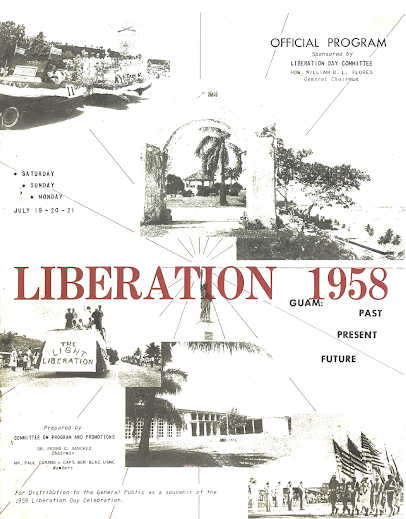
 One thing that I enjoy about being a researcher is that I get to search for things and come across things that others may not have the time, resources or privileges to find.  But the question is, what do you do with all of these things that you are able to gather? That was always a things that bothered me being part of academia. Is that so much of what I spent time working on was to be funneled into particular forums or formats, where it may not reach many people (scholars included). I remember talking to a Chamoru who has been at a university in the states for many years now about this issue. He in his time in archives across the US and the Pacific, had collected so much incredible research from Chamoru history.  He maintained that he was serving his islands back home and the Chamoru people in general by publishing his work into books and articles. I can understand that, but I had to be honest and remind him that I've never met an actual person back home who has read yo...

The Imperial Ouroboros

Image
There are certain things in Guam and Chamoru life and history that exist as such potent and powerful symbols to illustrate reality, whether negatively or positively. You could argue the Karabao is one such positive image. Even the latte or the sÃ¥kman/galaide'.  But when it comes to these types of negative symbols, you have the old standard, the vague image of island thieves or ladrones. But you also have two very powerful and obfuscating symbols that are more recent, from just the past century, that of SPAM and the brown tree snake.  I was in a virtual symposium last week where I talked about Spam as a way of talking about islanders and their relationship to everything from militarization to colonialism to the impact of capitalism and consumerism on everything from the land, the culture to the body itself.  The brown tree snake possess a similar sort of potential in talking about the impact on the island of Guam or the Chamoru people, their natural resources, by invasive ...

Un Interesånte na Finaisen...

Image
Kao guaha manli'e' hao guali'ek gi tasi yan kumekemåtmos gui'. Ha å'agang hao gi i batko-mu lao tåya' nina'sinå-mu. Manli'e' hao gekpu na kabåyu gi i mapagåhes ya un agångi gui' kao siña ha goggue i mamåtmos na guali'ek. Lao i kabåyu achokka' malåte' gui' ti siña ha komprende i fino'-mu sa' kabåyu gui'. Lao ti un embestiga sa' hafa na siña un komprende i guali'ek lao i kabåyu ti ha hulat kumomprende hao. Un hasso na gaige gi halom i betså-mu un lepblo put taimanu na siña hao mamå'tinas "tilifon para i kabåyu." Anggen siña un få'tinas este siña komprendeyon i kuentos-mu nu i gumugupu na kabåyu. Un tutuhun fumå'titinas i tilifon yan ha ayuda hao i mas mafñot na ga'chong-mu Si Maga'låhi Hurao. An munhåyan hao un oño chaddek i buttones gi i tilifon lao tåya' humuyong. Un atan i santatten i tilifon yan un komprende på'go na taibatteria gui'. Ti siña humånao hao para i tenda ...

Hu Guaiya Hao Taiguihi Book Launch

Image
The Guam Bus is a creative collective run by brothers – Michael and Jack Lujan Bevacqua (Familian Kabesa yan Bittot) – that produces and publishes Chamoru-themed books, comics and other educational materials aimed at promoting the Chamoru language, culture.  On Saturday, November 16 th , 2019 – from 9 am – 12 pm, at Java Junction, the Guam Bus will be launching its newest publication,  Hu Guaiya Hao Taiguihi,  a bilingual Chamoru-English children’s book, that is ideal for young readers. The book launch will feature readings, activities, a free Chamoru language lesson and also refreshments. It is open to everyone. Hu Guaiya Hao Taiguihi  is the third Chamoru-language children’s book published by The Guam Bus. The first,  SumÃ¥hi and the Karabao  was published in 2015 and features different stories of karabao in Chamoru culture and Guam history. The second,  The Adventures of Akli’e’  was published in 2017 and provides stories of Guam legend...

The Future Fire Interview

Image
Last year a graphic story that I wrote titled "I SindÃ¥lu" was published in the creative anthology Pacific Monsters edited by Margret Helgadottir. It was a fun story, that I thankfully got to write in the Chamoru language, with English translations. It tells the story of a Chamoru soldier who is dealing with the trauma of what he experienced while being deployed in a foreign land. He comes home to Guam and live in a ranch at the edge of the jungle, and begins to feel menaced by the spirits of his ancestors, the taotaomo'na. I really liked writing this story and was happy to see it in print, but I am terrible at promoting things, especially if I'm the one who created it ( ai lokkue'). Here is an interview that I did with the website The Future Fire.   ************************* Sunday, 6 May 2018 Interview with Michael Lujan Bevacqua The Future Fire http://press.futurefire.net/2018/05/interview-with-michael-lujan-bevacqua.html May 2018 I n th...

Adventures of Akli'e' Book Launch

Image
Local children's book launches tomorrow by Andrew Roberto The Guam Daily Post December 15, 2017 Local author and activist Michael Lujan Bevacqua, through his publishing group The Guam Bus, hopes his latest project can get young and old readers alike to think more profoundly about Guam's culture. Titled "The Adventures of Akli'e'," the new bilingual project is one book made up of two stories: In the first story, the titular character spends a day with his great-grandfather, a master blacksmith, and imagines what it would be like to use the tools his great-grandfather forges every day. In the second story, the young Akli'e' listens to his great-grandmother's tales of CHamoru history and legend, bringing the stories to life in his imagination. Bevacqua said he took inspiration for the tales from his own life. The main character is named after his son, and his own grandfather is master blacksmith Joaquin Flores Lujan. Bevacqua sai...

Truth-Telling in Children's Stories

Image
The first book that I bought for my daughter, prior to her even being born was a children's book that focused on the tale of the slaves who killed their captors aboard the ship The Amistad and after a long legal struggle were allowed to return to Africa. I only read it to her a few times over the years because the subject matter was difficult and the historical and racial politics difficult to unpack. Over the years I've tried to do the same with other books, especially liking to read to the kids books that focus on the experiences of Native Americans and African Americans. Parenting is a convoluted endeavor no matter what ethical commitments you do or do not feel. There are always problems, limitations, blindspots and ways in which your best intentions or goals backfire. But pushing your children to accept difficult truths and also feel the both responsibility and capacity to change things for the better is essential. It is one reason why, in my own creative works, includi...

Mensahi Ginen i Gehilo' #22: Biba UOG Press!

Image
After World War II, Chamorros launched into a period of aggressive Americanization, which you could argue is still going on until today. This Americanization had many levels and dimensions to it. There were clear desires amongst most Chamorros take on the material and consumer comforts America seemed to offer. There were also clear moves by some to ensure that there children were properly or at least passably Americanized, most notably through the refusal to use the Chamorro language with them. There were frameworks of economic, social and political dependency that were created and eventually celebrated by Chamorros themselves. There were also dramatic shifts in lifestyle due to land loss and trauma from the war, which made things such as cultural maintenance difficult because occupations and life-ways were changing so quickly. Alot of these shifts could not be helped, but simply came about because the US is so much larger than Guam, and it produces ideological content and material...