Posts

Showing posts with the label PDN

The True Meaning of Liberation Day

Image
What does Liberation Day on Guam make you think of? Does it remind you of parades? Beauty queens? Canopies? Columns of military marching? Does it remind you of rain? Fireworks? Playing games at the carnival? Spending time with family? I think of all of these things and one thing that most might not: I think of people chastising me for not really knowing what Liberation Day is really about. Today many people know me for writing a regular newspaper column. For the past 10 years I’ve had a column in the Pacific Daily News, and for around six years before that I wrote a column in the Marianas Variety (now known as the Guam Daily Post). But while I was a graduate student, I would sometimes write letters to the editor of the Pacific Daily News and occasionally they would get published. One of the first of these letters was published in 2003 and at that time there was a discussion around the official naming of Marine Drive to Marine Corps Drive. While Guam’s central road was well-known as Mar...
Aye na PÃ¥tgon

Image
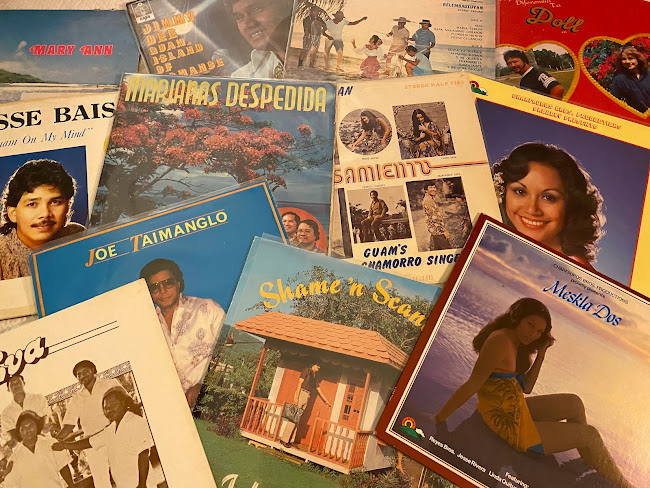
  When I first listened to this song more than 20 years ago, gi hinasso-ku gof na'chalek, lao ti hu komprende i tinahdong-ña gi kostumbren Chamoru. I was not aware when I first listened and translated to it, how much deeper the meaning is beyond the silly things described in the lyrics.   This song "Aye na PÃ¥tgon" from Johnny Sablan's album "My Marianas" describes a father taking his son to the ranch to try to teach him some basic life skills.  But for everything that he tells his son to do, his son does something different and sometimes nonsensically, as well as all around gago'.   For instance he tells his son to boil the papaya and the coconut and instead his son goes to pick berries.   He tells his son to go collect firewood but he doesn't actually come back until all the cooking is done.  The lyrics are silly and more about sounding fun or funny than actually depicting something real. But when I was younger I never connected this song to...

Sounds both Old and New

Image
Sunidu Pasifika was formed prior to the 12th Festival of Pacific Arts (FESTPAC) held in Guam in 2016 to help teach the making and playing of the belembaotuyan to future generations. The group performed as part of the two-week festivities, including a rendition of “Fanohge CHamoru.”    Sunidu Pasifika was led by Delores Taitano Quinata, who was the last apprentice of Master of CHamoru Culture for the belembaotuyan, Jesus Crisostomo. She was assisted by musicians Ruby Santos and Jesse Bais, as well as her husband Joe Quinata from the Guam Preservation Trust.    Many of the members of Sunidu Pasifika were CHamoru language and culture teachers in Guam’s public schools, who learned how to make and play the belembaotuyan with the hopes of bringing this knowledge into their classrooms.   I look forward to hearing more of the belembaotuyan around the island, especially in schools. I wish some younger Chamoru musicians would take the sound and auto-tune it or find ways t...

Mungga Yu' ni Konstitution

Image
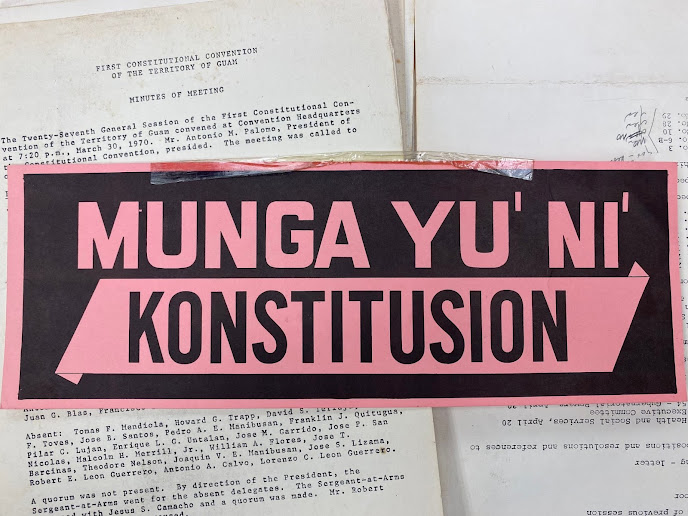
I came across this protest sign in the archives of the Nieves Flores Guam Public Library in HagÃ¥tña, while doing research on Guam's two previous Constitutional Conventions (1969-70 and 1977). Written in Chamoru, it translates to "I don't want the constitution."   A few months ago for Fanchu! I spoke to former Senator Hope Cristobal who was part of the campaign to defeat the draft constitution in 1979. The notable figures who organized against the constitution include Robert Underwood, Marilyn Manibusan, the late Tony Leon Guerrero, the late Tan Clotilde Gould, Rosa Palomo, and the late Dr. Benit Dungca. As Underwood writes in his wonderful article "Dies Mitt: The Origin and End of Chamrro Self-Determination," the constitutional opponents "coalesced around the billboard “Munga ma’apreba i konstetusion ya ta mantieni i derecho-ta komo taotao Guam. Bota NO!” In English, this read “do no approve the constitution and maintain our rights as the people of Guam...

Ten Weeks for the Tweed Protest

Image
  For the past 10 weeks, I've been writing columns for the Pacific Daily News providing historical context for the 1946 protest of US Navy Radioman George Tweed by more than a 100 Chamorus. Today marked my last column on the series. Although I did get a great deal more hate messages and a hateful comments during this series, I still greatly enjoyed writing these pieces. George Tweed was such an incredibly important symbol for Chamorus during the Japanese occupation. For me as a historian it is fascinating to think about how, just two years after the end of that occupation, more than a 100 Chamorus felt compelled to make signs and protest him when he returned to island. They didn't do this in the dead of night, but in the middle of the Plaza de España in front of the leadership of the US Navy on Guam. As I wrote in this last column, it was a multitude of things that compelled Chamorus to take this act, but many of them weren't about Tweed himself. Chamorus were frustrated th...

2005 Interview with Julian Aguon

Image
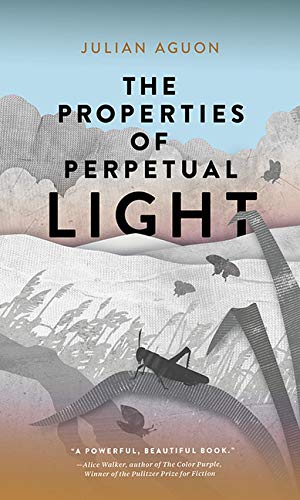
The newest book by International Human Rights Attorney Julian Aguon will be released later this month. It is already available for pre-order on Amazon.com, and has already sold several thousand copies there. This is an important moment for Julian in terms of him writing and publishing a book like this, at this level where it has national and international reach. It is also important for Guam and UOG Press which is publishing it, since this can help them capitalize on their massive local and regional success over the past few years and help them reach a variety of new markets and audiences.  Julian published three prior books, but they were published locally and by very small presses with limited runs and limited exposure. Below is an interview with Julian when he published his first book "Just Left of the Setting Sun" in 2005. I recently re-read two of his previous books in preparation for the newest one. It was interesting to also come across this interview with him 15 years...

Fanohge Columns

Image
The Fanohge Coalition formed earlier this year in part as a way of continuing the energy that was captured during last year's Fanohge: March for CHamoru Self-Determination. So far the group has written letters to elected leaders, organized forums and is planning to also send out a candidate survey this month. The Fanohge Coalition is made up of 37 different groups, and represents a wide swatch of Guam society. There are political status task forces, non-profits, small businesses and cultural organizations. Some are more conservative, some are more progressive. All are united however by the idea that the Chamoru people deserve to be treated with dignity in their own land and part of that is protecting their right to self-determination. Another unifying aspect to the coalition is the belief that Guam's political status should be changed to something more equitable. The coalition isn't untied by any particular options, but believes that a new status where Guam and its communit...