Posts

Showing posts with the label Torres

Starting a Chamoru Language Podcast with My Teens

Image
   For all my children, since the moment they were born, no matter what the topic, I only speak to them in Chamoru. This doesn’t mean that every single word is in Chamoru, as sometimes English words, or other words must be used or translated into Chamoru. But given my commitment to perpetuating the native language of the indigenous people of the Marianas, it means we use Chamoru and adapt Chamoru, no matter what the topic or context. Language are however social organisms, which means that for most people, children included, even if you use it with them, unless it is reinforced, and there is a sense of community or value associated with it, keeping the language alive and in turn passing it on will be difficult. Even if you speak Chamoru to your own children, they might speak it back to you, but if they don’t perceive that others around them speak it or that it doesn’t have any value expect in the past or within very narrow means, there is a marginal chance they will ...
Remembering My Year in Atåte

Image
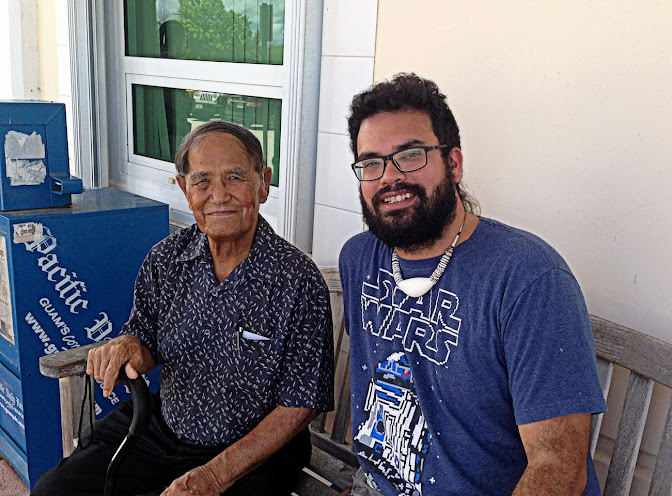
  From 2014-2015 I spent a year in AtÃ¥te in the village of Malesso’. Not in a physical sense mind you, but in an intellectual and scholarly sense. During that time I was a professor in the Chamorro Studies Program at the University of Guam, and I worked with the late Jose MÃ¥ta Torres to publish his memoirs “Massacre at AtÃ¥te” through the University of Guam. I was so thankful that we were able to see his book to completion in 2015, as he would pass away later that year.   In addition to being the memoirs of a young man, coming of age in Japanese-occupied Guam, the book also provides a first-hand account of the uprising of the people from Malesso'. After the people of the village learned that the Japanese had attempted to massacre 60 of their friends and family at Tinta and Faha, most felt that it is only a matter of time before the rest were slaughtered. On the eve of the US invasion, a group of men led by Jose "Tonko" Reyes, surprised the Japanese, killing most of them an...

Mensåhi Ginen i Gehilo' #25: Hagåtña, 1899

Image
I'm working on an exhibit for Humanities Guåhan, and its put me back into researcher/scholar mode. I've been pouring through books and reports for the past week looking for various bits and pieces of information. Part of this meant re-reading some books and archival documents I hadn't touched in over a decade. Given the way in which conversations over decolonization and self-government have begun to take on a new character lately, I was particularly attracted to passages that can help me or others reflect on our development over time, how far Chamorros and Guam may have come, or haven't, especially in the context of their political connection to the US. There are many ways that we can say that Guam has changed over the past 500 years or over the past 100 years. As we remain in the era of American colonialism, I am mostly concerned with the impact of the US and its policies. As I have written about in a variety of ways, these changes are tangible and very real, but a...

Inadaggao Lengguahen Chamoru

Image
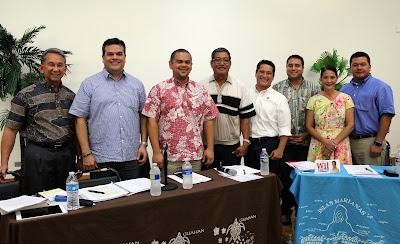
Hu gof agradesi i sinaonaon este na kandidatu gi i Inadaggao Lengguahen Chamoru gi ma'pos na simana. Mas ki dos siento na taotao manannok ya ma ekungok este na ocho mamfino' Chamomorro put diferentes takhilo' na asunto gi kumunidåt-ta på'go. Hu nå'i este siha dångkolu na respetu. Magof hu na bei anunsia na in kekeotganisa un otro na dinanña' taiguni para i otro'ña na simåna. Siempre bei na'huyong i infotmasion på'go pat agupa'. Biba Chamorro! Biba Chamorro Studie gi UOG! Si Yu'os Ma'ase to the candidates who participated in the Inadaggao Lengguahen Chamoru held last week at the University of Guam and organized by students from t he Chamorro Studies Program. They are from left to right in this photo: Senator Tom Ada, Senator Rory Respicio, Senator Dennis Rodriguez, Joe San Agustin, Wil Castro, Fernando Esteves, Eric Palacios and Senator Mary Torres. Due to the community response, a second Chamorro language forum may be sch...

Hami, i Taotao

Image
Hami, i Taotao Guahan by Michael Lujan Bevacqua The Marianas Variety July 29, 2015   On December 17 th , 1901 a group of more than thirty men, primarily Chamorros gathered in Hagatna. Most prominent on their minds was the political status of their island Guam, which had been taken by the United States during the Spanish American War three years earlier. Since the transfer of power, confusion over Guam’s future hung like dark foreboding clouds. Although the American flag flew over Guam, the United States had not set up a government in which Chamorros would now enjoy the glories of American democracy. They had established a military regime which the US Navy total control over the lives and lands of Chamorros. The group that gathered in HagÃ¥tña represented some of the largest landholders, the wealthiest families and some of the most educated Chamorros of the day. They carried last names familiar to us today, such as Perez, Torres, Dungca, Quitugua, Mart...

March Stories

Image
In Vivian Dames' dissertation on the Chamorro place inside and outside of what she referred to as "the circle of American belonging" she devotes a chapter to the first three non-voting delegates that Guam sent to the US Congress. She conducted interviews with both Robert Underwood and Ben Blaz, but at the time of her research Tony Won Pat had already passed away and so she instead interviewed his daughter Judi Won Pat, current Speaker of the Guam Legislature (a position her father historically held). She attributed to each of them a different identity as politicians in Washington D.C., a different approach to their job that made them effective despite being simultaneously included and excluded from Congress. Each of them didn't have much power in the formal sense, but were able to capitalize on something in their background or in the political climate that made it possible for them to accomplish things in the center of American power. Won Pat, took advantage of ce...